Walk through the streets of Havana right now and you'll hear the metallic clatter of pots and pans echoing off peeling paint. People call them cacerolazos. They aren't beating those pans because they're plotting global revolution. They're doing it because their fish rotted in the fridge three days ago, their water pumps won't turn on, and the heat in their living rooms is touching ninety-five degrees.
Meanwhile, in Washington, official reports portray a radically different universe.
The State Department recently released a massive 100-page document titled Cuba: Capital of 21st-Century Communism. The timing couldn't be more bizarre. While the island's 9.5 million residents face record fuel shortages and rolling 50-hour blackouts, US officials claim Havana remains a shadowy mastermind orchestrating civil unrest across the Western Hemisphere.
The gap between policy rhetoric and reality on the ground hasn't been this wide in decades.
A Hundred Pages of Allegations
The unsigned report paints Havana not as a struggling Caribbean nation, but as a dangerous octopus reaching into every corner of American political life. It pins domestic US civil unrest squarely on Cuban intelligence.
If you read the document, Havana is allegedly responsible for almost every major domestic protest movement in recent American history. It links Cuban agents to the 2020 racial justice demonstrations, the growth of antifa, and recent political activism across US university campuses.
Rewriting American Protests
This framing treats American political movements as products of foreign puppetry. Instead of acknowledging local social friction, police reform debates, or organic student organizing, the report recast decades of internal American struggle into a foreign plot aimed at bringing down Western institutions.
It even drags historical civil rights figures into the argument. It highlights black radicals who fled to Havana decades ago, like Assata Shakur, portraying their presence as proof of a centralized hub for American subversion.
Former political exiles have pushed back against this narrative for years. Many who ended up in Havana made it clear their political anger grew out of living in places like 1970s New York, not from reading communist literature written in the Caribbean. Many ended up frustrated by local restrictions once they arrived on the island.
The Mastermind Illusion
To make its case, the document relies on a central argument: you shouldn't mistake Cuba's poverty for harmlessness. It claims material weakness was never the measure of the country's danger.
According to this view, thousands of front organizations, solidarity networks, and activist non-profits act as conduits for Havana's political influence.
Is Havana active in regional diplomacy? Of course. Has it historically exported revolutionary ideas? Yes, back in the 1960s. But claiming a government that currently struggles to collect garbage in its own capital is actively orchestrating protests in major American cities strains credibility.
Life Under Total Blackout
If you want to understand Cuba right now, skip the government white papers and look at its electrical grid. It's falling apart.
The national power system has collapsed completely multiple times in single two-week stretches. When the main power plants trip, the entire island drops into pitch darkness.
Six Months Without Fuel
The immediate driver of this failure is a strict oil blockade initiated earlier this year following geopolitical clashes in Venezuela. Without crude shipments coming in, the island's antiquated thermoelectric units simply run dry.
Minister of Energy Vicente de la O Levy publicly acknowledged that the state lacks basic fuel reserves and can't source foreign spare parts to repair breaking turbines.
- The island's main power plants rely on equipment manufactured decades ago.
- Repair crews resort to cannibalizing broken units just to keep single circuits alive.
- Piped gas reaches only a fraction of residents in Havana, leaving millions with zero cooking options when the power cuts off.
Solar setups and private gas generators exist, but they are financial impossibilities for almost everyone. A basic gas generator costs roughly $1,000. The average monthly state salary sits below $20. Unless you have family in Miami sending wire transfers, you're sitting in the dark.
Cooking in the Dark
Daily existence has turned into an endless exercise in survival strategy.
Power comes back on for an hour, maybe two. People sprint to charge phones, run water pumps to fill roof tanks, and cook whatever rice or beans they have before the grid drops again. Food preservation is impossible. Meat rots within hours in the humid summer heat.
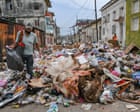
Sanitation is collapsing alongside the grid. Trash piles up on city corners because collection trucks don't have diesel. Crime, historically low across the island, is climbing as darkness covers neighborhood streets at night.
UN special rapporteurs recently pointed out that fuel starvation has effectively halted basic societal functions. Over 96,000 elective surgeries have been postponed nationwide because hospitals have to ration fuel for their backup generators.
Sanctions and Systemic Collapse
How did things get this bad? Blame sits on both sides of the Florida Straits, though official narratives rarely admit it.
Cuban state media points every finger at Washington's embargo, calling the fuel blockade an act of economic strangulation. Washington counters that six decades of centralized economic planning, corruption, and state mismanagement caused the collapse.
The reality is a compounding mix of both.
Cold War Politics in 2026
The political tone coming out of Washington feels like a total throwback. Secretary of State Marco Rubio and other hawks have doubled down on a maximum-pressure strategy designed to force a political breakdown in Havana.
The administration argues that restricting fuel and tightening financial rules will force the Cuban government to open its political system and allow market reforms.
President Miguel Díaz-Canel called the latest American report a modern iteration of McCarthyism. A prominent Havana academic noted privately that the 100-page dossier reads remarkably like the kind of exaggerated propaganda Cuba's own state outlets produce about the West.
Both sides use extreme narratives to justify their positions. Washington portrays a bankrupt island as an existential security threat to justify sanctions. Havana uses foreign sanctions as a convenient shield to hide its own policy failures and suppress internal dissent.
The Human Cost of Energy Starvation
While diplomats exchange insults, ordinary people bear the entire burden.
- Healthcare strain: Emergency rooms rely on aging diesel generators that sometimes fail mid-procedure.
- Water shortages: Electric pumps power the water distribution system. No power means no running tap water for days.
- Food decay: Hyperinflation had already destroyed purchasing power; now, power loss destroys the physical food supply.
- Emigration pressure: The worsening conditions drive record numbers of young Cubans to leave the island through any path available.
Instead of weakening the state apparatus, severe economic pressure usually cripples the general population first. Dissidents on the island get arrested for joining neighborhood blackouts protests, while high-ranking officials maintain access to fuel reserves and private generators.
How to Track the Reality Behind the Rhetoric
When reading international reporting on diplomatic feuds, separate political talking points from measurable facts on the ground.
Start by monitoring official primary sources directly rather than relying solely on press releases. Read the United Nations Special Procedures reports for independent data on humanitarian conditions, medical backlogs, and food security indices.
Compare government claims against satellite data and regional trade tracking. Outlets like the U.S. Energy Information Administration and maritime tracking services provide real-time data on fuel shipments, showing exactly how much oil is moving into regional ports regardless of official statements.
Keep an eye on independent journalists and local correspondents based in Havana rather than commentary written thousands of miles away. Field reporters who document daily life provide a vital reality check against both Washington's exaggerated threat models and Havana's state-controlled spin.