Smoke does not merely move. It occupies. It fills a valley the way water fills a lung, displacing breath, stealing color, and leaving behind a heavy, sulfurous dark that turns midday into the midnight of a bad dream.
Ask anyone who has stood on a ridge watching a wildfire crawl up a mountainside. The sound comes first—a low, rhythmic bass note, like a freight train rumbling over iron ties just out of sight. Then the heat arrives, dry and aggressive, stripping the moisture from your skin before you can turn your collar up against it. And finally, the air turns to ash.
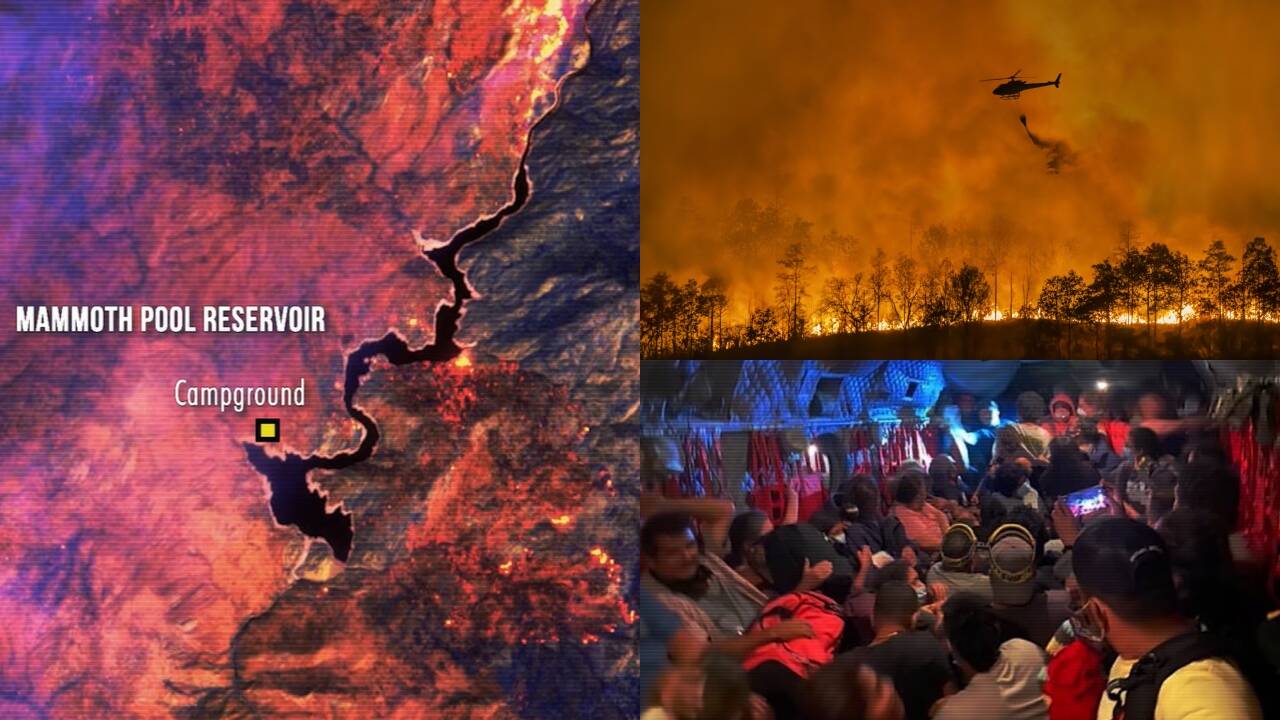
For two hundred and forty-two souls trapped at a remote resort lodge as walls of flame snapped power lines and choked off every paved exit route, that sound was the last warning they would get.
The Trap at the End of the Road
The resort sat nestled in a mountain pocket, beautiful in July, lethal in August. When the fire front shifted on a sudden, cruel gale, it didn't just advance; it converged. Two hundred and forty-two people—families on holiday, elderly couples seeking cool mountain air, teenagers working summer shifts—found themselves pinned against a sheer granite wall with only one way out, and that way was currently burning.
Panic has a specific texture. It smells like sweat and melted plastic. It sounds like a dozen conflicting voices shouting over a dead cell phone's static.
(Note: While the exact emotional timbre of those trapped moments belongs entirely to the human heart, the operational reality is a matter of strict public record. Air rescue coordinators later confirmed that ground evacuation had become a statistical impossibility within a twenty-minute window as falling timber blocked the highway.)
They gathered in the gravel parking lot, clutching small bags, watching the ridge turn a violent, bruised orange. The fire was chewing through old-growth pine at a rate that defied geometry. Trees exploded into fireballs, throwing embers the size of dinner plates a quarter-mile ahead of the main front.
There was no road left. There was no room left. There was only the sky.
When the Sky Becomes the Only Door
Helicopters do not belong in wildfire smoke.
Every pilot learns this in the first week of ground school. Smoke destroys lift. It creates erratic downdrafts that can slam a multi-million-dollar airframe into a canyon wall with the casual flick of a wrist. Visibility drops to zero. Instruments lie to you because superheated air plays havoc with barometric pressure altimeters.
Yet, looking up into that apocalyptic ceiling, rotor wash suddenly cut through the roar of the fire.
They came in low. Not because protocol demanded it, but because physics left them no other choice. The pilots—men and women flying utility and transport helicopters normally tasked with dropping water buckets or hauling gear—peered through windshields coated in soot and radiant heat.
Imagine sitting in a cockpit where the outside temperature gauge is spinning past numbers it was never designed to reach. The warning lights are blinking like a Christmas tree wired by a madman. The cabin smells like roasted metal. You cannot see the ground, you cannot see the ridgeline, and you know that if your engine ingests too much thick, oxygen-starved smoke, you will drop out of the sky like a stone.
They didn't hesitate. They couldn't.
The Arithmetic of Rescue
Rescue under fire is an exercise in brutal mathematics. A standard medium-lift helicopter can seat a dozen passengers if you strip the luxury and pack them shoulder-to-shoulder, knees to chest. But two hundred and forty-two people require rotation after rotation, each turn taking precious minutes that the fire was actively burning away.
The first ship touched down in a blinding cloud of stinging grey ash. The pilot didn't cut the engines. You don't cut engines when the ground beneath your skids might catch fire at any second.
Crew members leaped from the cabin, coughing violently through wet bandanas, waving frantically at the crowd. There was no orderly line. There were only desperate hands pulling children through doors, shoving strangers into seats, squeezing human lives into every square inch of available floor space.
Weight and balance calculations went out the window, replaced by a desperate, prayerful gamble: Will she lift?
Every time a heavily loaded bird strained against the downdraft, climbing straight up through a funnel of superheated gas, the pilots were betting their lives on the margin of error. One pilot later described the ascent as flying blind through an oven door while someone beat the hull with a sledgehammer. The turbulence was so violent it tore loose headsets and cracked instrument panels.
Flight after flight. Rotor blades slicing through air so thick with particulate matter it felt like liquid mud.
The Silence After the Roar
By the time the last aircraft cleared the zone, the parking lot was empty save for discarded luggage, a few abandoned strollers, and the settling ash of a world made new by destruction.
Two hundred and forty-two people survived an event that should have ended entirely differently. They sat in municipal gymnasiums hours later, wrapped in foil blankets, blinking against the fluorescent lights, clutching paper cups of lukewarm water. They were safe. Their children were safe.
And somewhere out there in the dark, the pilots were washing the soot from their eyes, checking their logbooks, and walking back out to pre-flight their machines for the next dawn.
We measure catastrophes by the acreage burned and the dollars lost. We tally the property values reduced to charcoal and write editorials about climate trends and forestry management. But behind every dry statistic of survival is a moment where human courage stared down a wall of fire and refused to blink.
The smoke clears eventually. The trees grow back, green and stubborn, pushing up through the black loam of the past. But the memory of those rotors cutting through the furnace remains—a testament to what happens when ordinary people decide that nobody gets left behind in the dark.