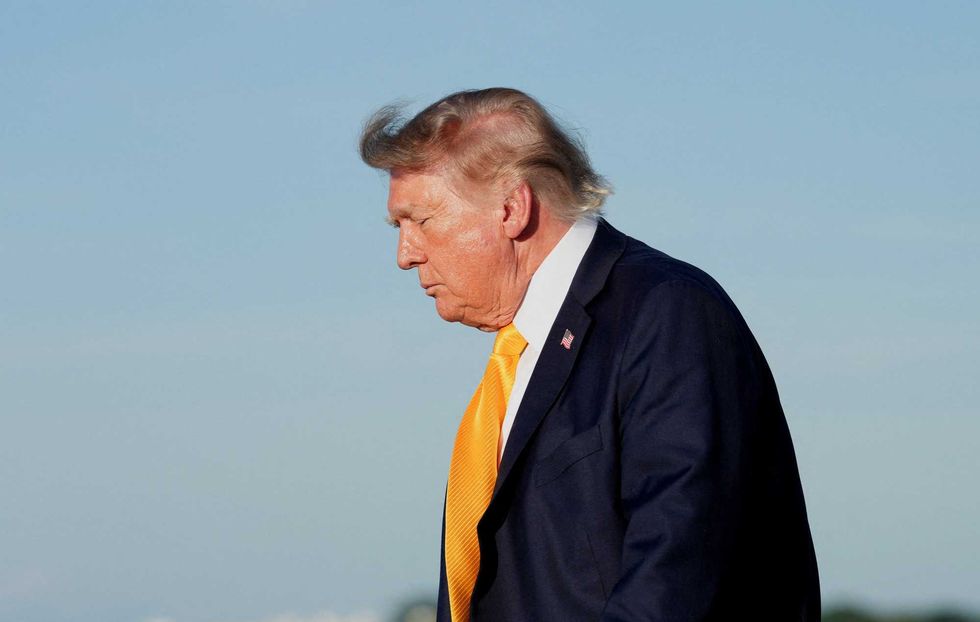
Static hums against the glass of a Moscow television studio, where the anchor’s tie is knotted with absolute, geometric precision. Behind him, a massive LED screen projects a looping graphic: a map of the United States fractured by digital red lines, overlaid with bold, Cyrillic typography declaring a political obituary. The message broadcasted to millions across the Russian federation is singular, unyielding, and broadcast with the confidence of an iron-clad prophecy. Donald Trump, they claim, is doomed. Finished. A spent force on the global stage, cornered by domestic opposition and legal gravity.
To watch state-aligned broadcasts in Russia is to step into a parallel architecture of reality. Here, the news cycle does not merely report events; it engineers inevitability. When anchors discuss American politics, they do so not with the frantic anxiety of the Western 24-hour news churn, but with the cold, detached satisfaction of a coroner completing an autopsy on a patient who has not yet stopped breathing.
Consider the perspective of a middle-aged Muscovite sitting in a kitchen choked with the scent of boiled buckwheat and damp wool, watching these very broadcasts. For years, the American electoral theater has been beamed into living rooms like a high-stakes soap opera. Trump was once viewed in these quarters with a mixture of cautious optimism and strategic amusement—a disruptive force who might shatter the monolithic consensus of Washington. But now? The narrative has shifted. The state-run editorials present his current political battles not as a resilient comeback story, but as the final, thrashing death throes of a political career.
Why this tone? Why this sudden, aggressive certainty from Moscow media?
To understand the broadcast, you have to understand the audience, and more importantly, the utility of the message. Russian state media rarely speaks about Washington for Washington’s sake. Every segment about American turmoil is a carefully calibrated mirror held up to the domestic population. The subtext is always identical: Look at their system. Look at the chaos, the endless investigations, the polarization, the constant threat of collapse. Our system may be rigid, the broadcast whispers, but at least it does not tear itself apart on live television every four years.
When anchors declare Trump cornered and nearly defeated, they are feeding a specific appetite. They are constructing a narrative of American decline. Every court filing, every scathing editorial from a New York daily, every poll showing a tight margin is vacuumed up by state producers, stripped of its nuance, and repurposed into a tidy package of schadenfreude.
Yet, anyone who has spent time navigating the unpredictable currents of American political life knows a fundamental truth that Moscow’s studio pundits conveniently omit: the American political animal thrives on crisis. What looks like a fatal blow from five thousand miles away often registers domestically as rocket fuel.
I remember standing in a diner in rural Ohio years ago, watching a cable news screen flash with red banners declaring a campaign effectively over. The man sitting across from me, a retired machinist with grease permanently etched into the lines of his knuckles, didn’t flinch. He sipped his coffee, looked at the screen, and chuckled. The talking heads thought they were delivering a verdict. The voters in that booth understood it as an opening salvo.
This disconnect highlights the profound danger of consuming foreign interpretations of domestic political theater. Moscow wants its citizens to believe that American democracy is a brittle vase that has already shattered. The reports of Trump being doomed serve as a psychological balm, reassuring viewers that the primary adversary on the world stage is too consumed by internal rot to project coherent power outward.
But politics, particularly the populist variety embodied by Trump, operates on a logic entirely alien to bureaucratic observers. Defeat, in the traditional sense, requires an admission of loss from the defeated. For a movement built on the grievance of the forgotten against the entrenched, every external attack is merely proof of concept. When foreign adversaries write an obituary for a political figure, they misread the chemistry of populism entirely. They mistake friction for destruction.
The screen in the Moscow studio flickers. The anchor moves smoothly to the weather report, transitioning from American political doom to the coming Siberian frost with practiced indifference. The graphic fades. The studio lights hum in the silence.
Across the ocean, the noise continues, loud, chaotic, and very much alive. The forecasts from abroad were never about American reality. They were fairy tales told in the dark to keep the cold at bay.