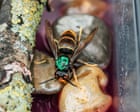
The spatial expansion of Vespa velutina across the British Isles represents an operational failure of early-stage biological containment, transforming a localized ecological anomaly into a systemic threat to agricultural productivity. Biosecurity frameworks rely on linear detection models that underestimate the exponential reproductive capacity of eusocial invasive species. As field data from the National Bee Unit confirms escalating nest discoveries across southern counties and northern expansions alike, the standard protocols of reactive nest destruction face a structural bottleneck. Managing this vector requires dissecting the mechanics of the invasion curve, evaluating the economic cost function of pollinator depletion, and recalibrating the detection architecture before saturation occurs.
The spread of the yellow-legged hornet follows a non-linear diffusion curve dictated by thermal tolerances and queen fecundity. Originating from a single introduction point in Europe via commercial freight two decades ago, the species utilizes climatic warming patterns to extend its active seasonal window. In an unconstrained environment, a single fertilized queen establishes a primary nest in spring, transitioning to a secondary, high-altitude canopy nest by mid-summer that houses thousands of predatory workers.
Traditional containment models assume that locating and destroying nests via government-led track-and-trace operations is sufficient to bend the curve. However, the operational reality of tracking an aerial vector with a foraging radius exceeding two kilometers introduces massive friction. Inspectors must reverse-engineer the flight vectors of individual hornets caught at bait stations, a labor-intensive process that scales linearly while the reproductive output of surviving queens scales exponentially. When annual nest detections jump from double digits to hundreds within sequential breeding seasons, state-level manual tracking hits an absolute resource ceiling.
The macroeconomic impact of Vespa velutina is driven by the creation of functional pollinator deserts. Unlike native predators that target specific prey, Vespa velutina exhibits opportunistic generalist predation across more than a thousand insect species, with a documented specialization in Apis mellifera. A single hunting hornet can dispatch dozens of honeybees daily, hovering outside hive entrances to intercept returning foragers.
This sustained predatory pressure induces behavioral modifications within honeybee colonies. Foragers cease orientation flights and restrict foraging intervals to minimize exposure, directly cutting down nectar and pollen intake. The resulting systemic shock compromises pollination services for commercial agriculture and wild ecosystems alike. The cost function is calculated through three distinct variables:
- Direct biological loss via the destruction of adult honeybee populations and whole colonies.
- Indirect agricultural loss measured by suppressed crop yields due to pollination deficits in orchards and field crops.
- Capital expenditure inflation required for heightened apiary management, protective hive netting, and localized surveillance infrastructure.
Public awareness campaigns often treat citizen science as a passive information-sharing exercise, but effective biological surveillance requires treating the public as a distributed sensor network. The primary vulnerability in current early-detection systems is not a lack of government willingness, but high latency in report verification. Thousands of misidentifications of native species flood reporting channels annually, overwhelming verification teams and delaying the physical tracking required to locate primary nests before queen dispersal.
Optimizing this sensor network demands moving away from broad, untargeted appeals toward high-density spatial filtering. Communities situated along historical transit corridors and primary entry ports require specialized training in trap management and photographic triage. Citizen participants must be equipped with modified selective traps that eliminate bycatch while capturing live specimens for verification, turning casual observers into active data collectors who reduce the false-positive ratio before alerts reach the National Bee Unit.
Deploy resources immediately toward hyper-local, high-density bait station grids within a five-kilometer radius of historical cluster zones, prioritizing volunteer-led trap networks over passive public reporting apps to shorten the verification latency window.