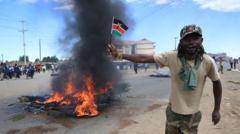
Two people are dead in central Kenya because Washington doesn't want potential Ebola patients on American soil.
That's the raw reality behind the violent clashes in Nanyuki. On Monday, hundreds of local residents took to the streets to protest a planned 50-bed isolation unit inside Laikipia Air Base. The facility is designed to quarantine American citizens exposed to a dangerous outbreak of the Bundibugyo strain of Ebola currently tearing through the eastern Democratic Republic of Congo and parts of Uganda.
The demonstration turned bloody when security forces confronted crowds who were burning tires and erecting roadblocks. According to protest organizer Patrick Wahome, police opened fire on the demonstrators, leaving two dead from gunshot wounds. While national police spokespeople claim they are still investigating the circumstances, the tragedy has instantly supercharged an already explosive geopolitical standoff.
This isn't just a local riot. It’s a direct clash over national sovereignty, public health ethics, and the lengths to which western superpowers will go to outsource their biological risks.
The Outsourcing of Biological Risk
Kenyans are angry, and frankly, it's easy to see why. The deal looks heavily one-sided. The Trump administration asked Kenyan President William Ruto to host the site because Washington has made it clear they won't risk bringing potentially infected citizens back to the US.
During the major West Africa Ebola outbreak a decade ago, the US brought infected medical workers home to specialized biocontainment units in Atlanta and Omaha. Not this time. This new policy draws a hard line at the border.
Instead of flying exposed Americans home, the plan sends asymptomatic frontline workers, diplomats, or contractors straight to Nanyuki. If they stay healthy, they go home later. If they show symptoms, officials say they'll move them to other international facilities.
To the people living near Laikipia Air Base, this feels like their backyard is being treated as a hazardous waste dump for a wealthy foreign power. They see a stark double standard. Why should a town 200 kilometers north of Nairobi bear the risk of an American medical quarantine?
A High Court Blocked the Deal but the Planes Kept Flying
The anger on the streets is intensified by a glaring disregard for local law. Last week, a Kenyan legal advocacy group successfully secured a temporary High Court injunction to suspend the project. On Tuesday, Judge Patricia Nyaundi extended that block for another three weeks, ordering the Ruto administration to hand over all secret agreements and operational protocols signed with Washington within seven days.
Yet, international flight trackers and local eyewitnesses tell a different story. Over the weekend, US military C-130 transport aircraft were spotted flying directly into the Nanyuki air base. Diplomatic sources confirm that personnel and equipment have continued to arrive despite the explicit judicial freeze.
When a superpower ignores a sovereign nation's highest courts to push through a medical facility, it stops looking like a partnership. It starts looking like an occupation.
President Ruto Defends the Deal Amid Backlash
President Ruto is in a tight spot, and he's doubling down. Speaking to reporters on Monday evening from Wajir, he vigorously defended the arrangement. He frames it as a natural extension of Kenya's decades-long health collaboration with the US on everything from HIV to COVID-19.
Ruto insisted that Kenya is a responsible government that knows exactly what it's doing. He argued that the facility isn't uniquely dangerous and forms part of a broader national preparedness strategy. According to Ruto, the base could also serve Kenyans who might be exposed while working or serving in peace-keeping missions in the DRC. He also claimed Kenya is screening around 3,000 people daily at its borders and has zero confirmed cases.
But the government's messaging has a massive consistency problem. While Ruto claims the center will treat people of all nationalities, US health officials have remained tight-lipped, maintaining that the facility is explicitly intended for American citizens.
Even American Health Experts Think This is a Terrible Idea
The skepticism isn't confined to Kenyan activists. A group of prominent American infectious disease specialists and epidemiologists recently published a scathing open letter condemning their own government's policy.
Top medical experts, including former CDC officials and frontline virus researchers, argue that shifting away from medical repatriation is a dangerous mistake. They point out several critical flaws in the US strategy.
- Discouraging Responders: If doctors and nurses know they won't be brought back to top-tier US hospitals if they get exposed, they simply won't volunteer to go to outbreak zones in the DRC.
- Wasted Resources: Building ad hoc, temporary infrastructure overseas drains millions of dollars that would be much more effective if spent stopping the outbreak at its source in Central Africa.
- Operational Risks: Managing a high-consequence pathogen quarantine inside a foreign military base logistically complicates an already delicate medical protocol.
The Bundibugyo Ebola strain currently active in the region has already caused over 900 suspected cases and more than 220 deaths since mid-May. Experts openly worry the real numbers are much higher. Trying to manage the fallout through a politically toxic, legally contested facility in a third-party country appears to be an logistical nightmare.
What Needs to Happen Next
The situation in Nanyuki is untenable. Forcing a high-risk medical site onto a population that is actively being shot at to protest it is a recipe for further catastrophe.
First, the Ruto administration must comply with Judge Nyaundi’s order. Total transparency is the only way to cool down the boiling public anger. The secret documents, the liability waivers, and the exact protocols regarding what happens if a patient escapes or if a local worker gets infected must be made public immediately.
Second, the US military needs to ground its transport flights to Laikipia Air Base until the legal challenges settle on June 23. Violating Kenyan court orders while preaching about the international rule of law is a terrible look that damages long-term regional alliances.
If Washington wants to protect its citizens abroad, it needs to fund local healthcare systems in the DRC or build containment facilities on its own sovereign territory. Using its geopolitical leverage to dump asymptomatic Ebola risks into central Kenya isn't statecraft. It's a dangerous health gamble that has already cost two lives.

