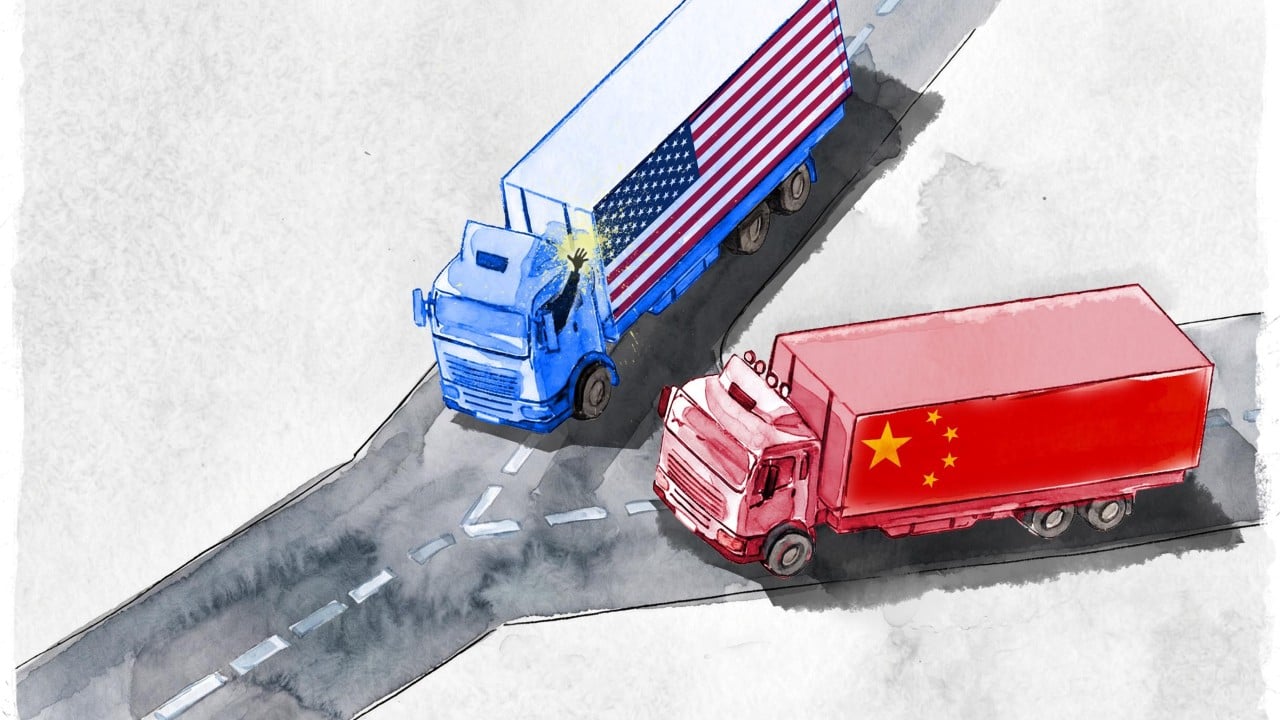
The constant drumbeat of an impending superpower war gets exhausting. Every single week, pundits and think-tank analysts dust off ancient Greek history to prove that Washington and Beijing are locked on an unavoidable collision course. They point to the Thucydides Trap as if history were a script written in stone. It is not.
People love a clean narrative. Conflict feels dramatic, easy to package, and simple to sell on cable news. But real international relations do not operate like a Greek tragedy. Leaders make choices. Economies bind nations together in handcuffs. Nuclear arsenals make total war an option of absolute last resort.
Let us look past the sensational headlines. When you examine the actual mechanics of modern superpower competition, a different picture emerges. War is neither preordained nor likely.
The Flawed Logic of Historical Determinism
Graham Allison popularized the idea that when a rising power threatens to displace a ruling power, war usually follows. He looked back across five centuries and found that sixteen out of twelve cases ended in bloodshed. That sounds terrifying until you actually look at the math and the context.
History is not a blueprint. Citing sixteenth-century Athens and Sparta to explain twenty-first-century trade disputes, cyber warfare, and semiconductor supply chains is lazy thinking. Athens and Sparta didn't share nuclear arsenals. They didn't trade billions of dollars in consumer goods every single day. Their economies weren't fused together by global shipping lanes and financial networks.
Treating war as inevitable creates a dangerous self-fulfilling prophecy. If decision-makers in Washington and Beijing genuinely believe a clash is guaranteed, they stop looking for off-ramps. They start preparing for the worst-case scenario immediately, which inadvertently triggers the exact security dilemmas they want to avoid.
We have to reject this fatalism. Structural pressures exist, yes. But human agency matters more.
Economic Interdependence is a Real Brake
Trade stops shooting. Well, most of the time.
Decoupling is a favorite buzzword in policy circles. Politicians love talking about cutting ties, bringing manufacturing home, and sealing economic borders. Yet the reality on the ground tells a much messier, more integrated story.
Look at bilateral trade numbers. Even amid tech bans, tariff hikes, and political posturing, billions of dollars in commerce flow across the Pacific every month. Apple builds iPhones in Zhengzhou. American consumers buy affordable goods manufactured in factories across Guangdong. Chinese firms invest in global assets, while American multinational corporations depend heavily on Chinese consumer markets for their revenue growth.
This is not the Cold War dynamic between the United States and the Soviet Union. Back then, trade between the two blocs was practically zero. They existed in separate economic universes. Today, the American and Chinese economies are Siamese twins joined at the financial hip. Tearing them apart requires massive economic pain that neither side's citizens or corporate elites actually want to endure.
When corporate balance sheets are tied to peace, war becomes an extraordinarily expensive proposition. Economic pain acts as a natural stabilizer. It forces leaders to look for diplomatic workarounds long before troops ever mobilize.
Deterrence in the Age of Mutually Assured Destruction
Let us talk about military reality. A direct kinetic war between two nuclear-armed superpowers is military suicide.
Washington and Beijing both know this. Military planners map out countless war games simulating Taiwan straits contingencies or South China Sea standoffs. Almost every single simulation ends in catastrophic economic collapse, massive casualties, and unpredictable escalation spirals.
Smart strategists look at those projections and realize winning a total war is mathematically impossible. When victory means smoking ruins and a collapsed global economy, nobody pushes the red button.
Instead of total war, competition manifests elsewhere. It happens in trade negotiations, diplomatic forums, space programs, artificial intelligence research, and standard-setting bodies for global technology. It is a fierce rivalry, absolutely. But it is contained. It is regulated by the unspoken understanding that crossing certain red lines invites mutual ruin.
Deterrence works. It worked for decades between the US and the Soviet Union during the height of the Cold War, and it works today in a multipolar world where the stakes are even higher.
The Myth of a Monolithic Threat
Another major misconception is that international politics is just a two-player game. Observers often treat the US and China as monolithic blocs where every actor moves in lockstep according to a grand master plan.
That is entirely false.
Both nations deal with immense internal pressures. Beijing faces demographic aging, real estate debt adjustments, slowing economic growth, and regional employment demands. Keeping the domestic economy stable is the Chinese Communist Party's number one priority. Foreign military adventures or catastrophic trade blockades threaten that stability directly.
Meanwhile, American politics faces deep polarization, shifting congressional priorities, and constant debates over foreign entanglement. The American public has little appetite for prolonged, costly foreign wars after the sobering experiences of Iraq and Afghanistan.
When you factor in domestic constraints, leaders on both sides have strong incentives to manage tensions rather than escalate them into open conflict. External posturing is often designed for domestic political consumption rather than actual battlefield preparation. Recognizing this theatrical element helps cut through the panic.
Managing Competition Without Crossing the Line
So how do we navigate this tense century without falling into catastrophe?
First, communication channels must stay wide open. During the worst diplomatic freezes, military-to-military talks are vital. Miscalculations happen when ships bump into each other in international waters and nobody can pick up the red phone to defuse the situation. Keeping those lines functional prevents accidents from snowballing into war.
Second, third-party diplomacy matters. Middle powers across Europe, Southeast Asia, Latin America, and Africa refuse to be forced into a binary Cold War choice. They act as diplomatic shock absorbers, pushing both capitals toward pragmatic cooperation on global challenges like climate change, pandemic preparedness, and financial stability.
Third, both superpowers need to accept managed competition as a permanent state of affairs. Total victory or total decoupling is a fantasy. The two largest economies on Earth will have to share the global stage, negotiate friction points, and find ways to cooperate even while they fiercely contend for technological and economic leadership.
Conflict is not inevitable. It is a choice. And right now, despite all the noise, both sides keep choosing to step back from the brink.