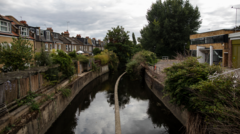
The degradation of urban river systems is frequently mischaracterized as a failure of behavioral compliance or surface-level littering, when it is, in fact, a predictable output of high-entropy legacy infrastructure. In cities utilizing dual-drainage systems—where one network manages treated sewage (foul) and another manages rainwater (surface)—the integrity of the entire ecological basin depends on the absolute separation of these vectors. When a "misconnection" occurs, domestic effluent enters the surface water network and bypasses treatment plants entirely, discharging raw contaminants directly into riverbeds. This failure represents a systematic collapse of the urban metabolic cycle, driven by decentralized plumbing errors and a lack of real-time architectural oversight.
The Dual-Network Logic and the Points of Divergence
To understand why rivers fail, one must map the structural intent of modern drainage. The separation of foul and surface water was designed to prevent hydraulic overloading of treatment facilities during storm events.
- The Foul Sewer: Designed to carry wastewater from toilets, sinks, baths, and appliances to a specialized treatment works. It operates on a closed-loop principle where every liter must be accounted for and processed.
- The Surface Water Sewer: Designed to collect rain runoff from roofs and roads, discharging it directly into local watercourses. It assumes the fluid is chemically inert.
A misconnection breaks this logic at the household level. It occurs primarily through two failure modes: the "Wrong Pipe" error, where a washing machine or sink is plumbed into a rainwater downpipe, and the "Cross-Contamination" error, where internal foul drains are incorrectly tapped into external surface drains during renovations. The result is a steady, invisible flow of phosphorus, nitrogen, and synthetic surfactants into fragile aquatic ecosystems.
The Three Pillars of Infrastructure Decay
The persistence of misconnected pipes is not a function of singular negligence but is sustained by three distinct structural variables.
1. The Decentralization of Mechanical Responsibility
Unlike centralized energy grids, the final ten meters of a drainage network are private property. This creates a vast, unmonitored frontier of infrastructure. Property owners often lack the technical literacy to distinguish between foul and surface access points, and the labor market for rapid-turnover home renovations frequently bypasses building regulations. Because the consequence—river pollution—is geographically and temporally removed from the act of flushing a toilet, there is no immediate feedback loop to correct the error.
2. The Information Gap in Sub-Surface Mapping
Most municipal records for residential drainage are outdated or non-existent for properties built prior to 1970. In the absence of digital twins or comprehensive GIS (Geographic Information Systems) mapping for individual domestic connections, water authorities are forced to rely on reactive "outfall monitoring." By the time a pollutant is detected at a river outfall, tracing it back to one of several thousand upstream properties requires a labor-intensive process of dye-testing and CCTV surveying.
3. The Economic Asymmetry of Correction
The cost of identifying and rectifying a single misconnection—often requiring the excavation of concrete or internal wall removal—falls on the individual homeowner. Meanwhile, the benefit of the repair is a public good (cleaner water). This creates a classic collective action problem where the private cost exceeds the private benefit, ensuring that unless forced by legal mandates or subsidized by utility companies, misconnections remain in situ for decades.
Quantifying the Chemical Loading Function
The impact of misconnected pipes can be modeled through a loading function that accounts for the type of appliance and the frequency of use. A single washing machine misconnection is disproportionately more damaging than a washbasin due to the chemical composition of the discharge.
- Biological Oxygen Demand (BOD): Domestic sewage introduced into rivers triggers a spike in BOD. Microorganisms consume the available dissolved oxygen to break down organic matter, leading to "dead zones" where fish and macroinvertebrates cannot survive.
- Nutrient Enrichment (Eutrophication): The influx of phosphates from detergents and nitrates from waste fuels algal blooms. These blooms block sunlight and, upon their death, further deplete oxygen levels.
- Pathogen Introduction: Surface water sewers are not designed to mitigate E. coli or intestinal enterococci. Misconnections turn local streams into public health hazards, rendering them unusable for recreation.
The cumulative effect of thousands of small-scale misconnections often rivals the impact of a large-scale industrial spill, with the added complexity that the source is diffuse rather than a single point of failure.
Structural Bottlenecks in Detection and Mitigation
The current strategy for managing misconnected pipes is hindered by technological and legal bottlenecks that prevent a rapid transition to a "zero-discharge" state.
Sensor Latency and Granularity
While smart sensors can detect changes in ammonia or turbidity at major outfalls, they lack the granularity to pinpoint the specific street-level source of a 5-liter-per-hour leak. Current chemical markers are often masked by urban runoff (oils, heavy metals from tires), making it difficult to isolate domestic sewage from road-based pollutants without expensive laboratory analysis.
The Regulatory Friction of Private Access
Water companies in many jurisdictions lack the statutory power to enter private property to inspect internal plumbing without a protracted legal process. This creates a "black box" at the exact point where the misconnection occurs. Enforcement is further weakened by the fact that many misconnections are "historic"—inherited by new homeowners who have no knowledge of the fault.
Operational Framework for Systemic Recovery
A transition from reactive monitoring to proactive prevention requires a fundamental shift in how urban hydro-geography is managed. This is not a matter of "awareness campaigns," which have historically low ROI in infrastructure management, but of technical and economic integration.
Integrated Outfall Fingerprinting
Authorities must deploy a hierarchy of sensors. High-level sensors at the river mouth trigger localized investigations. Mid-level sensors at neighborhood junctions isolate the specific "branch" of the failure. Finally, microbial source tracking (MST) uses DNA markers to confirm whether the bacteria are human-derived, eliminating false positives from animal waste.
The Mandate of Point-of-Sale Certification
The most effective lever for large-scale correction is the implementation of a "Drainage Integrity Certificate" required during property transactions. Much like energy efficiency ratings, this would force an inspection of the foul/surface separation before a title transfer can be completed. This internalizes the cost of the repair into the property value, solving the economic asymmetry of the public-private divide.
Transitioning to Blue-Green Infrastructure
To mitigate the impact of existing misconnections that cannot be easily found, cities are increasingly adopting "SuDS" (Sustainable Drainage Systems). By diverting surface water into engineered wetlands or reed beds before it reaches the river, the environment provides a final biological filter. These systems act as a "fail-safe," treating the low-level pollution from misconnections through natural aerobic processes, effectively neutralizing the error before it enters the primary watercourse.
The Strategy of Direct Intervention
The objective is to move toward a "hard-coded" separation of waste streams. Future urban planning must prioritize the elimination of domestic surface water sewers entirely in favor of on-site infiltration (soakaways). By removing the surface sewer connection from the house, the possibility of misconnecting a foul pipe into it is eliminated at the architectural level.
Strategic capital must be redirected toward the mass installation of "smart water butts" and permeable surfaces. If a property no longer has a pipe leading directly to the river, the river is no longer at risk from that property’s internal plumbing. Until this structural decoupling occurs, the urban river will remain a de facto extension of the sewage network, governed not by environmental policy, but by the random errors of unmonitored home improvements. Owners and developers should prioritize the installation of internal monitoring systems—low-cost flow meters on foul lines that alert the user to unexpected volume losses—to bridge the gap between private action and public environmental stability.