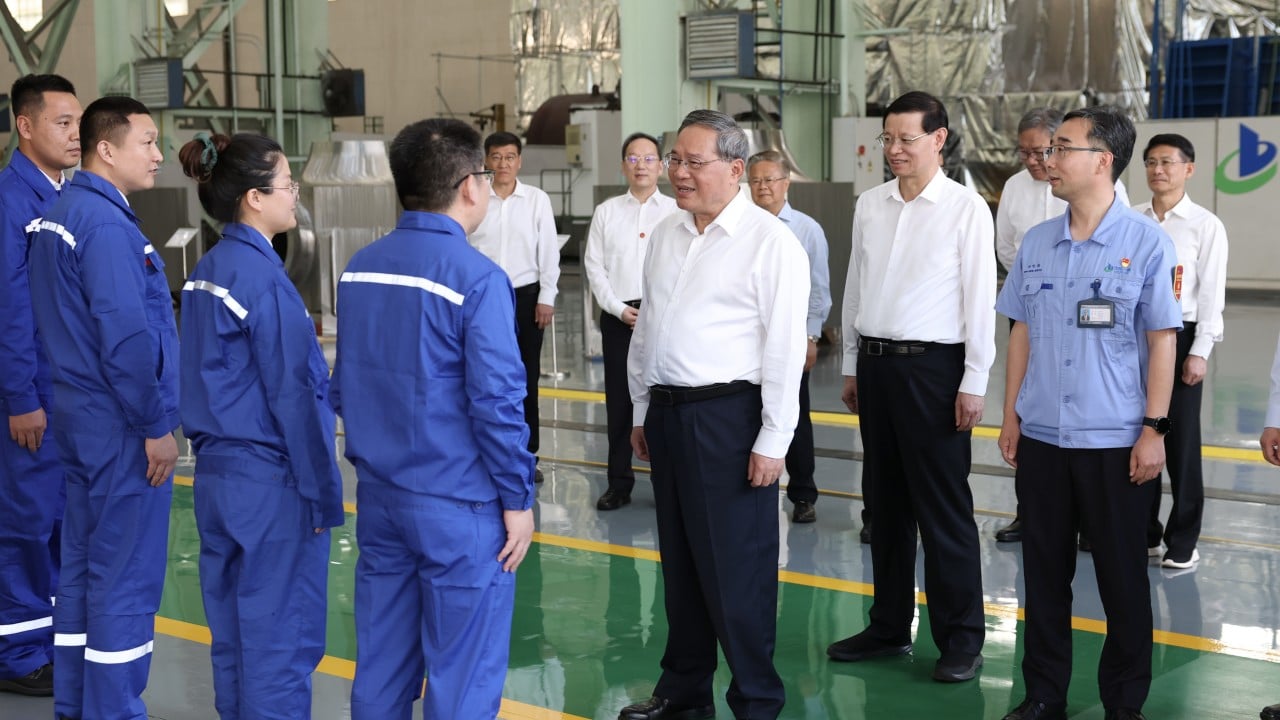
Beijing’s state-directed campaign to transform legacy industrial zones represents an economic survival mechanism driven by domestic growth deceleration and intensifying international tech containment. Premier Li Qiang’s June 2026 deployment to Dalian’s heavy industrial manufacturing corridor, immediately preceding the Summer Davos summit, signals a calculated pivot in national economic planning. The core thesis of this strategy is clear: China cannot afford to abandon its rust belt. Instead, the state must extract higher marginal returns from depreciated capital assets by grafting advanced automation, next-generation nuclear power, and value-dense maritime engineering onto existing state-owned infrastructure.
This structural overhaul is framed around the concept of "New Quality Productive Forces." In practice, this requires a fundamental shift in the classic Cobb-Douglas production function, transitioning from a reliance on brute capital accumulation ($K$) and massive labor inputs ($L$) toward a radical expansion of Total Factor Productivity ($TFP$), expressed as:
$$Y = A \cdot f(K, L)$$
Where $A$ represents the technological and operational efficiency factor that must offset structural contractions in the labor force and diminishing returns on fixed-asset investments.
The Structural Friction of Legacy Hubs
Traditional heavy industrial nodes, particularly those in Northeast China, operate under severe structural headwinds. Decades of state-directed asset allocation have created deep capital lock-in, where legacy manufacturing facilities suffer from low asset turnover and high carbon intensity.
The economic challenges of these hubs are defined by a three-fold bottleneck:
- Fixed-Asset Obsolescence: Equipment in heavy machinery, metallurgy, and basic chemical synthesis lacks the sensor density and computational architecture required for real-time process optimization. This causes high defect rates and excessive energy consumption per unit of output.
- The Debt-to-Equity Distortion: Highly leveraged State-Owned Enterprises (SOEs) carry significant historical debt burdens. This restricts their ability to secure commercial financing for research and development without explicit state guarantees or central bank liquidity facilities.
- Human Capital Flight: High-value engineering talent consistently migrates toward southern tech hubs, leaving older industrial zones with an aging workforce and an acute shortage of systems engineers, data scientists, and automation technicians.
The current strategy treats these liabilities not as terminal systemic failures, but as foundational layers for high-value upgrades. The goal is to avoid the massive asset write-downs associated with Western-style deindustrialization by modernizing existing heavy manufacturing plants.
The Capital Realignment Framework
The transformation relies on structured credit allocation and targeted state intervention rather than market-driven equity financing. Under the guidelines of the 15th Five-Year Plan, the state utilizes specific mechanisms to redirect capital into traditional industrial assets.
+--------------------------------------------------------------------------+
|                       State-Directed Capital Flow                        |
+--------------------------------------------------------------------------+
                                     |
              +----------------------+----------------------+
              |                                             |
              v                                             v
+----------------------------+               +----------------------------+
|  Structural Credit Policy  |               |  Fiscal Subsidy Machinery  |
|  (PBoC Re-lending Facilities)              |  (Equipment Upgrades)      |
+----------------------------+               +----------------------------+
              |                                             |
              +----------------------+----------------------+
                                     |
                                     v
                  +-------------------------------------+
                  | Advanced Industrial Base (e.g., DL) |
                  +-------------------------------------+
The first mechanism is the People's Bank of China's (PBoC) structural monetary policy tools. Specialized re-lending facilities provide low-cost capital directly to commercial banks, ring-fenced specifically for corporate equipment upgrades and industrial digitization projects. This lowers the weighted average cost of capital (WACC) for participating SOEs by 150 to 200 basis points below standard market rates.
The second mechanism is the fiscal subsidy machinery. Central government outlays cover a fixed percentage of the capital expenditure required to replace analog manufacturing equipment with high-precision CNC machinery, industrial IoT arrays, and automated material handling systems. This direct intervention shifts the corporate cost function, accelerating depreciation cycles and compressing the payback period for capital-intensive modernization.
Sectoral Execution: Case Studies in High-Value Upgrades
The strategic deployment of these principles is visible in three critical sectors based in the Dalian industrial corridor: maritime engineering, next-generation nuclear power, and high-end petrochemical equipment.
Maritime and Offshore Engineering
The global shipbuilding market is experiencing structural shifts toward alternative fuels and automated navigation. The strategy focuses on transitioning yards like Dalian Shipbuilding Industry Co. from low-margin bulk carriers to highly complex, high-value vessels.
- Liquefied Natural Gas (LNG) and Liquefied Hydrogen ($LH_2$) Carriers: These vessels require specialized cryogenic containment systems, such as GTT No. 96 or Mark III membrane technologies. Securing localized production lines for these invar and composite materials eliminates dependence on European supply chains and captures a larger share of global maritime capital expenditure.
- Offshore Engineering Modules: Production is shifting toward deep-water floating production storage and offloading (FPSO) units and automated wind turbine installation vessels. These units require advanced structural steel metallurgy and integrated positioning systems, converting basic steel production into high-value manufacturing.
Next-Generation Nuclear Energy
The integration of advanced energy infrastructure within industrial hubs addresses both decarbonization mandates and localized grid stability challenges. The deployment emphasizes the commercialization of Generation IV nuclear technologies.
- High-Temperature Gas-Cooled Reactors (HTGR): Utilizing pebble-bed fuel elements, these reactors provide high-temperature process heat ($750^\circ\text{C}$ to $950^\circ\text{C}$) directly to co-located petrochemical and metallurgical plants. This thermal integration eliminates the efficiency losses incurred when converting nuclear energy to electricity and then back to industrial heat.
- Small Modular Reactors (SMRs): The localized footprint of SMRs allows them to be deployed adjacent to coastal manufacturing hubs. This layout reduces long-distance transmission losses and guarantees uninterruptible power for high-precision manufacturing processes that are vulnerable to voltage fluctuations.
High-End Petrochemical Equipment
Traditional chemical synthesis suffers from narrow margins and high vulnerability to commodity price cycles. The technical blueprint demands a shift toward specialized, high-performance polymers and electronic-grade chemicals.
- Hydrocracking and Catalytic Reformer Units: Upgrading these reactors with advanced metallurgical linings and real-time gas chromatography sensors enables higher throughput and better conversion efficiency. This change maximizes the yield of high-value light olefins while minimizing low-value heavy fuel oil byproducts.
- Localized Catalyst Development: Replacing imported precious-metal catalysts with domestically engineered alternatives lowers operational expenditure and insulates the domestic chemical supply chain from external export control regimes.
Strategic Constraints and Execution Risks
This state-directed industrial model faces distinct systemic limitations. The assumption that injecting capital and automation into legacy hubs will consistently yield positive economic returns overlooks three main bottlenecks.
The first constraint is the algorithmic and hardware dependency in industrial AI. While the policy emphasizes digital integration, the underlying compute architecture remains vulnerable. Software platforms for industrial automation (such as advanced PLCs and SCADA systems) and specialized Electronic Design Automation (EDA) tools are heavily exposed to Western export restrictions. If access to high-performance microarchitectures is restricted, the digital upgrade of these facilities will hit a hard performance ceiling.
The second limitation is the fiscal capacity of local governments. While the central government sets the strategic direction, local authorities are responsible for co-financing and execution. Given the ongoing fiscal strain from regional land-sale revenue declines, many industrial municipalities lack the fiscal room to support large-scale technological transformations. This dynamic risks creating an execution gap between central policy objectives and regional financial realities.
The third challenge is the absorption capacity of traditional corporate structures. Managing an automated, data-driven shipyard or nuclear-coupled chemical facility requires a lean, agile corporate hierarchy. Many legacy SOEs retain bloated, multi-layered management structures that struggle to process and act on real-time operational data. Without deep institutional reforms that align executive compensation with asset utilization and TFP growth, capital infusions risk funding redundant hardware upgrades that yield minimal operational improvements.
The Long-Term Industrial Outlook
The success of China's industrial modernization depends on its ability to sustain high-end manufacturing growth despite external pressures. Over the next three to five years, expect a deliberate consolidation of the industrial landscape. Smaller, undercapitalized regional manufacturers will likely be integrated into larger, state-backed industrial clusters centered around key hubs like Dalian, Shenyang, and Harbin.
This consolidation will create highly integrated ecosystems where primary research institutes, specialized component suppliers, and heavy manufacturing facilities operate in close physical and operational proximity. This regional alignment is designed to accelerate innovation cycles and lower transaction costs, establishing a highly resilient domestic supply chain capable of withstanding protracted geo-economic disruptions.