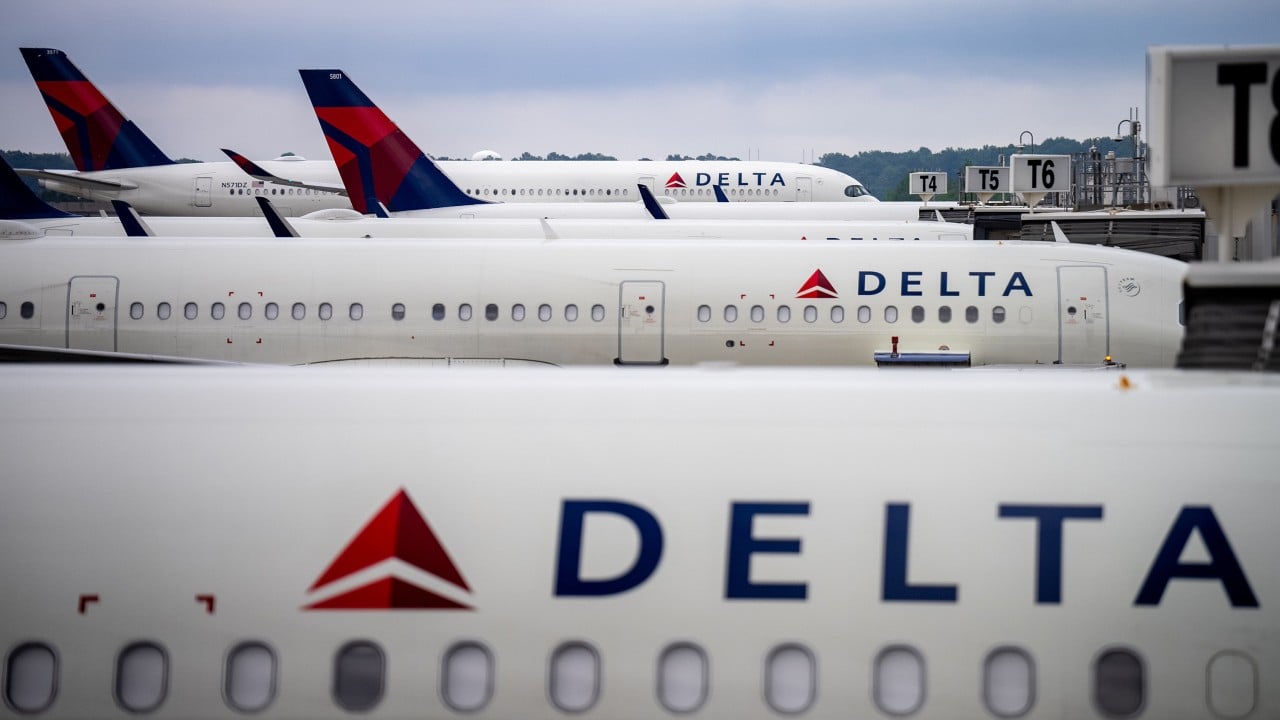
Delta Air Lines is attempting to capture transpacific market share in Hong Kong by abandoning the traditional volume-driven airline model in favor of high-yield cabin segmentation. Rather than competing on seat capacity or economy ticket pricing against entrenched Asian carriers, Delta is structuring its route economics around front-of-cabin revenue density, corporate contract consolidation, and long-haul fleet efficiency.
To understand whether this strategy can survive the structural realities of the Hong Kong aviation market, we must strip away corporate press releases and examine the underlying mechanics of route profitability, hub-and-spoke network effects, and competitive moats.
The Structural Shift in Transpacific Aviation Economics
Commercial aviation has historically operated on thin margins dictated by Revenue Passenger Miles (RPM) and Cost per Available Seat Mile (CASM). In ultra-long-haul markets—specifically routes exceeding 6,000 nautical miles between North America and the Pearl River Delta—traditional economy-heavy configurations fail to clear the cost of capital.
Fuel burn increases non-linearly with aircraft weight and stage length. Carrying an economy passenger across the Pacific requires carrying the fuel needed to transport that passenger, their luggage, and the fuel itself for the first ten hours of a fourteen-hour flight. When economy yields compress due to capacity dumping by state-backed or regional competitors, the marginal revenue of the back of the plane drops below its marginal fuel and maintenance cost.
Delta’s strategic response to this thermodynamic and financial constraint is cabin re-allocation. By shrinking the physical footprint of standard Main Cabin seating and expanding Delta One (business class), Delta Premium Select (premium economy), and Delta Comfort+, the airline alters its revenue-per-square-foot equation.
The Revenue Density Formula
Airline cabin economics mirror commercial real estate. An aircraft fuselage is a fixed cylinder of square footage. Profitability depends on optimizing the yield per square inch of floor space:
- Standard Economy: High passenger density, low average fare, high price elasticity, and minimal ancillary margin.
- Premium Economy: Approximately 35% more floor space per seat than economy, commanding 100% to 150% higher fares with negligible incremental fuel burn per passenger.
- Business Class Suites: Up to 350% more floor space than economy, generating 400% to 700% higher yields, insulated from leisure price wars through corporate travel budgets.
By weighting its long-haul fleet—specifically the Airbus A350-900—toward these upper tiers, Delta reduces its breakeven load factor. The aircraft no longer requires a 90% full cabin to turn a profit; it requires a 75% to 80% load factor in the front two cabins, turning the economy section into a low-risk base load rather than the primary profit engine.
Deconstructing the Hong Kong Market Bottlenecks
Hong Kong International Airport (HKG) presents a unique set of operational and competitive barriers that differentiate it from Tokyo Haneda (HND) or Seoul Incheon (ICN). Any US carrier entering or expanding in Hong Kong faces three distinct structural headwinds.
1. The Hub Dominance of Cathay Pacific
Cathay Pacific controls roughly half of the takeoff and landing slots at HKG and commands deep brand loyalty among Hong Kong-based corporate accounts. In airline network theory, the dominant hub carrier enjoys an S-curve advantage: a carrier with 50% of the flight frequency on a route captures significantly more than 50% of the high-yield business traffic because corporate travelers value schedule flexibility above almost all other variables.
If a consultant or investment banker finishes a meeting in Central three hours early, they want to take an earlier flight home. Cathay Pacific offers multiple daily departures to major North American gateways. Delta, operating limited daily frequencies from US hubs like Seattle or Los Angeles, cannot match that schedule density.
2. The Russian Airspace Penalty
Geopolitical airspace restrictions represent a massive hidden tax on US carriers flying to South China. Because US airlines are barred from overflying Russian airspace, flight paths from the US East Coast and Midwest to Hong Kong must route over the Arctic, down through East Asia, or across the Pacific via polar tracks.
This detour adds up to two hours of flight time and burns tens of thousands of pounds of additional jet fuel per round trip. On ultra-long-haul routes, this operational penalty often forces payload restrictions—meaning the airline must leave profitable belly cargo or even passengers behind to carry the extra fuel required to reach Hong Kong. Asian competitors that retain access to Russian airspace, or those operating from southern latitudes where polar routing is unnecessary, do not bear this cost penalty.
3. The Missing Joint Venture Shield
Delta’s success in other international markets relies heavily on immunized Joint Ventures (JVs). Across the Atlantic, Delta operates in lockstep with Air France-KLM and Virgin Atlantic. Across the Pacific to Northeast Asia, Delta relies on its JV with Korean Air, utilizing Seoul Incheon as a massive connecting hub for onward travel throughout Asia.
In Hong Kong, Delta lacks a local JV partner of Cathay Pacific’s scale. Cathay is a founding member of the rival Oneworld alliance, tightly aligned with American Airlines. Without a local partner to feed regional traffic from Southeast Asia and mainland China onto Delta’s transpacific flights, Delta must rely almost entirely on Origin and Destination (O&D) traffic—passengers starting or ending their journeys in Hong Kong or the immediate Greater Bay Area.
The Three Pillars of Delta’s Counter-Strategy
Given the lack of a local hub partner, the slot constraints at HKG, and the frequency disadvantage against Cathay Pacific, Delta cannot win a conventional market-share war. Instead, its strategy relies on three targeted mechanisms designed to bypass traditional hub limitations.
Pillar One: US-Origin Corporate Capture
Because Delta cannot easily win Hong Kong-originating corporate contracts away from Cathay Pacific, it focuses on capturing the US side of the transaction. Delta holds dominant fortress hubs in Atlanta, Detroit, Minneapolis, and Salt Lake City, alongside leading corporate share in New York and Boston.
When a US-based multinational corporation signs a global preferred carrier agreement with Delta, the airline mandates bundle compliance. To receive steep discounts on high-frequency domestic US routes, the corporate client must direct its international transpacific spend onto Delta metal. The Hong Kong flight does not need to win on standalone schedule convenience if it is locked into an enterprise-wide procurement contract negotiated in New York or Atlanta.
Pillar Two: The Seattle and Los Angeles Funnel
Rather than attempting point-to-point service from multiple US cities—which would fragment demand and destroy load factors—Delta concentrates its transpacific feed through coastal gateways, primarily Seattle-Tacoma (SEA) and Los Angeles (LAX).
By timing domestic arrivals from across North America to connect within a tight 90-minute bank to a single daily widebody departure to Hong Kong, Delta manufactures artificial frequency. A passenger flying from Austin, Chicago, or Orlando experiences a single-carrier, one-stop itinerary with synchronized baggage handling and lounge access. This hub-and-spoke aggregation allows Delta to fill a high-density premium cabin using thin streams of business travelers drawn from dozens of secondary US markets.
Pillar Three: Hardware and Ground Experience Parity
Premium travelers evaluate long-haul products based on sleep quality, privacy, and ground friction. Delta has systematically eliminated the product gap that historically plagued US carriers compared to Asian competitors.
The deployment of all-suite business class cabins with closing doors (Delta One Suites), paired with dedicated Delta One Lounges at major US gateways, directly targets the soft-product advantage long held by Cathay Pacific. When a corporate traveler is guaranteed direct aisle access, a lie-flat bed, and expedited private security screening in the US, the incentive to defect to a foreign carrier diminishes.
The Limitations and Failure Modes of the Premium Bet
Relying on premium cabin yields to conquer a slot-constrained, competitor-dominated market carries severe financial vulnerabilities. Strategy consulting requires stress-testing the thesis against downside scenarios, and three specific failure modes threaten Delta’s Hong Kong calculus.
Cyclicality of Corporate Travel Spend
Premium cabins are hyper-sensitive to macroeconomic contractions. While economy leisure demand remains relatively resilient during mild recessions—supported by price discounting—corporate travel budgets are the first line item cut by CFOs during earnings compression.
If global trade volumes slow or financial sector activity between New York and Hong Kong contracts, business class load factors can drop by 15% to 20% within a single quarter. Because Delta has physically removed economy seats to install suites, it cannot easily pivot back to capturing budget leisure travelers to fill the empty space. High fixed costs paired with collapsing front-cabin yields create rapid operating leverage in reverse.
The Greater Bay Area Spillover Effect
Hong Kong’s aviation monopoly over the Pearl River Delta has eroded. Shenzhen Bao'an International Airport (SZX) and Guangzhou Baiyun International Airport (CAN) have aggressively expanded their international widebody networks, backed by mainland Chinese carriers offering subsidized fares and direct connections to North America.
Price-sensitive travelers—and even mid-tier corporate accounts—based in Shenzhen or Dongguan increasingly bypass Hong Kong altogether, avoiding cross-border immigration friction and HKG’s high passenger departure taxes. Delta’s premium strategy assumes Hong Kong remains the undisputed financial and transit gateway for southern China; if capital and passenger flows continue shifting toward mainland hubs, the O&D pool in Hong Kong will stagnate.
Yield Dilution via Loyalty Redemptions
Delta’s SkyMiles program is a massive financial engine, generating billions in revenue through co-branded credit card partnerships with American Express. However, this creates an internal conflict of interest on flagship long-haul routes.
High-status frequent flyers and credit card holders expect to redeem miles or Global Upgrade Certificates for international business class seats. Every Delta One suite occupied by a non-revenue upgrade or a low-yield mileage redemption displaces a cash-paying corporate customer. If Delta over-allocates upgrade inventory to keep its domestic loyalty base satisfied, it cannibalizes the exact cash yields required to make the Hong Kong route profitable. Conversely, if it restricts upgrade availability to protect cash fares, it degrades the value proposition of its loyalty ecosystem.
Measuring Success: The Metrics That Actually Matter
External observers often judge airline route success by total passenger volume or overall load factor. Both metrics are misleading for a premium-heavy strategy. To accurately track whether Delta’s Hong Kong bet is working, analysts must monitor three specific operational indicators:
- RASM (Revenue per Available Seat Mile) Differential: Delta’s Pacific entity RASM must consistently outperform its system-wide average by at least 15% to 20% to offset the higher fuel burn and crew costs of ultra-long-haul flying.
- Paid Load Factor in Front Cabins: Total business class occupancy is irrelevant if half the cabin is filled with operational upgrades or employees. The critical metric is the percentage of Delta One and Premium Select seats sold for cash or high-margin corporate fares at least 14 days prior to departure.
- Connecting vs. Local O&D Yield: Delta must maintain a healthy balance between lower-yielding connecting traffic fed through Seattle/Los Angeles and higher-yielding local O&D traffic. If local HKG-USA point-to-point share falls below 40% of the aircraft’s manifest, the route becomes overly reliant on prorated connecting fares that erode net profitability.
The Strategic Imperative for Delta
Delta cannot out-fly Cathay Pacific on frequency, nor can it out-discount mainland Chinese carriers on economy fares. Attempting to grow capacity in Hong Kong through additional daily frequencies would destroy yields and trigger a ruinous price war.
The optimal strategic play is strict capacity discipline paired with aggressive corporate bundling. Delta must cap its Hong Kong seat capacity at current widebody levels, refuse to add secondary frequencies until bilateral airspace restrictions ease, and focus its sales force entirely on locking US-based financial, legal, and technology firms into multi-year transpacific volume commitments. Profit in Hong Kong will not come from winning the market; it will come from skimming the top 10% of the yield curve while leaving the unprofitable volume to competitors.