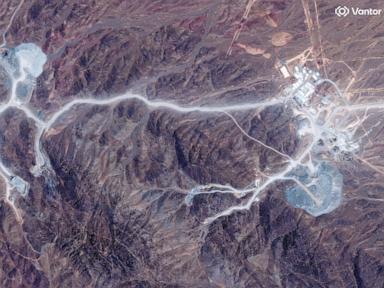
The Granite Shield Near Natanz
When military planners talk about target hardiness, depth is only part of the equation. The real nightmare is rock density.
Buried roughly 100 meters beneath solid granite in Iran's Zagros mountain range lies Kuh-e Kolang Gaz La, known colloquially as Pickaxe Mountain. Located barely two kilometers south of the heavily bombed Natanz nuclear complex in Isfahan province, this subterranean facility has emerged as the central flashpoint of the military campaign between Washington and Tehran. Following weeks of public warnings, President Donald Trump declared that American forces would hit the site "pretty soon, and very heavily," describing the complex as a prime target for a strike directly into its tunnel entrances.
The announcement answered a question that non-proliferation experts have asked since Operation Midnight Hammer in mid-2025: where did Iran put its core nuclear capabilities when the main surface plants were ruined?
Western intelligence assessments and satellite tracking indicate that Tehran spent months moving thousands of advanced uranium-enrichment centrifuges into the mountain's four reinforced tunnel portals. It is not merely an assembly hall anymore. Intelligence agencies suspect Pickaxe Mountain now shelters a significant portion of Iran's 60 percent enriched uranium stockpile, creating a hardened fallback position that conventional air campaigns struggle to neutralize.
Why Conventional Bunker Busters Fall Short
Dropping bombs on a mountain is simple. Eliminating what sits deep inside it is another matter entirely.
The primary tool in the Pentagon's conventional inventory for hardened target defeat is the GBU-57 Massive Ordnance Penetrator. A 30,000-pound precision-guided monster, the weapon is engineered to punch through up to 200 feet of reinforced concrete or moderate earth before detonating its high-explosive payload. Against standard underground bunkers, it works. Against 300 feet of metamorphic granite, physics intervenes.
"You can collapse an entrance, but you cannot crush a mountain core with a standard kinetic strike without repeated, hyper-precise stacking."
The structural design of Pickaxe Mountain presents specific tactical hurdles:
- Depth of Overburden: The facility sits under 100 to 150 meters of solid granite, exceeding the rated penetration envelope of a single GBU-57 bomb.
- Tunnel Geometry: Unlike Fordow, which relied on two main access points, Pickaxe Mountain features four separate tunnel portals cut into opposite faces of the ridge.
- Internal Blast Baffling: Satellite imagery reveals s-curved ingress routes designed to redirect atmospheric shockwaves away from primary research halls.
- Backfilled Access Routes: Intelligence reports show Iranian engineering units have partially backfilled eastern portals with reinforced concrete rubble, turning access points into physical barriers.
To collapse an installation like this from the air, military strategists must employ a tactic known as "same-hole bombing." This involves dropping multiple GBU-57 weapons sequentially into the exact same crater, using the first blast to strip away surface rock and subsequent blasts to dig deeper into the mountain spine. The margin for error is minimal. A deviation of a few feet renders the second bomb's kinetic energy useless against intact granite.
The Centrifuge Shell Game Inside the Zagros Range
Construction at Pickaxe Mountain did not begin as an impulse reaction to war. It was a calculated response to sabotage.
In July 2020, an explosion decimated the above-ground centrifuge assembly workshop at Natanz. Iranian authorities publicly blamed foreign intelligence services and announced an immediate pivot. Ali Akbar Salehi, then head of the Atomic Energy Organization of Iran, informed parliament that the regime would construct a far larger, more secure facility deep in the nearby hills. Excavation crews spent years hauling thousands of tons of spoil out of the mountainside, creating a subterranean footprint far exceeding original Western estimates.
NATANZ SURFACE COMPLEX (Destroyed)
       │
       └──► PICKAXE MOUNTAIN TUNNELS (100m+ Depth)
               ├── North Portal (Reinforced Access)
               ├── South Portal (Reinforced Access)
               ├── East Portal (Partially Backfilled)
               └── West Portal (Heavy Equipment Transport)
The physical migration of hardware gathered speed following airstrikes on Natanz and Fordow. Thousands of IR-4 and IR-6 centrifuges were transported into the mountain complex under cover of darkness. These advanced machines operate at rotational speeds exceeding 1,000 meters per second, demanding extreme mechanical precision. Moving them underground shelters them from missile strikes, but it also creates an operational bottleneck.
Without external cooling infrastructure, ventilation shafts, and high-voltage power lines running down from the surface, advanced centrifuges cannot function for long.
The Stockpile Strategy That Changes the Math
Centrifuges are expensive machinery, but nuclear material is the true center of gravity.
During recent Oval Office briefings, administration officials shifted focus from raw centrifuge counts to the tracking of enriched materials. Iran holds an estimated 1,000 pounds of uranium enriched up to 60 percent purity. From a technical standpoint, 60 percent material sits a short mechanical step away from weapons-grade threshold.
| Facility Name | Estimated Depth | Primary Purpose | Current Target Status |
|---|---|---|---|
| Natanz (Above Ground) | Surface level | Original centrifuge assembly | Heavily damaged / Unusable |
| Fordow | ~80 Meters | Enrichment chambers | Damaged in prior strikes |
| Pickaxe Mountain | 100+ Meters | Underground fallback & assembly | Active threat / Imminent target |
If that material resides inside Pickaxe Mountain, air strikes that merely seal the tunnel entrances do not destroy the uranium. They entomb it. Entombment buys time, but it leaves the material intact under solid rock until recovery crews dig it out.
Strategic Reality Behind the Rhetoric
Public warnings about striking "the front door" of a bunker facility serve political purposes alongside military ones.
Tehran understands that destroying the tunnel portals at Pickaxe Mountain will require a prolonged air campaign involving dozens of sorties, specialized tanker support, and continuous electronic warfare coverage. Conversely, Washington knows that leaving a fully equipped underground facility operational gives Iran an untouchable hedge against future diplomatic demands.
The technical consensus among non-proliferation analysts is stark: a kinetic strike on Pickaxe Mountain will shatter the concrete portals, crush external power connections, and delay operations for months. It will not erase the underlying engineering or the material buried deep within the granite. As long as the mountain stands, the core capability remains intact beneath the rock.