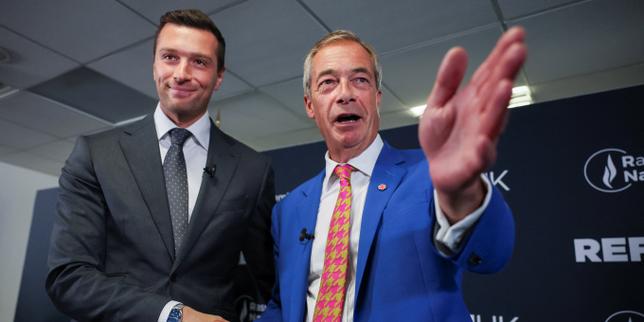
The rain over Westminster does not fall with theatrical fury. It is a persistent, gray mist that gets into the wool of your coat, chilling you from the outside in before you even realize you are shivering. On a damp afternoon outside Parliament, Nigel Farage adjusts his tie. He has spent decades standing in this precise drizzle, playing the perpetual outsider who somehow always manages to set the weather inside the room.
Except the weather today is turning against him.
Questions hang in the damp air like unburned smoke. Financial reports, silent and sharp as scalpels, have begun to carve away at the polished exterior of Reform UK. Whispers of irregular funding, of money arriving from channels that prefer the dark to the light, are no longer whispered. They are shouted across headlines. For a man who built an entire political identity on the promise of throwing open the windows and letting in the clean, fresh air of transparency, the smell of closed-door accounting is toxic.
And then, from across the Channel, a hand reaches out.
Jordan Bardella does not need to cross the water to make his presence felt. The young face of the National Rally in France watches the British political theater with an acute, calculating gaze. When Farage stumbles, Bardella steps forward. Not with a rescue package or a legal defense, but with something far more potent in the modern political arena: validation.
Solidarity.
To understand why this cross-border embrace matters, you have to step away from the antiseptic glow of television studios and look at how populist movements actually survive. They do not live on policy papers. They live on tribal geography. When your domestic house is on fire, you do not look to your neighbors for buckets of water; you look to them for proof that the fire is just a campfire, and that everyone else is simply exaggerating the heat.
Farage is wounded. The allegations concerning his party's funding streams strike at the very heart of his populist appeal. Populism relies on a simple, devastatingly effective contract with the voter: I am the only honest man in a room full of thieves. Once the public begins to wonder if the honest man has a ledger he would rather keep closed, the magic starts to fade. The spell frays at the edges.
Enter the continental cousin.
Bardella’s public backing of Farage is not an accident of timing. It is a tactical deployment of international camaraderie. By standing shoulder-to-shoulder with the British agitator, the French rising star sends a message to both sides of the English Channel. He suggests that the scrutiny Farage faces is not a legitimate inquiry into financial transparency, but rather a coordinated assault by the establishment. It is a classic rhetorical judo move. Turn the accusation of corruption into proof of persecution.
Listen closely to the language used in the backrooms of these allied movements. (To be clear, I am describing the operational logic observed by political analysts across Europe, not sitting inside their strategy meetings). The logic is ancient and cynical. If the system is corrupt, then any rule broken to fight the system is merely a tactical necessity. When financial irregularities surface, the defense is rarely an itemized audit. The defense is an indictment of the auditors.
Yet, beneath the political theater, the stakes are painfully real.
Think of the small-business owner in Clacton or the factory worker in northern France. They wake up before dawn. They pay their taxes down to the last centime, because they have no offshore accounts, no clever accountants, and no political party to shield them when the state comes knocking. When they hear that millions are moving through political pipelines with questionable origins, a quiet exhaustion settles into their bones. It is the exhaustion of knowing that the rules apply only to those who cannot afford to bend them.
Bardella’s gamble is that his supporters will not care about the provenance of the money. He is betting that the emotional bond of anti-establishment identity is thicker than water, thicker than law, and certainly thicker than a financial compliance report. By wrapping his arm around Farage, he is telling his own electorate: We are under attack everywhere, and we must hang together.
It is a powerful narcotic. It dulls the sharp edges of accountability and replaces them with the warm, intoxicating glow of collective victimhood.
Walk through the streets of Paris or London today, and you can feel the tectonic plates shifting. Traditional political parties are hollowed out, their institutional memories fading like old wallpaper. In their place, these transnational populist networks are rising—loose, agile, and funded by mechanisms that often defy traditional oversight. They operate like modern corporations, optimizing their messaging across borders while keeping their balance sheets comfortably obscured.
When the British electoral commission or investigative journalists start pulling threads on these financial structures, they aren't just looking at bank accounts. They are pulling at the thread of an entire political mythology. If Farage cannot account cleanly for every pound, the narrative of the pure, grassroots insurgent collapses into something much more mundane: another politician playing the game with loaded dice.
And that is why Bardella’s intervention is so desperate, and so necessary for their shared survival.
If one domino falls, the momentum slows. If the British wing of this populist wave stalls under the weight of financial scandal, the French wing loses a crucial mirror. They need each other to reflect a larger-than-life image back to their voters. They need to look like an unstoppable wave rather than a collection of isolated political operators trying to keep their books balanced while the rain pours down.
The mist thickens over Westminster. Farage stands his ground, flanked by the invisible shield of continental solidarity, while the auditors sharpen their pencils and the public waits to see if the illusion can survive the daylight.
The rain does not care about politics. It simply falls, washing over the clean and the compromised alike, waiting to see what is left when the water finally clears.