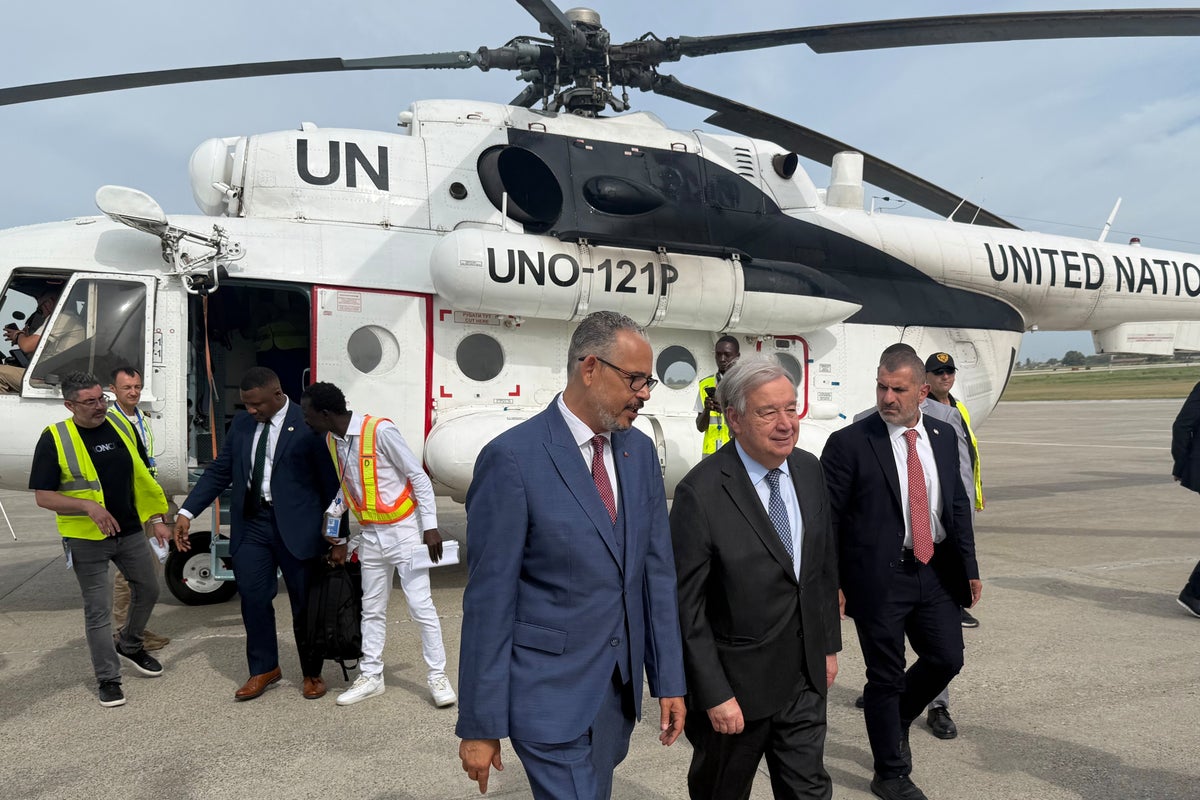
Haiti is running out of time. UN Secretary-General António Guterres just landed in Port-au-Prince, touching down in a capital where local authorities have lost control of nearly everything. This isn't a routine diplomatic tour. The UN chief visits Haiti at a moment when more than one in ten people across the country have been driven from their homes by unchecked urban warfare. A new international security force is setting up its headquarters right now, preparing to launch direct combat operations against the heavily armed coalitions that rule the streets.
The stakes couldn't be higher. For years, the international community responded to the Haitian crisis with little more than empty statements and half-funded aid packages. Now, the newly established Gang Suppression Force, or GSF, is trying to pull the nation back from the edge of total collapse. Guterres walked through bullet-paddled neighborhoods and met with families crammed into sweltering, makeshift camps to deliver a raw message. The world needs to stop looking away.
The Reality on the Ground in Port-au-Prince
Walking through the capital right now means navigating a war zone. The numbers coming out of the country are staggering. UN rights officials confirmed that gang violence has killed at least 2,300 people since the start of this year alone. Another 1.5 million people are completely displaced nationwide. Just days before Guterres arrived, a brutal assault in the Cité Soleil seaside slum left more than 30 people dead, wounded, or missing.
The physical destruction tells the whole story. As the UN convoy moved through the city, it passed blocks of abandoned homes, burned-out car dealerships, and concrete structures riddled with heavy gunfire. Public transit buses roll down the street with windshields shattered by stray bullets. On the walls, fresh graffiti reads, "Down with Viv Ansanm, long live the police."
Viv Ansanm is the dominant gang federation terrorizing the population. The coalition controls roughly 70 percent of Port-au-Prince. They operate with total military efficiency, using high-caliber weapons smuggled into the country to outgun the local police force. They don't just rob people. They systematic destroy communities to expand their territory.
Inside the New Gang Suppression Force
The primary focus of the UN chief visits Haiti was inspecting the newly minted Gang Suppression Force. This international unit replaces the previous, disastrously underfunded security mission that was led by Kenyan police. That older mission never got the manpower or the financial backing it needed to make a dent. The GSF is supposed to be different.
The force is currently staffed by fewer than 1,000 personnel from a handful of countries, including Chad, Jamaica, El Salvador, Guatemala, and Mongolia. The United Nations Security Council gave the green light for this deployment to eventually scale up to 5,500 uniformed troops and police officers.
Their operational goal is straightforward. GSF head Jack Christofides stated that the force intends to degrade the operational capacity of the gangs until local Haitian institutions can manage them on their own. They aren't here to occupy the country forever. They are here to act as a sledgehammer so the Haitian National Police and the local military can step in and hold the line.
Outside the dusty roads near the GSF base, hundreds of young Haitian men and women have been lining up for a chance to enlist in their own national forces. They want to fight back. The desire to reclaim their country is there, but they lack the heavy armor, tactical training, and logistical support that the international community has promised but failed to deliver quickly enough.
The Human Toll of International Neglect
Guterres didn't just meet with military commanders and politicians. He spent time inside the school buildings and public facilities that have been turned into refugee camps. At a former school called Colombie, more than 1,200 displaced people are sleeping side-by-side on concrete floors under rusted tin roofs.
The conditions inside these camps are horrific. In closed-door meetings, local women told Guterres that up to ten families are packed into single, unventilated classrooms. There is zero privacy. Parents are terrified for their young children, who are completely cut off from schooling and exposed to disease. Most families are lucky if they get one meal a day. The $880 million humanitarian aid budget that the UN requested for Haiti this year is currently sitting at less than 24 percent funded.
During the tour, an angry resident began hammering on the metal siding of a shelter building, shouting that they wanted to go home because they don't have a life in the camps. Security teams quickly moved the UN chief away. It was a sharp reminder that the people of Haiti are sick of sympathy. They want security so they can walk out of these squalid shelters and rebuild their lives.
Political Vacuum and the Next Steps
You can't solve a security crisis without a working government, and Haiti hasn't had an elected president since Jovenel Moïse was assassinated in July 2021. The political system is in complete stasis. Following his security briefings, Guterres held a private meeting with Prime Minister Alix Didier Fils-Aimé, the head of the current transitional government.
Fils-Aimé is facing intense pressure to stabilize the capital so the country can finally hold general elections. He explicitly pressed the UN chief to hold international backers accountable. The nations that promised to fund and equip the Gang Suppression Force need to deliver on their agreements immediately.
True stability requires a multi-pronged approach. The international community must heavily enforce arms embargoes to stop the flow of illegal weapons from entering Haitian ports. Wealthy nations need to bridge the massive funding gap for the UN humanitarian plan to prevent widespread starvation. Finally, the transitional government must establish legitimate judicial units to prosecute gang leaders and corrupt officials who profit from the chaos.
The deployment of the GSF offers a fragile window of opportunity. If the international community fails to fully back this mission, the capital will completely fall to the federation of gangs, and the humanitarian disaster will spill far beyond Haiti's borders. There are no more excuses left.