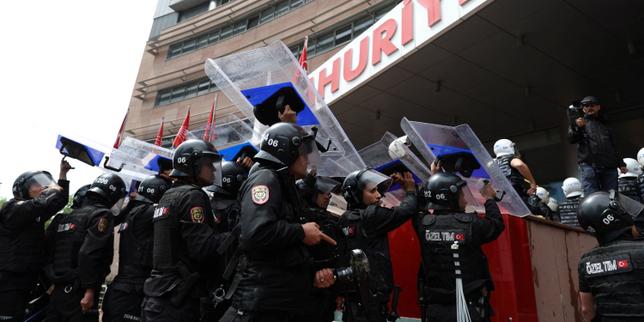
Mainstream media outlets love a predictable script. The moment police sirens wail outside a political headquarters in Ankara, the international press rushes to dust off the standard authoritarian playbook. We see the same headlines splashed across European dailies: "Democracy Under Siege," "The Death of Turkish Pluralism," or the recent lamentations regarding the police raid on the main opposition party headquarters following the ousting of its leadership.
It is lazy journalism. It treats complex structural survival strategies as a simple morality play of good versus evil.
The consensus view is that this raid represents an existential crisis for the Turkish opposition. Western analysts look at the barricades, the seized documents, and the forced removal of party executives, and they conclude that the ruling Justice and Development Party (AKP) is executing a final, desperate death blow to dissent.
They are entirely wrong.
This raid is not the execution of the opposition. It is the life-support system. To understand Turkish politics, you have to discard the naive notion that the ruling coalition and the main opposition are fighting a zero-sum war. They are locked in a symbiotic dance. This engineered confrontation serves both sides, masking a deeper structural rot within the opposition itself while giving the state exactly what it needs: a highly visible, easily contained enemy.
The Myth of the Paralyzed Opposition
Let’s dismantle the primary premise floating around international newsrooms: the idea that state intervention catches the opposition completely off guard and neutralizes their power.
I have spent years analyzing electoral dynamics and political party infrastructure across the Eastern Mediterranean. If there is one undeniable truth about institutional political parties in hybrid regimes, it is that they require external pressure to justify their internal failures.
Before the police arrived at the Ankara headquarters, the main opposition party was drowning in internal factional warfare. A forced change in leadership had triggered bitter infighting, threatens to fracture their voter base, and exposed an absolute lack of a coherent economic alternative to the current administration.
Then came the state intervention.
Suddenly, internal dissent vanished. The factions unified under the banner of victimhood.
In Turkish politics, victimhood (mağduriyet) is the ultimate political currency. The current ruling elite built their entire multi-decade empire on the narrative of being the persecuted underdogs of the old secular establishment. The opposition has learned this lesson well. A police raid is not a logistical disaster; it is a branding windfall. It provides an instant infusion of moral legitimacy without requiring the party to pass a single piece of meaningful legislation or present a viable plan to fix the country's skyrocketing inflation.
The Mechanics of Manufactured Polarization
To understand why this happens, we must look at the structural mechanics of what political scientists like Levitsky and Way call competitive authoritarianism. The regime does not want to eliminate the opposition entirely. Total elimination forces dissent underground, where it becomes unpredictable, unmapped, and genuinely dangerous.
Instead, the state requires a visible, centralized target. By raiding the headquarters of the principal opposition party, the state achieves two critical objectives:
- It forces all anti-government sentiment into one specific, institutional bucket that the state already knows how to monitor, litigate, and control.
- It scares away radical, grassroots movements that might actually threaten the status quo by signaling that the state will use force whenever it pleases.
Consider the data from previous crackdowns, such as the targeting of municipal leaders in Istanbul or the purging of regional administrations in the southeast. Mainstream pundits predicted these moves would trigger widespread, uncontrollable civil unrest.
What actually happened? The institutional opposition called for "restraint" and urged citizens to wait for the next electoral cycle.
[State Intervention / Raid]
       │
       ▼
[Instant Coalition Victimhood] ──► [Suppression of Internal Party Dissent]
       │
       ▼
[Channeled Public Anger into Safe Electoral Vents]
This is the cycle. The state applies pressure, the opposition absorbs the blow to collect moral capital, and the public’s genuine anger is successfully funneled into a safe, predictable bureaucratic box. The system resets. The status quo wins.
Dismantling the PAA Fallacies
The questions dominating search engines right now reveal just how deeply the public has swallowed the superficial narrative. Let’s address them with cold reality.
Does this raid mean Turkey is transitioning into a total dictatorship?
No. A total dictatorship does not bother with the elaborate theater of raiding an opposition headquarters over leadership disputes; it simply bans the party by decree and fills the seats with loyalists. The presence of these dramatic, highly publicized standoffs proves that the regime still relies on the facade of a competitive electoral arena to maintain international trade agreements and financial credit lines. The theater is the point.
Can the opposition recover from the removal of its leadership?
The question assumes the leadership mattered. The institutional structure of the Turkish opposition is notoriously top-heavy, bureaucratic, and detached from the working-class realities of Anatolia. New faces in old offices change nothing. The party infrastructure remains an employment agency for career politicians who are perfectly comfortable commanding a steady 25% of the vote in perpetuity, safely insulated from the actual burdens of governance.
The Cost of the Contrarian Reality
There is a dark side to this perspective, and we must acknowledge it. Viewing these events through the lens of regime co-dependency can breed absolute cynicism among the electorate. When voters realize that the theatrical clashes between the police and party officials are part of an unwritten script, voter fatigue sets in.
But cynicism is better than delusion.
As long as international observers and domestic voters treat these raids as unexpected shocks rather than systemic features, they will continue to fall for the same trap. They will keep donating to parties that cannot protect their own front doors, and they will keep expecting electoral miracles from organizations that are structurally designed to lose elegantly.
Stop looking at the police lines outside the Ankara offices as a sign of a regime reaching its peak power. Look at them for what they really are: the boundaries of a carefully managed cage, built by the state, and maintained with the passive compliance of an opposition that prefers the safety of the cage to the unpredictable storms of true political revolution.
Stop weeping for the broken glass at headquarters. Start questioning why the building was so easy to walk into in the first place.


