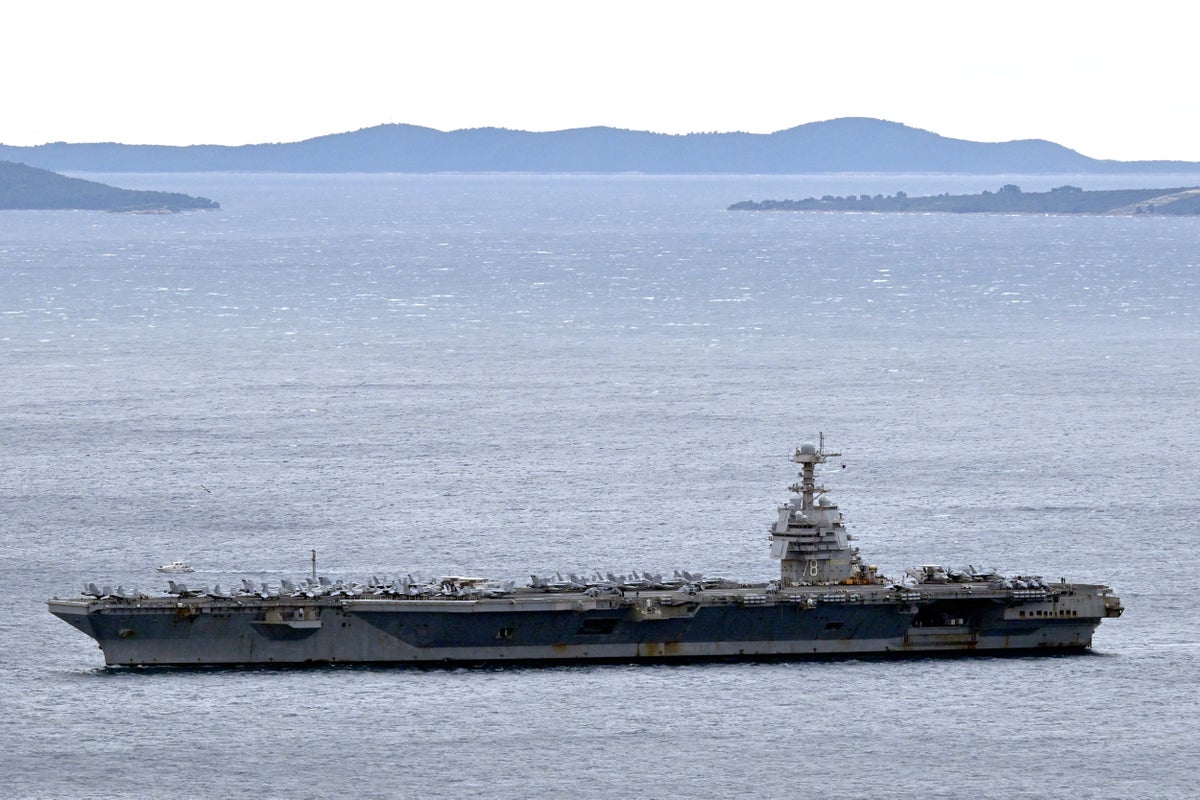
The defense press is having a collective meltdown over a headline that sounds like alternate history fiction. Reports indicate that leadership is floating the aesthetic and structural revival of World War II-style major warships to satisfy Donald Trump’s distinct architectural tastes. Predictably, the punditry has rushed to judgment. Editorial boards are clutching their pearls, dismissing the notion as a nostalgic vanity project cooked up by amateurs who watch too many History Channel documentaries at midnight.
They are wrong. They are wrong because they are looking at steel plates and gray paint instead of naval economics, industrial realities, and survivability math.
When civilian leaders push for a retro visual signature, defense analysts instinctively roll their eyes and lecture the room about missile defense, Aegis combat systems, and distributed maritime operations. They assume the policy target is purely cosmetic. That assumption is a catastrophic failure of imagination.
Strip away the populist rhetoric about battleship nostalgia, and you find a legitimate, hard-nosed critique of modern naval procurement. The current fleet architecture is a fragile, multi-billion-dollar house of cards. We build floating glass castles packed with delicate electronics, vulnerable to low-cost saturation attacks, and anchored by shipyards that cannot even maintain the fleet we currently own.
The Myth of the High-Tech Megaship
For thirty years, defense acquisition policy has suffered from a terminal case of exquisite engineering disease. The prevailing doctrine demands every surface combatant be a Swiss Army knife of networked sensors and vertical launch systems. The result is the modern destroyer and cruiser: massive, expensive platforms that carry all our eggs in a few very sophisticated baskets.
Consider the mathematics of a modern Arleigh Burke-class flight III destroyer or a future large surface combatant. You are putting billions of dollars of hull and electronics into a single address. When every adversary from the Baltic to the South China Sea is flooding the zone with cheap anti-ship cruise missiles and hypersonic gliders, concentration of force becomes an invitation to catastrophe.
Critics of the Trump aesthetic proposal argue that thick armor plating and massive gun turrets belong in the last century. They remind us that steel armor cannot stop a modern torpedo or a Mach 5 anti-ship missile.
That is true, but it misses the entire counter-argument. Armor is not about stopping a direct hit from a modern warhead. Armor is about compartmentalization, structural redundancy, and damage control survivability. Modern warships are built with thin-skinned aluminum-infused superstructures designed to save weight for sensors, making them intensely vulnerable to fire, flooding, and structural collapse from minor hits.
When naval architects talk about a throwback silhouette, they are often describing a shift away from top-heavy integrated masts and toward deep hull redundancy. They are talking about ships that can take a beating and stay in the fight instead of checking into a dry dock for eight months after absorbing shrapnel.
The Industrial Baseline Reality
Let us talk about the dirty secret the Pentagon tries to bury under slide decks: American shipbuilding is broken.
I have watched taxpayers pour billions into programs that deliver late, over-budget, and chronically under-maintained hulls. Our public and private shipyards are choked by a lack of skilled labor, archaic infrastructure, and a procurement process designed by bureaucrats who have never stepped foot on a welded deck plate.
If you want a fleet that can scale in a protracted conflict, you cannot rely exclusively on nuclear-powered supercarriers and exquisite stealth destroyers that take five years to construct. You need volume. You need simple, rugged geometries that can be welded together in secondary yards if primary facilities are taken offline.
The World War II aesthetic is not about reliving Midway. It is about industrial triage.
When you look at the designs generated during the peak of 1940s industrial mobilization, you see a masterclass in design for manufacture. Standardized shapes, heavy structural frames, and systems that prioritize mechanical reliability over fragile software integration. A modern adaptation of these principles means shifting from fragile software-defined platforms to modular, heavily framed hulls that can absorb upgrades without requiring a complete redesign of the ship's center of gravity.
The Electronic Vulnerability Trap
The mainstream defense establishment loves to talk about network-centric warfare as if radio waves are impervious to physics.
Modern warships are floating server rooms. They rely on constant, uninterrupted data feeds, active radar emissions that light up the ocean like a neon sign, and automated combat systems that require pristine supply chains for microchips and proprietary software patches.
What happens when the GPS constellation goes dark? What happens when high-altitude electromagnetic pulses, cyber attacks, or quantum-enhanced electronic warfare blind the network?
A ship that relies entirely on an exquisite digital nervous system becomes a floating target dummy the moment the network drops.
A heavier, structurally dominant warship with ruggedized analog backups, massive physical ammunition storage, and line-of-sight command capabilities operates with a degraded-mode resilience that modern destroyers simply do not possess. By mocking the visual cues of a bygone era, critics expose their deep ignorance of degraded-state warfare. In a contested electromagnetic spectrum, raw physical mass and mechanical redundancy are not nostalgic luxuries. They are survival traits.
Dismantling the Cost Per Ton Fallacy
Let us address the cost argument head-on.
The standard pushback against any unconventional naval architecture proposal is that it diverges from the Program of Record, blowing up budget baselines and confusing the acquisition community.
This is bureaucratic self-preservation disguised as fiscal conservatism.
The current Program of Record is a fiscal black hole. We are currently trying to sustain a fleet size that shrinks while unit costs skyrocket. When a single new-generation combatant costs upwards of two to three billion dollars, the loss of even one hull represents a strategic trauma for the nation.
Imagine a scenario where we pivot toward a high-low mix centered around ruggedized, simpler hulls with heavy structural defense and modular payload bays. You lower the unit cost, increase the hull count, and force the enemy to burn through expensive inventory just to deal with baseline platforms.
The real financial risk is continuing down a path where our entire surface fleet is too few to cover the globe and too delicate to risk in a real fight. If your warships are too precious to use aggressively, you do not have a navy. You have a museum collection that floats.
The Strategic Misdirection
The media treats the Trump administration's interest in naval aesthetics as a quirky distraction from serious defense planning.
They have it backward.
The aesthetic preference is the symptom; the underlying disease is a sclerotic procurement system that refuses to question its own dogmas. When leadership looks at sleek, modern destroyers and sees vulnerable, overpriced toys, they are expressing a visceral, intuitive understanding of strategic risk that career acquisition officials are too institutionalized to admit.
You do not need to resurrect 16-inch guns to learn the lessons of 1945. You need to rediscover the virtues of scale, structural resilience, mechanical simplicity, and the courage to build ships that can take a punch.
Stop worrying about what the fleet looks like from the shore, and start worrying about whether it can survive the first ten minutes of a war.