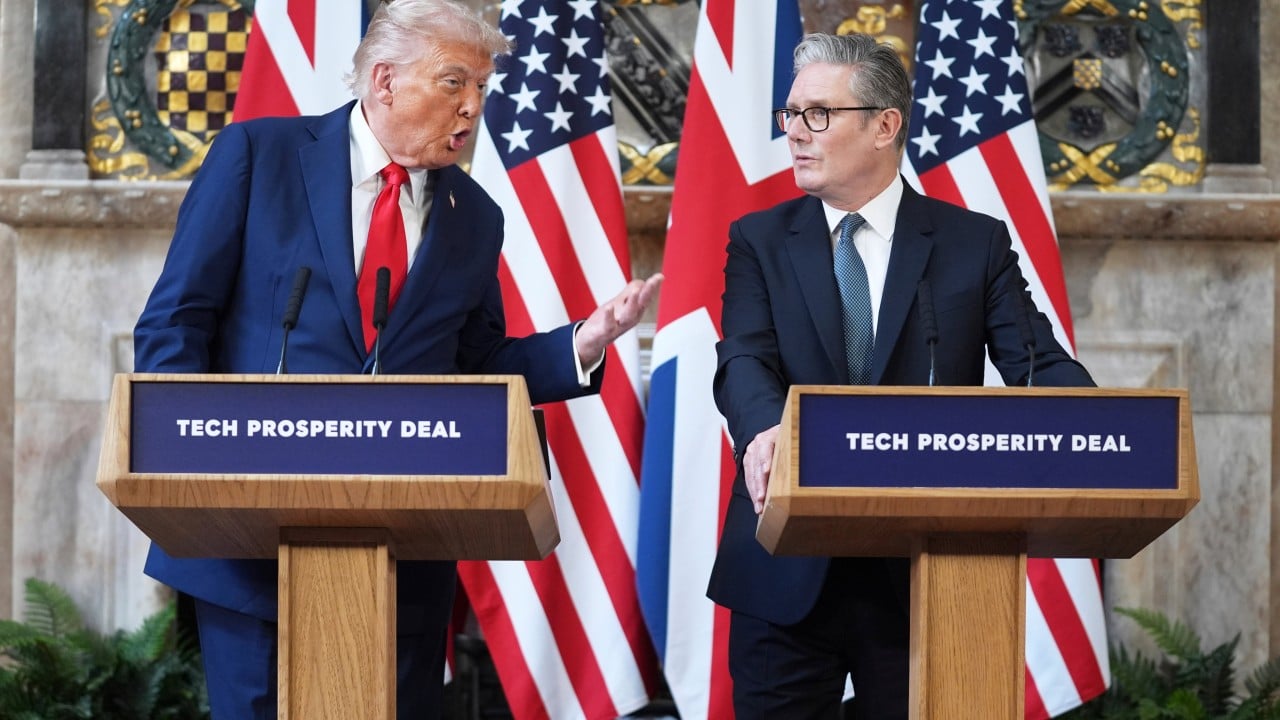
The mainstream media is choking on its own narrative again.
Keir Starmer resigns, Donald Trump fires off a characteristically blunt critique from across the pond, and the pundit class immediately retreats to its favorite, comfortable script. They call it a "clash of ideologies." They wring their hands over the "fracturing of the special relationship." They treat a predictable geopolitical sneeze like it’s the black plague.
It is pure, unadulterated theater. And everyone is buying tickets.
The lazy consensus dominating the airwaves right now suggests that Trump’s remarks are a shocking breach of diplomatic protocol that will fundamentally destabilize US-UK relations. This perspective is not just wrong; it completely misunderstands how modern global power actually operates.
The truth is far more cynical, far more transactional, and entirely detached from the melodramatic headlines.
The Myth of the Special Relationship
Let’s dismantle the biggest lie first: the idea that the US and the UK share a sacred, fragile bond that can be shattered by a few late-night truths or calculated political jabs.
I have spent nearly two decades watching transatlantic policy roll off the assembly line. I have sat in the rooms where bilateral trade agreements are picked apart by lawyers who do not care about "shared history" or "common values." They care about leverage. They care about supply chains. They care about who owns the intellectual property.
The "Special Relationship" has been a ghost in the machine since Suez. It is a rhetorical blanket used by British prime ministers to feel important on the world stage and by American presidents when they need a coalition partner to legitimize a military deployment.
When Trump criticizes a departing British prime minister, he isn't breaking a sacred pact. He is acknowledging reality.
The UK is no longer an indispensable global superpower; it is a mid-tier economy trying to find its footing in a post-Brexit landscape while battling stagnant productivity and a permanent fiscal crisis. Trump’s critique isn't an emotional outburst. It is a brutal, cold-eyed market correction of Britain's perceived geopolitical value.
Starmer’s Exit Was Failure by Design
The mainstream post-mortem on Starmer’s resignation frames him as a tragic technocrat sunk by unforeseen economic headwinds and internal party factionalism.
Nonsense. Starmer’s project was structurally doomed from day one because it relied on the fatal assumption that managerial competence could substitute for a coherent national vision.
Imagine a scenario where a CEO takes over a failing heritage brand, fires the radical marketing team, promises to "stabilize the balance sheet," but refuses to launch any new products. The stock price might flatten for a quarter or two out of sheer relief. But eventually, the lack of growth kills you.
That was Starmerism. It was political austerity wrapped in a sharp suit.
He inherited a country with crumbling infrastructure, an overstretched National Health Service, and an acute productivity puzzle. His solution was to promise "growth" through sheer administrative discipline.
You cannot manage your way out of a structural collapse. When Trump points out that Starmer failed to deliver, he isn't wrong. He is merely stating what British voters realized months ago: you cannot run a G7 nation like a mid-tier law firm.
The Counter-Intuitive Truth: Friction is the New Alignment
The chattering classes are terrified of the friction between Washington and London. They think diplomacy should look like a smooth, choreographed minuet.
They are living in 1997.
In the current geopolitical era, friction is not a sign of failure; it is the currency of domestic political survival. Trump’s attacks on foreign leaders are rarely meant for the foreign leaders themselves. They are highly calculated signals sent directly to his domestic base, designed to contrast his "America First" nationalism with what he frames as weak, globalist mismanagement abroad.
Conversely, British leaders benefit domestically from standing up to perceived American bullying. It is a symbiotic ecosystem of manufactured outrage.
- The Shock: A US leader breaks protocol.
- The Reaction: The British press corps experiences collective vertigo.
- The Result: Both leaders solidify their respective bases without shifting a single real-world policy metric.
While the media focuses on the verbal fireworks, the actual machinery of statecraft continues completely uninterrupted. Intelligence sharing via the Five Eyes network does not stop because of a social media post. GCHQ and the NSA do not tear up their data-sharing agreements over a press conference. The military-industrial complex that binds the US and the UK remains entirely intact.
The Flawed Premise of "Diplomatic Etiquette"
People frequently ask: "How can Western alliances survive if leaders don't respect basic diplomatic norms?"
The premise of the question is entirely flawed. It assumes that international alliances are built on politeness. They aren't. They are built on hard power, geographic necessity, and shared capital.
The post-war consensus created a veneer of politeness to make raw imperial and economic dominance look like a gentleman’s club. What we are seeing now is not the collapse of alliances, but the stripping away of the polite vocabulary. It is vulgar, yes. It is loud. But it is also a much more honest representation of international relations.
If the UK wants to be taken seriously by any US administration—whether led by Trump or anyone else—it needs to stop crying about a lack of respect and start building genuine economic leverage.
The High Cost of the New Realism
There is a distinct downside to this shift, and it is one that contrarians often ignore to their own detriment.
When you abandon the theater of diplomatic politeness, you lose the ability to bluff. The UK used to punch above its weight class precisely because everyone agreed to pretend the country was still a global heavyweight.
Now that the curtain has been pulled back, the vulnerability is total. If the US decides to implement sweeping tariffs, London no longer has the diplomatic capital to ask for a quiet exemption in the name of the "special relationship." You live by the transaction, you die by the transaction.
Stop Looking for Continuity
The era of predictable, institutionalized Western solidarity is over. It is not coming back, no matter who moves into 10 Downing Street next.
The Western alliance is no longer a monolithic bloc; it is a shifting collection of ad-hoc coalitions driven by immediate self-interest. Trump’s broadside against Starmer is simply the opening salvo of a world where every nation is an island, every agreement has an expiration date, and politeness is discarded the moment it stops yielding a profit.
Stop waiting for a return to normalcy. This is normalcy.