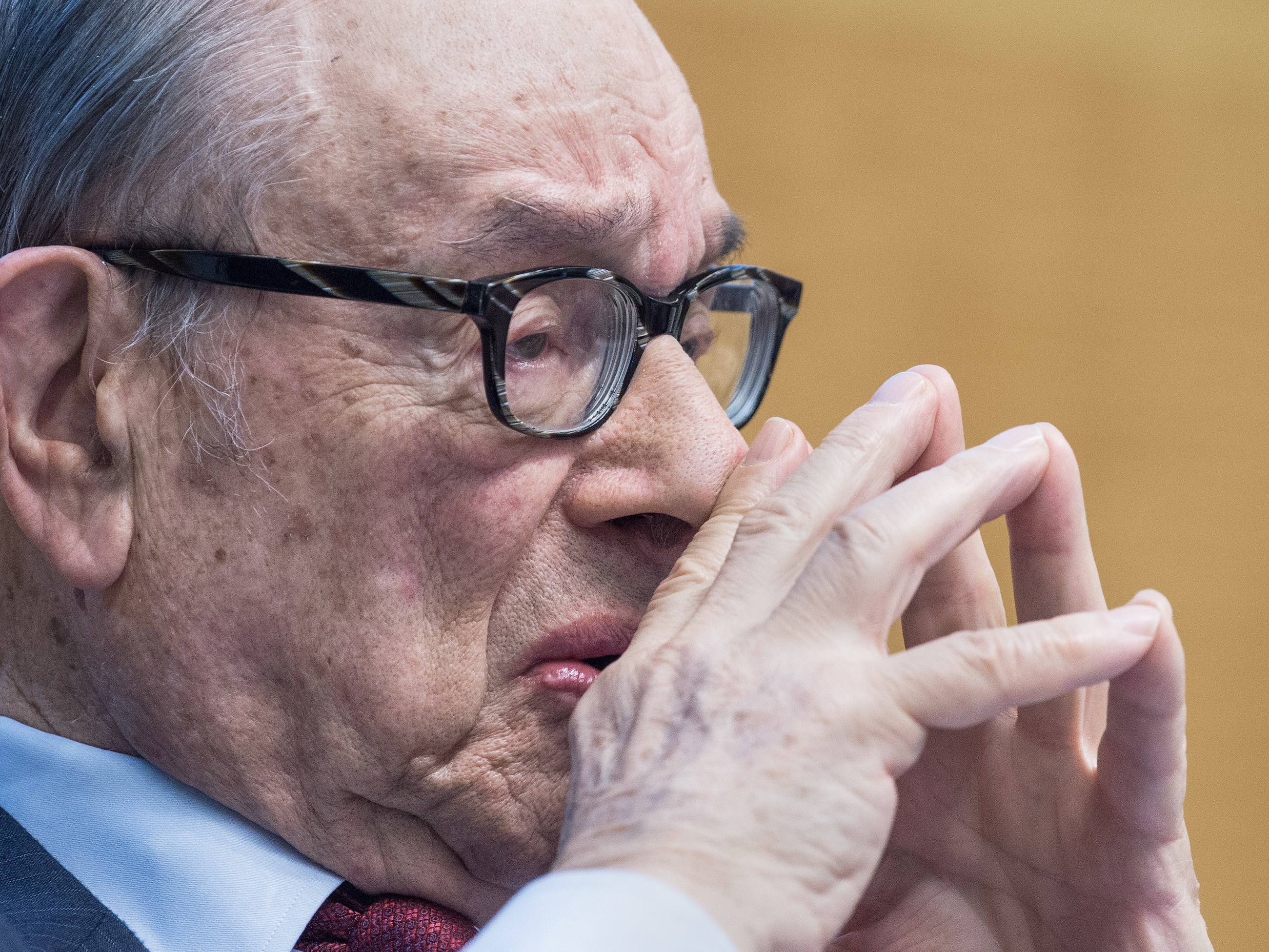
Alan Greenspan, the long-serving Federal Reserve chairman who sat at the controls of the American economy for nearly two decades, has died at the age of 100. His wife, Andrea Mitchell, confirmed that he passed away from complications of Parkinson's disease. To the public that watched him navigate the 1987 crash, the dot-com boom, and the early 2000s, he was the ultimate financial wizard. They called him the Maestro. Yet, behind the curtain of late-twentieth-century economic growth lies a more complicated reality that Wall Street prefers to ignore. The systems he built to protect the market ultimately left it uniquely vulnerable.
The Mirage of the Great Moderation
Greenspan took the helm of the central bank in 1987. Within days, the stock market plummeted on Black Monday. His response was immediate and definitive. He flooded the financial system with liquidity, creating an unwritten rule that would govern markets for a generation. Wall Street learned that whenever asset prices fell too far, the central bank would lower rates to save them. Traders began calling this the Greenspan put. It transformed speculation from a high-stakes gamble into a protected activity. You might also find this connected coverage interesting: The Real Reason Blue Collar Labor Costs a Fortune Abroad.
This period became known as the Great Moderation. Inflation remained quiet, unemployment stayed low, and corporate profits grew steadily year after year. It looked like an economic miracle, but it was built on cheap credit. By keeping interest rates exceptionally low after the tech bubble burst, Greenspan encouraged commercial banks to search for higher yields in increasingly risky places.
The money poured into real estate. Mortgages were repackaged, sliced into complex derivatives, and sold worldwide as safe investments. Greenspan consistently rejected calls to regulate these new instruments, arguing that Wall Street executives were best suited to manage their own risks. He believed that self-interest would prevent major institutions from committing suicide. He was wrong. As extensively documented in detailed coverage by CNBC, the effects are significant.
The Flaw in the Philosophy
In October 2008, two years after stepping down, Greenspan stood before a congressional committee. The financial system was collapsing around him. In a rare moment of public vulnerability, he admitted he had found a flaw in his free-market ideology. His belief that banks would protect their own shareholders had collapsed under the weight of subprime defaults.
That admission came too late for millions of Americans who lost their homes and savings. The deregulation he championed stripped away structural firewalls established after the Great Depression. He viewed regulations as sand in the gears of capital efficiency, rather than brakes on a vehicle traveling at high speed.
His defenders argue that he cannot be blamed for a crisis that erupted long after he left office. They point out that his successors chose how to handle the fallout. This defense misses the point entirely. The subprime boom required years of cheap money to grow to a size capable of threatening global stability. Greenspan provided that fuel.
The Legacy of Political Central Banking
Before Greenspan, Federal Reserve chairs generally avoided the spotlight. They were technocrats who spoke in dry, mathematical terms. Greenspan changed the job into a celebrity position. He mastered a style of speaking that lawmakers called Fed-speak, a deliberately confusing mix of double negatives and economic jargon designed to say nothing clearly.
Greenspan Era Policy Loop:
Low Interest Rates -> Asset Bubble Forms -> Fed Declines to Intervene -> Bubble Bursts -> Rate Cuts to Rescue Market -> Next Bubble Forms
This obscurity masked a deep political instinct. He cultivated close relationships with leaders across the political spectrum, serving under four different presidents from Ronald Reagan to George W. Bush. By making the Fed a central player in political debates over deficits and tax cuts, he tied the central bank to the fortunes of Washington.
The consequences of this shift are visible today. The independent nature of monetary policy has eroded as politicians routinely demand lower interest rates to boost their electoral chances. The expectation that the central bank must constantly support asset markets has distorted the true value of risk.
His passing marks the end of an era that promised permanent stability but delivered systemic fragility. The tools he popularized remain the default settings for central banking, leaving modern policymakers to solve every crisis with the same liquidity injections that created the imbalances in the first place.