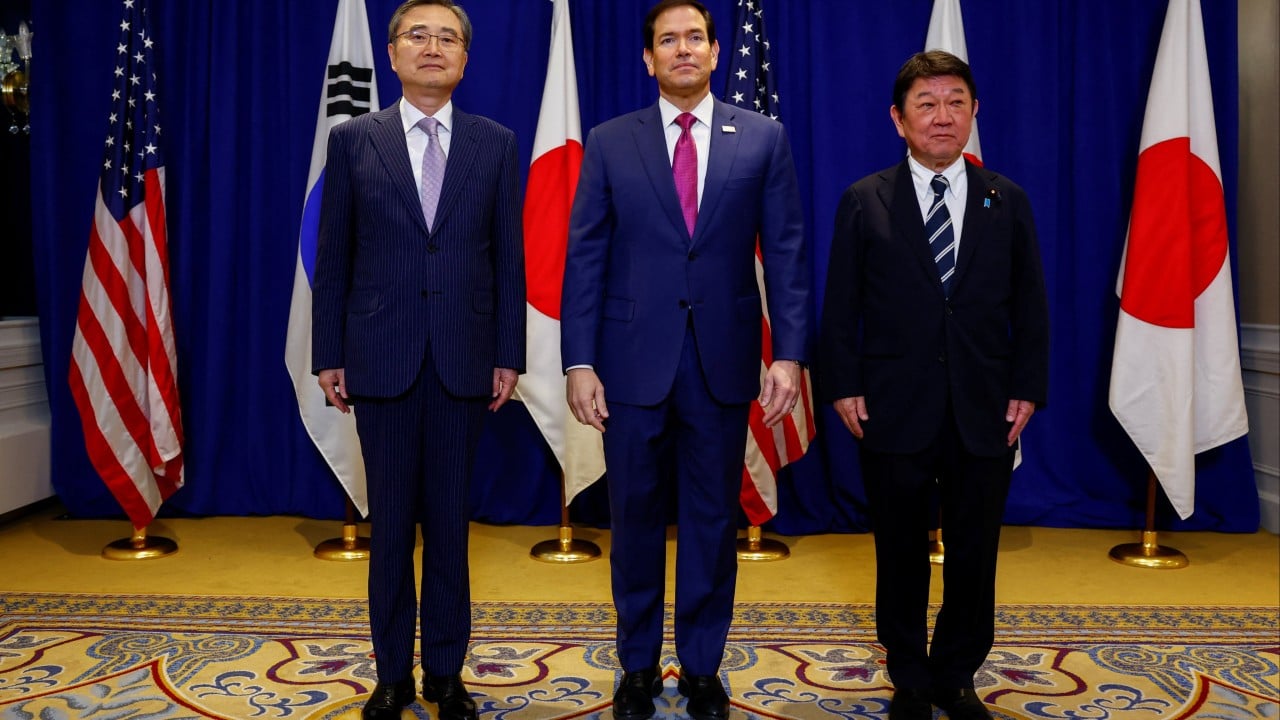
The diplomatic choreography is rarely subtle in statecraft. When Washington, Tokyo, and Seoul convene their highest-ranking trade and security officials ahead of a major summit with Beijing, the timing carries an unmistakable weight. This trilateral alignment is not merely a routine diplomatic check-in. It represents a calculated structural hardening of supply chains, advanced technology export controls, and strategic deterrence designed to check China's economic dominance in the Indo-Pacific.
For decades, multilateral pacts in Asia stumbled over historical grievances, particularly the deep-seated diplomatic friction between Seoul and Tokyo. Beijing frequently exploited these regional fractures, deploying economic coercion—ranging from unofficial boycotts to sudden import restrictions—against individual neighbors while avoiding unified pushback. The ongoing trilateral economic security talks signal a sharp departure from that vulnerability. By institutionalizing coordination on critical minerals, semiconductor manufacturing, and supply chain resilience, the three capitals are attempting to build an economic NATO capable of absorbing and deflecting geopolitical shocks.
The immediate catalyst remains clear. As leaders prepare for high-stakes diplomatic engagement with Beijing, aligning negotiating positions ensures that Beijing cannot play one democratic ally against another. Yet the broader reality is far more permanent. The era of frictionless globalization, where corporate efficiency superseded geopolitical risk, has expired. Multinational firms operating in Asia now face a fractured regulatory environment where national security dictates market access.
The Semiconductor Chokepoint and Critical Mineral Vulnerabilities
At the heart of the trilateral strategy lies the absolute protection of advanced semiconductor supply chains. Modern microelectronics form the nervous system of both commercial enterprise and military capability. For years, the West and its Asian allies outsourced the heavy lifting of raw material processing and manufacturing concentration to regions vulnerable to geopolitical disruption.
Tokyo and Seoul anchor vital nodes of this architecture. Japan commands the manufacturing equipment and chemical precursors without which advanced chips cannot be etched. South Korea dominates memory chip production. Meanwhile, Washington supplies the foundational software and design intellectual property. When combined, these three nations hold an effective monopoly over the upper tiers of the technology ladder.
Securing this advantage requires aggressive defensive measures. Export controls on extreme ultraviolet lithography machines and artificial intelligence processors are only the opening salvo. The trilateral talks focus intensely on plugging enforcement loopholes, preventing transshipment through third-party nations, and joint investment in domestic fabrication alternatives.
Parallel to microelectronics sits the vulnerability of critical minerals. Rare earths, gallium, germanium, and graphite are indispensable for electric vehicles, renewable energy infrastructure, and defense guidance systems. Beijing's past deployment of export restrictions on these materials served as a wake-up call to industrial planners from Seoul to Washington.
The economic security talks are shifting from reactive crisis management to proactive stockpiling and joint financing of alternative extraction projects. Australia and other resource-rich partners are increasingly integrated into this network. However, building independent processing capacity takes years of capital expenditure and environmental navigation. Market forces alone cannot bridge the gap quickly enough, necessitating direct state intervention and industrial policy on a scale not seen since the Cold War.
The Corporate Dilemma in a Bipolar Market
Corporate executives in Seoul, Tokyo, and the United States find themselves trapped in a difficult structural contradiction. Their boardrooms demand continued access to the massive consumer market inside China, yet their home governments demand decoupling from vulnerable supply chains and adherence to strict security mandates.
This tension is particularly acute for South Korean semiconductor giants and Japanese industrial conglomerates. For decades, their profitability depended on deep integration with Chinese manufacturing hubs. Walking away from those investments is financially prohibitive. Consequently, firms are executing a strategy of bifurcated operations, often referred to as "China plus one" or complete structural compartmentalization.
Research and development, along with the production of sensitive cutting-edge components, are pulled back to secure domestic jurisdictions or allied nations like Vietnam and India. Meanwhile, legacy production lines inside China are maintained strictly to serve the local domestic market. This division minimizes exposure to sudden regulatory crackdowns or expropriation risks, but it introduces massive structural inefficiencies and drives up operational costs.
Governments in Washington, Tokyo, and Seoul are quietly acknowledging these corporate realities while tightening the screws. Financial subsidies and tax credits, such as those embedded in major industrial legislative packages, provide the necessary financial cushion to offset the immense costs of supply chain relocation. Yet subsidies alone will not resolve the underlying market divergence.
The Limits of Multilateral Deterrence
Despite the diplomatic triumph of presenting a united front, significant structural vulnerabilities remain within the trilateral security architecture. Domestic political cycles in all three nations introduce persistent volatility. A shift in executive leadership in Washington or Seoul can abruptly alter the intensity and enforcement of trade policies, leaving international partners questioning the long-term durability of current commitments.
Furthermore, economic interdependence cannot be wished away by executive decree. The sheer volume of bilateral trade between China and its neighbors creates a gravitational pull that institutional frameworks struggle to resist. If economic growth slows significantly across the region, domestic pressures within South Korea and Japan to ease trade restrictions for short-term commercial relief will intensify.
Beijing is watching these developments closely, utilizing its own economic leverage and diplomatic channels to fracture the nascent coalition. The ultimate test of the trilateral economic security framework will not occur in the press conferences preceding a summit, but in how resilient the alliance proves when one member bears the brunt of retaliatory economic measures.
The architecture is built, the parameters are drawn, and the global economy has permanently crossed the threshold into a fragmented reality where national security dictates the terms of trade.