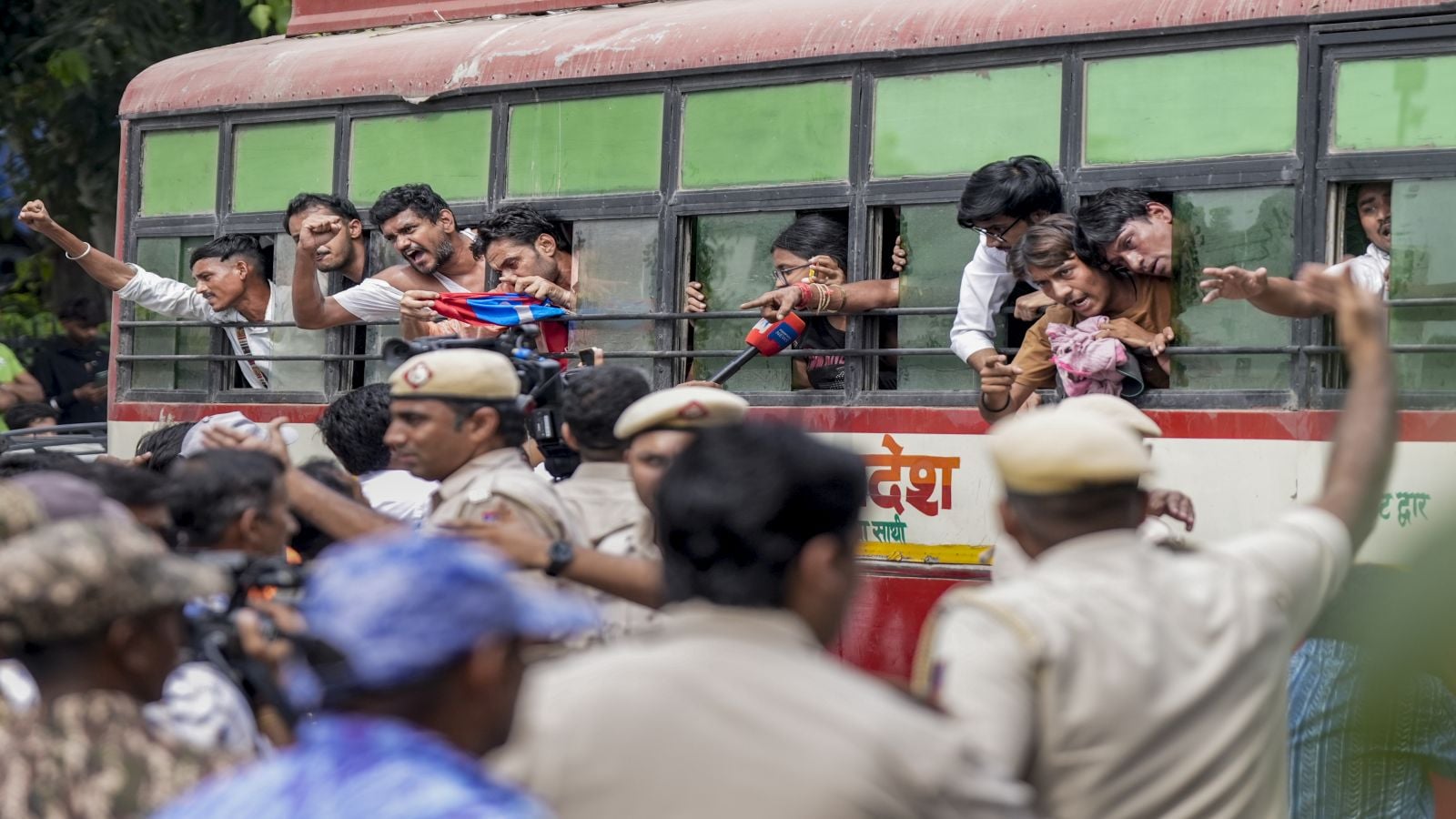
When a United States student organization issues a formal statement supporting street protests in New Delhi over voter roll revisions, the event is rarely an isolated gesture of solidarity. It represents the activation of a transnational advocacy network (TAN)—a mechanism through which domestic political disputes are externalized to international actors to generate reputational pressure on a sovereign state. Understanding the mechanics of this intervention requires separating the administrative realities of electoral roll maintenance from the strategic incentives of cross-border political mobilization.
The Architecture of Electoral Roll Revisions
In any large-scale representative democracy, maintaining an accurate electoral roll is a continuous administrative optimization problem defined by two competing failure modes: Type I errors (false exclusions) and Type II errors (false inclusions).
- Type I Errors (Disenfranchisement Risk): Occur when eligible citizens are omitted or deleted from the voter registry due to administrative oversight, migration, documentation gaps, or aggressive purging protocols.
- Type II Errors (Integrity Risk): Occur when deceased individuals, non-citizens, or duplicate entries remain on the active roll, creating vulnerabilities for impersonation or artificial inflation of turnout metrics.
In India, the Election Commission of India (ECI) manages the world’s largest electorate through a standardized statutory process governed by the Representation of the People Act, 1950, and the Registration of Electors Rules, 1960. The annual Special Summary Revision (SSR) operates on a predictable operational cycle:
- House-to-House Verification: Booth Level Officers (BLOs) conduct field audits to identify demographic shifts, deaths, and new voters reaching the qualifying age of 18.
- Draft Roll Publication: The ECI publishes a preliminary list, opening a statutory window for claims (Form 6 for inclusion) and objections (Form 7 for deletion).
- Quasi-Judicial Adjudication: Electoral Registration Officers (EROs) evaluate applications and hold hearings before issuing deletions. No name can legally be struck from the roll without prior notice and an opportunity to be heard, except in verified cases of death or duplicate registration.
- Final Roll Publication: The consolidated registry is released to recognized political parties, who deploy Booth Level Agents (BLAs) to cross-verify the data.
Friction emerges during the execution phase. At a scale exceeding 900 million voters, even a 0.1% administrative error rate translates to nearly one million affected individuals. When deletions cluster disproportionately within specific socioeconomic, religious, or migrant demographics—whether due to systemic bureaucratic bias, lack of permanent housing documentation, or targeted bulk objections filed by rival political operatives—domestic civil society and opposition groups interpret Type I errors not as administrative noise, but as deliberate disenfranchisement.
The Externalization Strategy of Domestic Protests
Domestic protests in New Delhi face an immediate structural bottleneck: domestic institutional insulation. When state institutions possess high centralized authority and strong legislative majorities, localized street demonstrations often fail to alter administrative execution on their own. To overcome this, domestic actors frequently employ the Boomerang Pattern, a model formalized in international relations theory by Margaret Keck and Kathryn Sikkink.
The Boomerang Pattern functions through four distinct stages:
- Domestic Blockage: Domestic groups identify a grievance (alleged voter roll manipulation) and find domestic avenues of redress (administrative appeals, judicial injunctions, street protests) slow or unresponsive.
- Information Transfer: Domestic activists package localized grievances into universalized normative frames—shifting the narrative from "procedural flaws in ECI Form 7 adjudication" to "systemic erosion of democratic franchise."
- External Amplification: Foreign actors—such as US student organizations, diaspora advocacy groups, or foreign legislative caucuses—adopt the narrative. These actors operate outside the jurisdiction of the target state, insulating them from domestic regulatory or political pushback.
- Reputational Rebound: The external actor’s endorsement is re-imported into the domestic media ecosystem. A statement from a US campus coalition is framed domestically as "international scrutiny," raising the reputational cost for the governing administration on the global stage.
Incentives Driving US Student Coalition Involvement
The participation of US-based student groups in Indian domestic electoral disputes is governed by specific organizational incentives rather than direct electoral stakes. These groups operate within an academic and activist ecosystem characterized by low barriers to entry and high reputational rewards for cross-border solidarity.
- Low Cost of Signaling: Drafting a statement of solidarity or hosting a campus teach-in requires minimal capital expenditure while generating immediate visibility within activist networks.
- Intersectionality Framing: US campus politics heavily rewards the linking of localized global issues to broader domestic frameworks of civil rights, minority protection, and anti-authoritarianism. Framing India’s voter roll revision alongside US debates over voter ID laws and gerrymandering makes the issue immediately legible to an American audience.
- Diaspora Network Mobilization: Second-generation South Asian student cohorts often serve as the connective tissue between Indian civil society organizations and Western academic institutions. They possess the linguistic and cultural fluency to translate complex Indian bureaucratic procedures into digestible advocacy campaigns.
The Information Asymmetry Problem
A critical vulnerability in transnational advocacy is information asymmetry. External student groups rarely possess the primary operational data required to audit the ECI’s backend database. They do not have access to booth-level Form 7 objection logs, ERO hearing transcripts, or granular demographic cross-tabulations of deletions versus additions.
Instead, external actors rely on curated secondary reporting from aligned domestic civil society groups or opposition-leaning media. This creates a structural distortion:
- Selection Bias: Extreme cases of wrongful deletion (e.g., an entire neighborhood omitted due to a mapping error) are elevated as representative of the entire national registry.
- Procedural Omission: The distinction between a draft roll (which is explicitly designed to be flawed and corrected through public claims) and a final roll is frequently collapsed in external communications.
- Intent Attribution: Administrative incompetence—such as poorly trained BLOs using outdated census maps—is systematically reclassified as malicious state intent.
Counter-Mobilization and Sovereignty Framing
When foreign student groups intervene in domestic electoral administration, they inadvertently provide the target government with a potent counter-narrative: foreign interference in sovereign democratic processes.
In Indian political discourse, electoral administration is guarded as a core pillar of post-colonial sovereignty. The ECI enjoys high baseline institutional trust compared to many other state organs. When external actors critique the voter roll revision, domestic authorities and aligned media execute a three-step neutralization strategy:
- Jurisdictional Delegitimization: Dismissing the foreign group as lacking legal standing, operational familiarity with Indian electoral law, or democratic accountability to Indian voters.
- Motivated Reasoning Attribution: Linking the US student group to broader geopolitical or ideological agendas aimed at destabilizing India’s global standing.
- Diversion from Granular Audits: Shifting the public debate away from specific, verifiable administrative errors in Delhi’s constituencies toward a macro-level defense of national sovereignty.
This counter-mobilization frequently backfires on the domestic protesters. By aligning with foreign student groups, local activists risk alienating undecided domestic voters who may share concerns about bureaucratic inefficiency but reject external policing of Indian institutions.
Evaluating the Strategic Efficacy of Cross-Border Endorsements
To determine whether US student backing advances the objective of electoral roll accuracy, the intervention must be measured against tangible administrative outcomes rather than media impressions.
- Impact on ECI Execution: Near zero. The ECI responds to Supreme Court directives, formal representations from recognized national political parties, and statutory audit triggers—not non-binding statements from foreign university organizations.
- Impact on Domestic Legal Remedies: Negligible. Indian courts require localized, verifiable evidence of statutory non-compliance (such as violation of Rule 21A of the Registration of Electors Rules) to stay deletions or order re-verification.
- Impact on Narrative Polarization: High. The intervention sharpens ideological boundaries, hardening the positions of both protesters and state defenders while reducing the space for technical, non-partisan electoral reform.
The Optimal Protocol for Electoral Roll Accountability
For domestic stakeholders seeking to prevent wrongful deletions and ensure registry integrity during a Special Summary Revision, externalizing the dispute to foreign student networks is a low-yield diversion. Resources must instead be concentrated on the technical choke points of the ECI’s statutory workflow.
- Deploy Booth-Level Data Audits: Political parties and civil society groups must stop relying on anecdotal protest narratives and execute programmatic diffs comparing the previous year’s final roll against the current draft roll. Identifying anomalies at the polling-booth level provides undeniable empirical proof of Type I errors.
- Weaponize Statutory Forms: Instead of street demonstrations, mobilize paralegal teams to file bulk Form 6 applications (for re-inclusion) and formal objections to unwarranted Form 7 deletions within the ECI’s mandated window, forcing EROs to create a written, appealable legal record.
- Litigate on Procedural Violations: Challenge systemic omissions in High Courts using specific statistical clusters of wrongful deletions where EROs failed to issue mandatory individual notices prior to removal, compelling judicial oversight of the final roll publication.