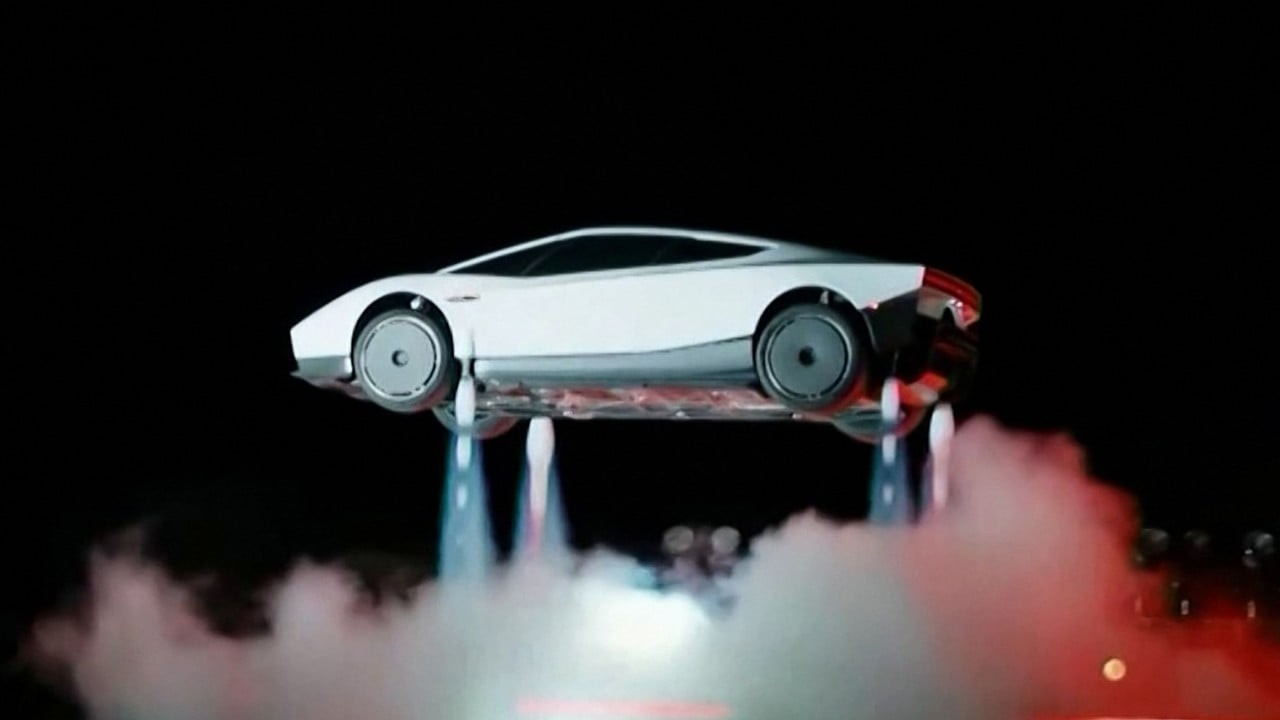
Headline coverage of Elon Musk's October 15, 2026 demonstration in McGregor, Texas treats a brief, thruster-assisted aerial maneuver as the arrival of a practical flying car. That framing conflates ballistic impulse and cold-gas attitude control with sustained, wing-borne or rotor-borne flight. A rigorous evaluation separates public-relations spectacle from mass-energy constraints, regulatory boundaries, and multi-year execution risk.
Deconstructing the Competitor Narrative
Standard media coverage of the October 2026 event relies on four recurring shortcuts that obscure how the vehicle actually behaves:
- Semantic inflation: Calling a short jump or mid-air flip a "flying car" stretches the term beyond winged or vertical-lift aircraft capable of sustained point-to-point transit.
- Treating demos as production specs: Quoted figures such as sub-second acceleration, high-pressure gas capacity, or a 2028 production start reflect event claims or targets rather than certified, customer-ready hardware.
- Ignoring propellant depletion: Coverage highlights dramatic thrust bursts while glossing over how fast a fixed reservoir of compressed gas empties under continuous load.
- Skipping homologation realities: Treating road performance and aerial capability as interchangeable ignores the separate legal regimes governing street vehicles and aircraft.
Treating a demonstration stunt as a finished product creates a predictable analytical error: readers overestimate near-term utility and underestimate engineering trade-offs. Separating known disclosures from open questions provides a cleaner baseline. Tesla presented three Roadster configurations—a two-seat road-focused Performance trim, a rear-thruster Thrust trim, and an invite-only, single-seat Rocket variant equipped for flight—while pointing to a 2028 production target. By contrast, independent verification of sustained flight endurance, final retail pricing across trims, and exact production volume remains incomplete.
The Physics of Cold-Gas Impulse and Downforce
Conventional automobiles generate cornering force through tire friction, which scales with normal load and lateral grip limits. Standard aerodynamic wings rely on forward airspeed to create pressure differentials, meaning they contribute minimal downforce at low speeds or standstill. Tesla's October 2026 presentation paired a suction system with a spaceflight-derived cold-gas thruster arrangement using high-pressure air storage and multiple nozzles.
In physics terms, cold-gas thrusters operate on conservation of momentum rather than high-temperature combustion. Mass ejected at high velocity produces a reaction force proportional to mass flow rate and exhaust velocity. That architecture brings two operational advantages:
- Speed-independent authority: Unlike passive wings, active suction and directional gas jets can apply force when vehicle speed is low or zero.
- Rapid response: Electric valve actuation allows fast thrust modulation for pitch, yaw, and roll control during short airborne intervals.
The same physics imposes a hard ceiling on endurance. Cold-gas systems have lower specific impulse than chemical rocket propellants, and carrying high-pressure tanks adds dead mass that penalizes braking, tire wear, and baseline battery range. Once stored gas pressure drops, aerial authority disappears until the system is recharged or refilled. A vehicle that can hop a ramp or rotate mid-air is exercising impulse and attitude control over seconds, not cruising across a metropolitan region like an airplane or helicopter.
The Four Constraints Governing Execution
Turning a high-theater prototype into a credible 2028 program requires clearing four coupled constraints.
Mass and Packaging Trade-Offs
Every kilogram added for pressure vessels, valves, structural reinforcement, and by-wire controls must be carried by the chassis and suspension. Packaging high-pressure tanks and ten nozzles inside a compact sports car footprint forces compromises in cabin space, serviceability, and center-of-gravity management. That tension explains why the flight-capable Rocket configuration is framed as a single-seat, invite-only variant rather than a roomy grand tourer.
Energy and Replenishment Limits
An electric drivetrain draws from a high-energy battery pack, whereas a compressed-gas subsystem is bounded by tank volume, working pressure, and recharge time. Even if an onboard compressor can replenish air reserves over time, continuous high-thrust maneuvers demand rapid mass flow that quickly drains stored inventory. In practical terms, thruster bursts are reserve capability for specific maneuvers rather than continuous propulsion.
Regulatory Bifurcation
Public roads and navigable airspace are governed by distinct safety standards, crashworthiness rules, noise limits, and operator licensing regimes. Even when a vehicle is engineered for road driving in standard trims, a flight-equipped variant faces scrutiny over aerial stability, ground-effect debris, and public-space operations—which is why Tesla itself indicates the flying configuration is not approved for public roads.
Schedule Credibility After a Long Runway
The second-generation Roadster has carried a long history of shifting timelines since its initial 2017 reveal, making any future production date a milestone to test rather than a settled fact. Even when a company leadership team signals technical ambition and acknowledges execution risk, moving from a controlled demonstration to repeatable manufacturing and customer deliveries requires locking down supplier tooling, validation testing, and assembly workflows.
Competitive Positioning in Hybrid Ground-Air Mobility
Tesla's entry intersects with dedicated electric vertical takeoff and landing (eVTOL) and roadable-aircraft developers such as Alef Aeronautics, yet the underlying architectures target different problems. Aerodynamic and multi-rotor designs prioritize lift efficiency and airborne endurance, whereas a thruster-equipped sports car prioritizes ground dynamics with brief airborne impulse.
| Dimension | Thruster-Equipped Roadster Concept | Dedicated Lift or Roadable Aircraft |
|---|---|---|
| Primary operating domain | Ground performance with brief air bursts | Airborne lift and transit |
| Lift / thrust mechanism | Electric drive plus cold-gas nozzles and suction | Rotors, propellers, or wings |
| Endurance profile | Short impulse bursts limited by stored gas | Longer airborne segments governed by energy/fuel |
| Regulatory path | Road rules vs. non-road / restricted flight rules | Aviation airworthiness and airspace rules |
This comparison highlights why rivals and observers watch different proof points. A competitor focused on vertical lift faces hard problems around transition flight and airworthiness certification. A thruster-equipped car faces a different test: proving repeatable, safe controllability and durable hardware without turning a niche halo project into a distraction from core volume manufacturing.
Strategic Recommendation for Decision-Makers
Investors, fleet planners, and technology analysts should treat the October 2026 Roadster demonstration as a brand and engineering signaling event rather than a near-term mass-transit breakthrough. Track three concrete falsifiable milestones ahead of 2028: independent verification of sustained or repeatable flight profiles beyond ramp-assisted stunts, finalized production specifications and pricing across trims, and clear regulatory boundaries governing where the Rocket variant can legally operate. Allocate capital and strategic attention to scalable electrification, autonomy, and certified aviation platforms until those three gates are cleared.