The waiting room of a provincial hospital knee trauma clinic is not where you go to find poetry. It smells of institutional floor wax and anxiety. The lighting is unforgiving, casting a sickly greenish hue over rows of plastic chairs occupied by people waiting to be told that their joints, much like their youthful ambitions, are slowly grinding to a halt. It is a purgatory of bad posture and ice packs.
But if you watch closely, it is also a theater of profound vulnerability.
Imagine two people sitting three chairs apart, ignoring the outdated lifestyle magazines on the table. One is Clive. He is sixty years old, a recently retired schoolteacher whose house has felt entirely too large and entirely too quiet since his wife passed away. The other is Shelley Anne, fifty-five, an environmental health officer whose life has devolved into a grueling war of attrition called a bitter divorce. They have nothing in common except a profound sense of isolation and a joint that refuses to cooperate. When Clive tries to stand up, his right knee lets out an audible, agonizing pop. Shelley Anne, possessing a left leg that functions more like a rusted hinge, looks up. Their eyes meet.
They do not fall in love. That would be too easy. Instead, they do something far scarcer in the middle stretches of adulthood: they strike up a friendship.
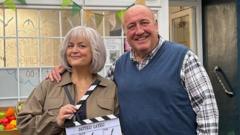
This isn’t a real waiting room, not technically. It is the fictional engine behind Better Later, a new six-part BBC comedy series that has quietly begun filming against the sweeping, rain-bruised backdrop of Bannau Brycheiniog, the Brecon Beacons. But while the characters of Clive and Shelley Anne are scripted fabrications, the hands tracing their lines belong to two people who know the exact weight of a thirty-five-year bond.
Ruth Jones and Steve Speirs are finally back in front of the lens together.
The trades reported the news with standard industry brevity. Production companies were listed. Executives were thanked. The locations—including the real-world streets of Llantwit Major and the fictional village of Brynfach—were cataloged. Yet, the real story of Better Later is found in the spaces between those cold facts. It is a narrative about the slow, agonizing, beautiful process of artistic fermentation.
The Physics of Living
To understand why this production matters, you have to look at the mechanics of television comedy. Most modern sitcoms are engineered in writers' rooms by twenty-something graduates pulling apart cultural tropes like mechanics dismantling an engine. They are sharp, cynical, and fast.
Better Later is none of those things. It is heavy with the weight of lived experience.
Jones and Speirs first crossed paths thirty-five years ago. They were young, ambitious, and utterly unaware of the trajectories their careers would take. Jones would eventually shape the British comedic consciousness as Nessa in Gavin & Stacey, capturing the precise, melodic absurdity of working-class South Wales. Speirs would carve out a reputation as one of the industry's most reliable character actors before creating The Tuckers, an affectionate, sharp-tongued portrait of a Valleys family.
They wrote and starred together in Stella, which anchored Sky’s comedy slate for five seasons, but their partnership wasn’t born from an agent’s pitch meeting. It was forged over decades of shared meals, missed trains, and the distinct, quiet griefs that accumulate as you cross into your fifties and sixties.
Consider what happens next when two performers share that much history. When they filmed a pair of travelogue documentaries recently—wandering through Merthyr Tydfil and Porthcawl—they weren't reading from a teleprompter. They were hobbling. Literally. Jones was nursing a treacherous right knee; Speirs was struggling with his left.
As they walked through the damp Welsh air, complaining about their joints and laughing at the absurdity of their own decay, the seed for Better Later was planted. During an intimate audience Q&A at the Hi-tide Café in Porthcawl, Speirs recalled people asking if those travel shows were scripted or rehearsed. His response was immediate: "We’ve been rehearsing for thirty-four years."
The Architecture of Midlife Grief
There is an unspoken rule in commercial television that stories about aging must either be patronizingly heartwarming or relentlessly bleak. We are accustomed to seeing older characters portrayed as tech-addled grandparents or tragic statistics.
Better Later rejects both archetypes by leaning into the specific, jagged edges of midlife transition.
Shelley Anne isn't a saintly victim; as written by Jones, she is an angry, bitter woman dealing with severe obsessive-compulsive tendencies while her marriage dissolves in legal ink. Clive isn't a tragic figure; he is a gentle, quiet man trying to remember how to breathe in a house where the closets still hold his late wife’s coats.
The comedy here doesn't come from wacky misunderstandings or punchline-heavy setups. It emerges from the friction of two broken systems trying to align. It is the humor of survival.
There is a distinct bravery in choosing a knee clinic as the crucible for this story. The knee is the joint that bears our weight. It is what allows us to stand tall, to move forward, to pivot. When it fails, the metaphor writes itself. Your world shrinks. You become hyper-aware of every staircase, every curb, every distance. For Clive and Shelley Anne, the physical limitation reflects their emotional paralysis. They are stuck in the mud of their own histories.
But the real magic of this production lies in the live-wire chemistry of its creators. On set in the Brecon Beacons, outside a dressed-up village shop, the crew has to contend with a recurring problem: Steve Speirs cannot stop giggling.
"Ruth makes me laugh more than anyone," Speirs admitted between takes, a seasoned actor reduced to a schoolboy by a well-timed glance from his oldest friend. "This could be a long shoot."
That laughter isn't just a workplace distraction; it is the currency of their collaboration. You cannot manufacture the timing that exists between two people who have witnessed each other’s entire adult lives. It is a rhythm built on decades of shared references, mutual respect, and an intimate knowledge of what makes the other person tick.
The Quiet Resonance of Brynfach
When the series eventually broadcasts across BBC One and iPlayer, viewers will see the mist rising off the Welsh hillsides. They will see the stone cottages of Brynfach and the familiar, comforting textures of South Wales life.
They will laugh at Shelley Anne’s sharp-edged defensiveness and feel a tightening in their chests when Clive looks out at the empty valleys.
But beneath the narrative arc of these six half-hour episodes lies a deeper truth about human connection. Better Later is an assertion that the most important chapters of our lives do not always begin in our twenties when our bodies are flawless and our paths are clear. Sometimes, the most vital stories begin when we are limping, bruised, and convinced that the best parts of the journey are already behind us.
The cameras continue to roll in the valleys. The light is changing, shifting from the bright clarity of afternoon to the long, deep shadows of dusk. And there, in the middle of the frame, two old friends are standing together, waiting for the director to call action, still making each other laugh after thirty-five years.



