Mainstream climate coverage has a fatal addiction to simple binaries. Ice melts, sea levels rise, panic ensues. Then, a group of researchers publishes a study showing that ground ice in parts of the Qinghai-Tibet Plateau is actually getting thicker, and the science press loses its mind trying to frame it as a bizarre climate paradox.
They got the physics right and the story entirely wrong.
Thickening ground ice on the "Third Pole" is not a reprieve from global warming. It is not a quirk of nature balancing the scales. For anyone who actually understands geotechnical engineering, cryosphere hydrology, or high-altitude infrastructure, thickening permafrost ice is a structural death sentence waiting to detonate.
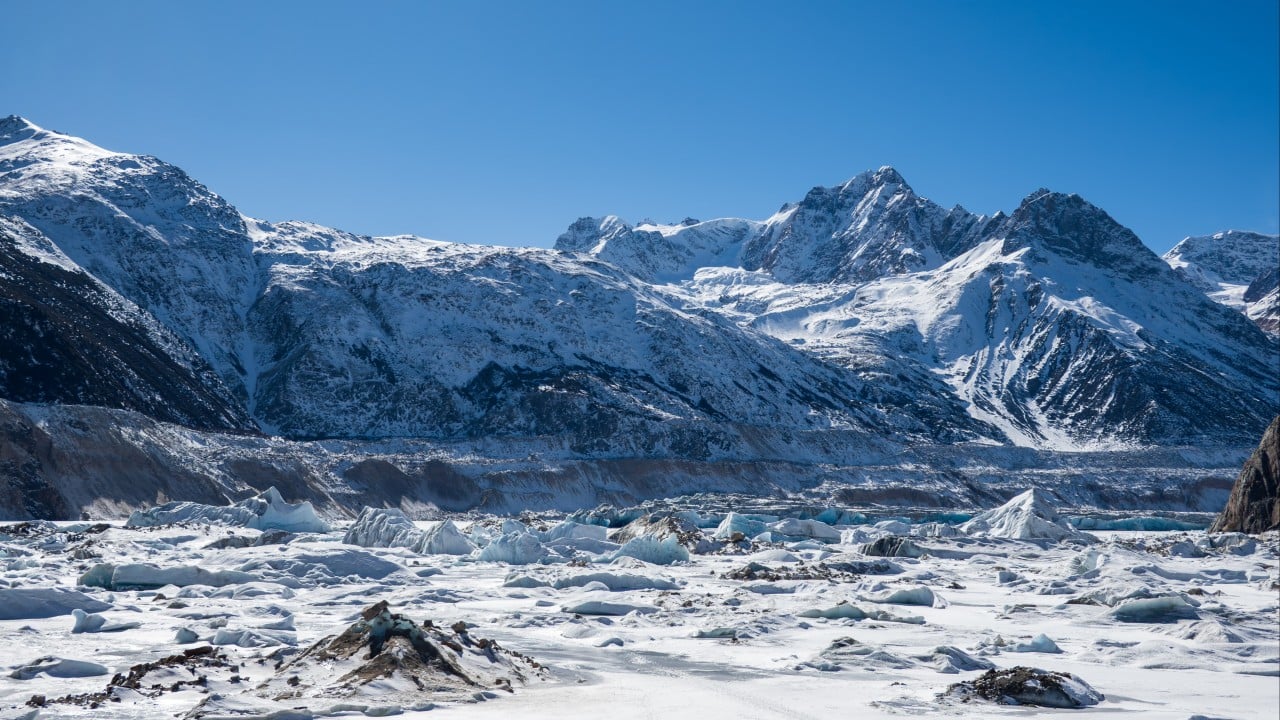
The lazy consensus in climate reporting treats ice as a single, monolithic entity. To a generalist reporter, frozen water equals stability, and liquid water equals disaster. That surface-level logic fails the moment you look beneath the topsoil of the Tibetan Plateau. When Chinese scientists from the Chinese Academy of Sciences recently documented localized increases in ground ice thickness across regions like the Hoh Xil and the Tanggula Mountains, the takeaway shouldn't have been "look at this weird exception to warming." The takeaway should have been a blaring siren for every highway, railway, and pipeline crossing high-altitude Asia.
The Physics of the Subsurface Time Bomb
To understand why growing ice is a catastrophe, you have to stop thinking about glaciers and start thinking about segregated ice and cryosuction.
Glaciers sit on top of the earth. Ground ice lives inside the soil pores, binding silt, clay, and gravel into a solid mass. Under normal, stable cold conditions, permafrost remains locked at a consistent depth. Above it sits the active layer—the top meter or two of soil that thaws every summer and refreezes every winter.
Here is what happens when the climate warms and regional precipitation increases, which is exactly what is occurring across the central Tibetan Plateau.
- Warmer summers deepen the active layer. Soil that hasn't thawed since the Pleistocene suddenly turns into saturated mud.
- Increased summer rainfall floods this newly thawed zone. Water percolates downward until it hits the top of the remaining permafrost table.
- Winter returns, triggering cryosuction. As the surface freezes from the top down, a thermodynamic pressure gradient pulls that excess liquid water upward and downward toward the freezing front.
- Ice lenses form and expand. Water expands by roughly 9% when it freezes, exerting crystallization pressures that can exceed 200 megapascals—more than enough force to heave a multi-ton concrete bridge pier straight out of the ground.
I have watched geotechnical teams spend tens of millions of dollars stabilizing high-latitude roadbeds, only to see their work torn apart within three seasons because they modeled for thermal thaw rather than frost heave. When engineers design for permafrost degradation, they usually build to prevent thaw settlement—the sinking that happens when ice turns to water and the ground collapses into a thermokarst sinkhole. Nobody budgets for the earth violently swelling upward before it inevitably collapses.
The Lazy Consensus Missed the Hydrology
The competitor coverage of this phenomenon leans heavily on the "paradox" angle: How can ice grow when temperatures are rising?
That question exposes a fundamental ignorance of high-altitude climatology. Warming does not just add heat to a system; it supercharges the hydrological cycle. A warmer atmosphere holds roughly 7% more moisture per degree Celsius of warming (the Clausius-Clapeyron relation). On the Tibetan Plateau, this atmospheric shift has driven a measurable wetting trend over the last three decades.
More rain in August means more water trapped in the soil in October. When the brutal Tibetan winter hits, that water has nowhere to go. It freezes at the base of the active layer, creating a thicker, ice-rich transition zone just above the older permafrost.
Scientists call this aggradational ice. To a journalist looking for a catchy headline, aggradational ice sounds like healing. To a civil engineer, aggradational ice is pure poison.
Why? Because ice-rich soil has zero shear strength once it crosses 0°C. Soil particles suspended in pure ice are not touching each other; they are floating in a frozen matrix. As long as that matrix stays below freezing, it behaves like concrete. The second a particularly brutal heatwave pushes the summer thaw depth six inches deeper than the previous year, that newly thickened ice lens turns into a frictionless liquid slurry.
Thickening ground ice doesn't stop permafrost collapse. It stores up potential energy to make the eventual collapse infinitely more violent.
Dismantling the "Climate Skeptic" Hijack
Whenever a paper drops with words like "thickening ice" in the abstract, two predictable things happen within 48 hours. First, mainstream outlets publish breathless, confused articles treating it like a scientific magic trick. Second, bad-faith commentators hijack the headline to claim global warming has stalled on the roof of the world.
Both sides are looking at a thermometer and ignoring a barometer.
Let's look at the actual mechanics documented by researchers at the Northwest Institute of Eco-Environment and Resources (NIEER). Their borehole data and ground-penetrating radar surveys show that ground ice accumulation is hyper-localized. It happens specifically in flat, poorly drained basins where fine-grained silts and clays dominate the soil profile.
In steep, rocky terrain, water drains away. In flat basins—the exact topography engineers choose to build railroads, fiber-optic trunk lines, and power grids—water pools.
Imagine a scenario where you build a 1,000-kilometer railway across a flat, frozen valley. You install thermosyphons—passive heat pipes filled with ammonia or carbon dioxide—along the embankment to keep the ground frozen during summer. Now, regional rainfall spikes by 20%. Water pools alongside your embankment, seeps underneath, and freezes into thick lenses of segregated ice. Your thermosyphons actually accelerate the ice growth by keeping the subsurface cold enough to freeze the invading water. Within five years, your track isn't sinking; it is buckling upward in uneven, roller-coaster waves that derail freight trains.
This isn't a theoretical risk. The Qinghai-Tibet Railway and the Qinghai-Tibet Highway already spend astronomical sums every single year fighting differential frost heave and thaw settlement. Thickening ground ice means the mechanical stress on these corridors is actively increasing, not subsiding.
The Questions You Should Actually Be Asking
If you search for information on Tibetan permafrost, you get hit with standard, surface-level queries. Most of them are built on flawed premises. Let's tear them down.
Is the Tibetan Plateau cooling down?
No. The plateau is warming at roughly twice the global average—a phenomenon driven by elevation-dependent warming and snow-albedo feedback. As seasonal snow cover shrinks, darker soil absorbs more solar radiation. The thickening ground ice is a direct symptom of this warming-induced shift in precipitation, not evidence against it.
Does thickening ground ice protect the carbon locked in permafrost?
Temporarily, yes—and catastrophically, no. Permafrost on the Tibetan Plateau holds an estimated 15 to 30 billion metric tons of organic carbon. While an ice-rich transition layer temporarily insulates deeper carbon deposits from summer heat, the high thermal conductivity of ice (roughly four times higher than that of liquid water) means winter cold penetrates deeper, while summer heat transfer accelerates once phase change begins. More importantly, when that thick ice finally melts, it triggers retrogressive thaw slumps—massive landslides where entire hillsides liquefy and peel away, exposing ancient carbon to the atmosphere overnight rather than over decades.
Can engineering fix unstable permafrost?
Not permanently. You can buy time, and buying time is expensive. Techniques like crushed-rock embankments (which allow cold air to sink through the rocks in winter while trapping cool air in summer) and sun-shading boards work well for 15 to 20 years. However, when the hydrological baseline shifts and ground ice begins aggressively aggrading in places it never used to exist, static engineering designs fail. You cannot build a rigid structure on a foundation that breathes, swells, and liquefies on an unpredictable cycle.
The Uncomfortable Truth About Cryosphere Research
We need to be brutally honest about the limitations of current permafrost modeling. Most global climate models (GCMs) treat permafrost like a simple thermal block: add X degrees of heat, melt Y meters of ice.
They do a terrible job of modeling coupled thermo-hydro-mechanical (THM) processes at a regional scale. Predicting where ground ice will thicken versus where it will vanish requires knowing the exact grain size of the soil, the local micro-topography, the snow cover thickness, and the subsurface groundwater flow at a resolution of a few meters. We simply do not have that data for 99% of the Tibetan Plateau.
Every borehole drilled by Chinese scientists gives us a pinpoint of truth in a 2.5-million-square-kilometer blind spot.
The downside of taking this contrarian view—treating thickening ice as an immediate structural hazard rather than a benign anomaly—is that it forces infrastructure planners to admit their current risk maps are obsolete. If you tell a ministry of transport that their biggest threat is melting, they know how to reinforce foundations against sinking. If you tell them their biggest threat is simultaneous, adjacent heaving and sinking driven by migrating subsurface water, you are telling them their linear infrastructure corridors are fundamentally incompatible with the terrain.
How to Actually Read Cryosphere Data
If you work in infrastructure finance, climate risk modeling, environmental policy, or science journalism, stop reading abstracts for emotional comfort. Start reading them for mechanical consequences.
- Separate glacial mass balance from ground ice volume. Glaciers are surface reservoirs; ground ice is a structural binder. When glaciers melt, rivers flood. When ground ice shifts, the earth itself loses its load-bearing capacity. Never conflate the two in risk assessments.
- Track precipitation anomalies alongside temperature curves. In cold regions, water is the primary carrier of heat and mechanical force. A 2°C rise in a dry desert does very little to the soil structure. A 2°C rise paired with a 15% increase in summer rainfall turns stable permafrost into a dynamic, destructive hydraulic press.
- Audit linear infrastructure for differential movement. Any asset crossing discontinuous or warming permafrost—pipelines, highways, rail lines, high-voltage transmission towers—must be monitored using Interferometric Synthetic Aperture Radar (InSAR) capable of detecting millimeter-scale uplift, not just subsidence. If your monitoring protocol only triggers alerts when the ground sinks, you will miss the frost heave until the pipe ruptures.
- Abandon permanent concrete foundations in ice-rich basins. The future of cold-region engineering isn't fighting the ice with deeper pilings and heavier concrete. It is modular, adjustable, lightweight structures that can be mechanically leveled every spring after the active layer finishes shifting.
The planet does not care about clean narratives. Warming a high-altitude desert doesn't just turn ice into water; it sets off a violent, chaotic reorganization of mass beneath the surface. The scientists in Tibet didn't find a silver lining to climate change. They found the pressure gauge climbing into the red right before the boiler blows.