The dust in the northern West Bank does not settle; it merely waits. It clings to the wool of the sheep, darkens the creases of a shepherd’s hands, and hangs in the air long after the trucks have sped away. For generations, this dust was just a part of the landscape. Today, it smells like a robbery.
To understand what happened on the outskirts of Tuqu’ village just days before the Eid al-Adha festival, you have to look past the political maps and the endless talk of borders. You have to look at the sheep.
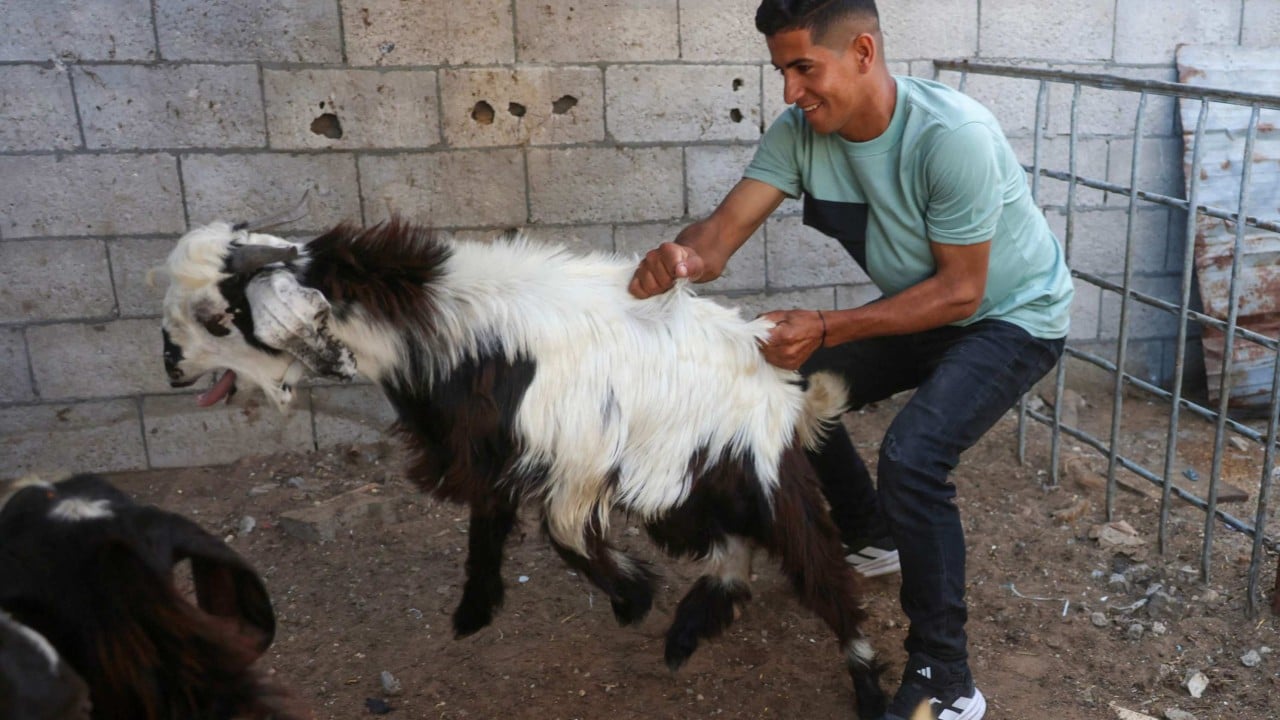
For a Palestinian family in the rural West Bank, a herd of sheep is not a mere commodity. It is an insurance policy. It is a college tuition fund. It is the meat that will feed an extended family during the holiest days of the year, and it is the pride of a father who can look at his children and know they will not go hungry. When masked men descend from a nearby illegal outpost and drive those animals away at gunpoint, they are not just stealing livestock. They are erasing a family's future.
This is the reality of life in Area C—the more than sixty percent of the West Bank under full Israeli military control. Here, the law is a shape-shifter.
The Anatomy of an Outpost
To fully grasp how a family loses its entire livelihood in a single afternoon, consider the mechanics of modern settlement expansion. It does not always begin with bulldozers and government contracts. Often, it begins with a single hilltop, a couple of mobile homes, and a flock of sheep.
This is what researchers call pastoral colonialism.
A handful of radical settlers establish an unauthorized outpost. They do not build permanent structures immediately. Instead, they herd their livestock across vast swathes of land, aggressively pushing Palestinian shepherds off traditional grazing grounds. The strategy is simple, deliberate, and highly effective. By taking over the pastures, they render the surrounding Palestinian villages unviable. Without land to graze, the sheep die or must be sold. Without the sheep, the people must leave.
Consider the numbers that define this quiet conflict. Over the past few years, the rate of shepherd displacement has surged. According to data tracked by international observers and Israeli human rights groups like B'Tselem, violent incidents involving the seizure of livestock, destruction of cisterns, and physical assaults on herders have doubled. These are not random acts of vandalism. They are a coordinated effort to alter the demographics of the territory, acre by acre, hill by hill.
But statistics can glaze the eyes. Let us ground this in a specific, representative reality.
Imagine a man named Ahmad. He is a composite of the shepherds who walk these hills, carrying a legacy passed down from his grandfather. Ahmad wakes at four in the morning. The air is crisp, carrying the scent of wild thyme. His sheep know the sound of his voice; a low, guttural call is all it takes to move fifty head of livestock across the rocky terrain.
For months, Ahmad has been preparing for Eid al-Adha. The festival is the peak of his financial year. Prices for sacrificial meat rise, and the earnings from this week will sustain his household through the dry winter months. His oldest daughter needs tuition for her university semester in Ramallah. His youngest son needs new shoes. Every calculation Ahmad makes is tied to the weight and health of his rams.
Then, the silence of the hillside breaks.
Three young men appear from the ridge. Their faces are wrapped in t-shirts. One carries an M16 rifle, a weapon frequently seen in the hands of settlement "security coordinators." There are no words exchanged, no legal documents presented. There is only the cocking of a firearm and a command spoken in Hebrew.
Move.
Ahmad watches as his herd—the tuition, the shoes, the Eid feast—is driven up the dirt track toward the settlement fence. When he tries to follow, a warning shot is fired into the dirt at his feet. The dust rises. The sheep are gone.
The Shield of Impunity
The true tragedy of this theft is not the loss of the property, as devastating as that is. It is the total absence of recourse.
When a crime occurs in most parts of the world, you call the police. In Area C of the West Bank, the arrival of the police often compounds the trauma. Israeli civil police have jurisdiction over Israeli citizens in the territory, while the military governs the Palestinian population. When a Palestinian shepherd attempts to file a complaint about settler violence or theft, the bureaucratic labyrinth is designed to exhaust them.
The shepherd must travel to an Israeli police station, often located inside a heavily fortified settlement that they are barred from entering without a special permit. If they manage to log the complaint, the likelihood of an investigation is vanishingly small. The Israeli human rights organization Yesh Din has tracked these cases for over a decade. Their findings are stark: over ninety percent of investigations into ideologically motivated crimes committed by Israelis against Palestinians in the West Bank are closed without an indictment.
The reasons given are consistent: "culprit unknown" or "insufficient evidence."
This creates a culture of absolute impunity. The perpetrators know that no one is looking for them. They know that the cameras monitoring every inch of the highways for Palestinian stone-throwers somehow malfunction or face the wrong way when a herd of sheep is stolen. The state, through its inaction, becomes a partner in the theft.
This systemic failure shifts the entire burden of survival onto the victims. It forces communities into an impossible choice: stay and risk physical harm and economic ruin, or leave the land of their ancestors for the crowded, impoverished enclaves of Areas A and B.
The Broken Cycle of Eid
The timing of this specific raid was not accidental. Cruelty is often most effective when it is timed to inflict maximum psychological weight.
Eid al-Adha commemorates Ibrahim’s willingness to sacrifice his son in obedience to God, a narrative of ultimate devotion and divine mercy. It is a time of generosity, where meat is distributed to the poor, neighbors visit one another, and children receive gifts. It is the emotional anchor of the Islamic calendar.
To strip a family of their livestock on the eve of this festival is to strip them of their ability to participate in their own culture. It transforms a season of joy into a season of mourning.
In the days following the theft in Tuqu’, the community rallied as best it could. Neighbors offered what little they had, sharing portions of their own meat so that Ahmad’s children would not look at an empty table while the rest of the village celebrated. But solidarity, while beautiful, cannot pay for a university education. It cannot buy back fifty head of prime livestock.
The loss ripples outward. The local butcher loses his supply. The market loses a seller. The delicate, traditional economy of the rural West Bank suffers another micro-collapse, moving the entire region one step closer to total dependency on international aid or low-wage labor inside Israel.
The View From the Ridge
The sun goes down over the hills of Tuqu’, casting long, dramatic shadows across the terraces that have been cultivated for thousands of years. From the village, you can see the white-roofed caravans of the outpost gleaming on the opposite crest. They look permanent now.
The stolen sheep are up there, mixed in with the settlement’s own herds, their ear tags clipped, their identities erased.
We often talk about the Israeli-Palestinian conflict in grand, abstract terms. We debate geopolitical strategies, United Nations resolutions, and the theoretical viability of two-state solutions. But out here, on the rocky slopes where the wild thyme grows, the conflict is not an abstraction. It is a zero-sum game played out with clubs, rifles, and livestock.
It is the slow, agonizing process of a family watching their life’s work walk away into the hills, knowing that tomorrow, they will have to wake up and find a way to survive in a world that has stolen their past and fenced off their future.
The hills remain silent. The dust waits.