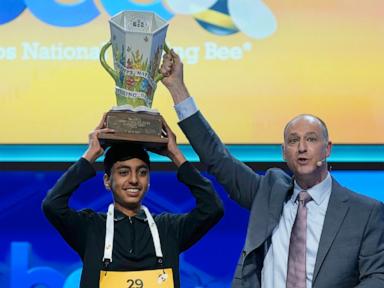
The auditorium smells of expensive air conditioning and cheap panic.
Under the blinding stage lights of the National Spelling Bee, the air is thick, almost heavy enough to chew. A child stands alone at a microphone that looks too tall for him. He is thirteen years old. His name is Shrey Parikh. Around his neck hangs a heavy placard bearing a number, making him look less like a competitor and more like a prisoner of his own extraordinary intellect.
To the casual viewer channel-surfing on a Thursday night, this looks like a quaint academic exercise. It looks like a room full of prodigies reciting dictionary pages for a trophy and a college fund.
They are wrong. This is high-stakes, blood-and-guts theater. It is a psychological crucible that can break a young mind in a matter of seconds.
Consider the sheer mechanics of what is happening inside that middle-school brain. A word is spoken. It is often a word the child has never heard aloud, a relic of 17th-century medical Latin or an obscure German botanical term. The clock begins to tick. Sixty seconds. In that one minute, the mind must travel through thousands of linguistic roots, trace etymological migrations across continents, and visualize a sequence of letters with absolute, unflinching precision. One wrong letter—an 'e' instead of an 'i', a silent 'ch' forgotten—and a bell rings.
That bell is brutal. It is a sudden, metallic death knell. When it rings, the dream dies. The child must turn around, walk off the stage, and face the long, lonely walk to the comfort of their parents' arms, weeping in front of millions of television viewers.
Shrey Parikh knew that bell intimately. He had heard it before. He had felt the crushing weight of coming so close, only to watch the prize slip through his fingers.
The pressure of the final rounds is not linear; it is exponential. As the field thinned out, the silence in the room deepened. You could hear the faint rustle of the judges' papers. You could hear the sharp, anxious inhalations of parents in the front rows, their knuckles white, living and dying by every syllable their children uttered.
Then came the moment where everything almost fell apart.
It happens to every great athlete. The nerves do not disappear; they simply change shape. For Shrey, the anxiety gripped him mid-round. A word was delivered. The definition was read. The language of origin was confirmed. But inside the cockpit of his mind, the instruments were failing. The letters blurred. The confidence that had carried him through thousands of hours of flashcards and root-study began to waver.
He stumbled. The rhythm was broken.
In that agonizing stretch of time, the auditorium held its breath. It is a terrifying thing to watch a child confront their own limitations in real-time under a national spotlight. The composure cracks. The fingers twitch against the fabric of the shirt. The eyes dart upward, searching the ceiling for an answer that is only hidden deep within the folds of memory.
He lost his footing. The bell rang.
For most, that is where the story ends. The psychological damage of a public failure at thirteen can linger for years. It becomes a ghost that haunts future exams, future interviews, future risks. But the true narrative of human achievement is never about the absence of failure. It is entirely about what happens in the ten minutes after you fall.
Because of the unique, brutal structure of this year's competition, a tie at the top triggered the ultimate tie-breaker: the spell-off.
Imagine a penalty shootout in the World Cup, but instead of a ball and a net, you are firing letters at a rapid-fire pace into a microphone. The clock is no longer a generous sixty seconds. It is a relentless countdown. You have ninety seconds to spell as many words correctly as humanly possible. Accuracy is required, but speed is the dictator.
Shrey had to walk back out onto that stage. The ghost of his recent mistake was still hovering over the microphone. His hands were likely cold. His heart was undoubtedly hammering against his ribs like a trapped bird.
This is where technique fades and character takes over.
When the timer began, a transformation occurred. The hesitant boy who had succumbed to the weight of the room vanished. In his place stood a machine of pure linguistic instinct. The words were fired at him like bullets from a machine gun.
Word. Spell. Word. Spell.
His voice took on a rhythmic, almost hypnotic cadence. He did not ask for definitions. He did not ask for alternate pronunciations. He did not have the luxury of time to analyze Latin suffixes or Greek prefixes. He had to rely entirely on the muscle memory of his brain.
It was a display of sheer psychological dominance. While his opponent fought valiantly, matching the frantic pace, Shrey operated in a state of flow that athletes spend lifetimes trying to achieve. He rattled off letters with an eerie, calm velocity. He transcended the fear of the bell. He bypassed the conscious doubt that dooms so many competitors and tapped into something primal.
When the ninety seconds expired, the silence returned to the room. But it was a different kind of silence now. It was the breathless quiet that follows a masterpiece.
Shrey Parikh had spelled twenty-six words correctly in a minute and a half. It was an astonishing feat of mental endurance, a blitzkrieg of vocabulary that left the audience and the judges stunned.
The trophy was his. The confetti fell, glittering under the hot stage lights, coating the stage in gold and silver. His family rushed toward him, tears free-flowing, the immense relief washing over them like a wave.
We love to celebrate the victory, but the trophy is the least interesting part of the story. The trophy is just metal and wood.
The real triumph happened in the dark space between the mistake and the microphone. It happened when a thirteen-year-old boy looked at his own terror, acknowledged the burning sting of public failure, and decided to step back into the light anyway.
Long after the confetti is swept away and the dictionary is closed, that is the lesson that remains. The stage will always be terrifying. The bell will always be waiting to ring. But the magic happens when you refuse to let the noise of your own doubts drown out the letters you know by heart.