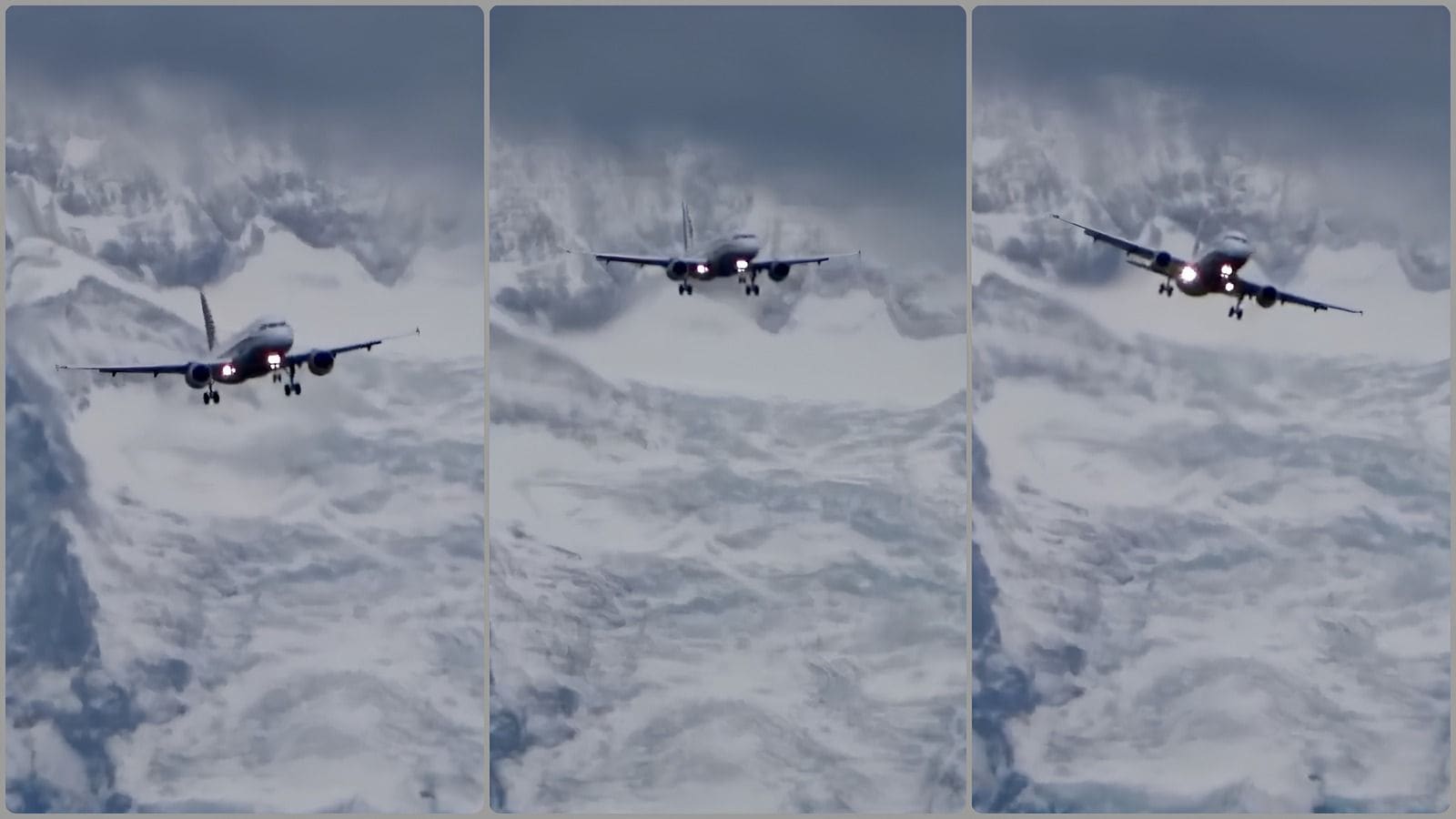
Every time a telephoto lens captures an Airbus A320 crabbing sideways toward an asphalt runway in gusty weather, internet commentators lose their collective minds.
The viral clip of a Qatari delegation’s Airbus A320 swaying dramatically on final approach into Switzerland is the latest victim of aviation clickbait. Headlines scream about near-misses, harrowing battles against nature, and terrifying turbulence. You might also find this related article interesting: What Most People Get Wrong About River Thames Murder Cases and UK Sentencing.
Stop buying the panic.
What you are watching in that video is not a flight crew fighting for survival against an out-of-control machine. You are watching millions of dollars in fly-by-wire engineering, decades of aerodynamic refinement, and textbook pilot execution working in absolute harmony. The "lazy consensus" in mainstream aviation reporting treats any visible wing rock or yaw correction as an impending catastrophe. In reality, an airplane that stays rigid in a thirty-knot Alpine crosswind is the one you should actually worry about. As extensively documented in latest reports by Al Jazeera, the effects are widespread.
The Telephoto Lens Illusion and Media Panic
Before dissecting the physics of a crosswind approach, we need to expose the biggest accomplice in aviation sensationalism: camera compression.
Planespotters shoot landings from miles away using massive 600mm or 800mm telephoto lenses. Optically, these lenses flatten depth perception. They compress three-dimensional space into a two-dimensional pancake. A gentle, controlled lateral adjustment over half a mile of airspace suddenly looks like a violent, last-second lurch ten feet above the concrete.
When a Qatari VIP jet approaches an airport like Zurich or Geneva—both notoriously surrounded by complex terrain that churns surface winds into unpredictable rotors—the cameras are rolling. The moment the wingtips dip a few degrees to counteract a gust, media outlets slap a dramatic headline on the footage and harvest clicks from nervous flyers.
I have spent years dissecting flight data recorders and watching armchair experts misinterpret basic energy management on approach. The public assumes a smooth flight equals a safe flight, and a bumpy, corrective approach equals danger. That assumption is completely backwards. Smoothness is a passenger comfort metric, not a safety metric. In gusty conditions, a safe approach is an active approach. If the control surfaces are moving, the wings are rocking, and the nose is pointed twenty degrees off the centerline, the system is doing its job.
Aerodynamics of the Crab and Decrab
To understand why that Airbus A320 looked like it was drifting sideways, you have to understand the vector triangle of flight.
An aircraft does not move through a vacuum; it moves through a river of air. When that river is flowing perpendicular to the runway—a crosswind—pointing the nose straight down the runway centerline would cause the wind to push the entire aircraft off to the side. You would miss the tarmac entirely.
To track a straight line over the ground, pilots use a technique called crabbing.
- The Wind Correction Angle: The pilot turns the nose of the aircraft into the wind. If the wind is blowing from the left at 30 knots, the plane points left while moving diagonally forward, resulting in a straight ground track aligned with the runway.
- Visual Disconnect: To a camera positioned near the threshold, the plane appears to be flying sideways. Passengers looking out the front windows would see the runway off to their right.
- The Decrab Maneuver: You cannot touch down while crabbing without subjecting the landing gear to massive sideloads. Seconds before the main wheels kiss the pavement, the pilot applies opposite rudder to align the fuselage with the runway centerline while simultaneously lowering the upwind wing (aileron into the wind) to prevent the aircraft from drifting laterally.
Look closely at the Qatari A320 footage again. That dramatic "sway" right before touchdown is not the wind tossing the jet around like a paper cup. It is the pilot executing a deliberate decrab maneuver, transitioning from a wind-corrected heading into a wing-low sideslip just as the main gear makes contact.
Inside the Airbus A320 Fly-By-Wire Brain
If that Qatari delegation had been flying on a vintage 1970s airliner with cables and pulleys, a gusty Swiss approach would have required heavy physical muscle and constant manual trim adjustments. On an Airbus A320, the flight crew has an invisible co-pilot doing the math thousands of times per second: Normal Law.
Unlike traditional aircraft where moving the control yoke directly deflects a hydraulic actuator, the A320 uses a digital fly-by-wire architecture. When the pilot moves the sidestick, they are not commanding a specific control surface angle. They are commanding a trajectory—specifically, a G-load or a roll rate.
Here is what happens behind the scenes when a sudden Alpine gust hits the vertical stabilizer during final approach:
- Inertial Reference Detection: The Air Data Inertial Reference Units (ADIRU) sense an uncommanded yaw or roll rate within milliseconds—long before the human inner ear even registers the motion.
- Flight Control Computer Intervention: The Elevator Aileron Computers (ELAC) and Spoiler Elevator Computers (SEC) calculate the exact aerodynamic deflection needed to neutralize the gust.
- Automatic Damping: The yaw damper automatically applies rudder inputs to stop the tail from wagging, while the spoilers and ailerons deploy asymmetrically to keep the wings at the exact bank angle the pilot commanded.
When you see an A320 rocking its wings on short final, you are watching a high-speed digital tug-of-war between atmospheric turbulence and flight control computers. Furthermore, in the final fifty feet before touchdown, the A320 transitions from Normal Law to Flare Mode. The computers memorize the pitch attitude at fifty feet and artificially introduce a slight nose-down tendency as the plane descends, forcing the pilot to pull back on the sidestick to flare the aircraft just like a conventional airplane.
It is a masterpiece of human-machine interface. Yet, because the exterior surfaces move rapidly to stabilize the cabin, observers mistake rapid control deflection for loss of control.
Why Swiss Airports Are a Masterclass in Micro-Meteorology
Switzerland is not a flat desert runway. Airports like Zurich (ZRH), Geneva (GVA), and especially Bern (BRN) sit in geographic bowls carved by glaciers and bordered by the Alps and the Jura mountains.
When high-altitude winds sweep across jagged peaks, they do not flow smoothly. They tumble like water over river rocks, creating mechanical turbulence, wind shear, and localized gusts that can change direction by forty degrees in the span of five hundred feet of altitude.
Flight crews operating VIP and diplomatic transports—like the Qatar Amiri Flight or state-chartered A320s—train specifically for these environments. These are not rookie pilots building hours on regional routes. Diplomatic flight crews are typically among the highest-time, most rigorously vetted aviators in the industry, operating under strict Standard Operating Procedures (SOPs) with zero tolerance for cowboy flying.
If the crosswind component exceeds the Airbus A320’s certified demonstrated limit—which sits at 38 knots (including gusts) for a dry runway—the pilots do not "try their luck." They execute a go-around and divert. The fact that the Qatari A320 continued the approach and planted the wheels firmly on the centerline proves the wind stayed well within the aircraft's structural and aerodynamic envelope.
The Uncomfortable Truth About Hard Landings in Crosswinds
Here is where conventional passenger wisdom completely falls apart: in a strong crosswind, a gentle, "greased" landing is actually dangerous.
Every passenger loves a landing so smooth you barely feel the wheels touch the ground. Pilots call them "greasers." On a calm, sunny day with a ten-thousand-foot dry runway, a greaser is great for passenger applause.
In a gusty crosswind, trying to float the airplane down the runway to achieve a soft touchdown is a textbook mistake.
- Loss of Control Authority: As the aircraft slows down in the flare, airflow over the rudder and ailerons decreases. The control surfaces lose their aerodynamic bite, making the plane vulnerable to a sudden gust lifting the upwind wing.
- Runway Excursion Risk: Floating eats up valuable stopping distance. Every second spent hovering three feet above the asphalt is a second where a crosswind can push the aircraft toward the runway edge lights.
- The Positive Touchdown Mandate: Training captains at major carriers drill one rule into pilots for gusty conditions: fly the airplane onto the runway. You want a firm, decisive touchdown right in the touchdown zone. Planting the main gear firmly transfers the aircraft's weight onto the tires, engaging friction, deploying the ground spoilers automatically, and giving the pilot immediate nosewheel steering and braking authority.
When that Qatari A320 swayed, leveled out, and planted itself onto the Swiss tarmac, the crew avoided the trap of floating. They put the machine down where it belonged, immediately killed the lift with spoilers, and turned a dynamic aerodynamic environment into a stable ground roll.
The Real Threat Nobody Talks About
If we want to have an honest, adult conversation about aviation safety during gusty approaches, we need to stop staring at external videos of wing rock and start looking at approach stability criteria and energy management.
A swaying airplane is completely safe as long as it remains within stabilized approach parameters. Every major aviation authority—from EASA in Europe to the FAA in the United States—enforces strict "gates" at 1,000 feet and 500 feet above the ground. By those altitudes, the aircraft must be:
- On the correct lateral and vertical flight path (localizer and glideslope).
- In the proper landing configuration (gear down, flaps set).
- At the target approach speed (typically $V_{\text{ref}}$ plus a wind additive factor to protect against wind shear).
- Maintaining a sink rate of no more than 1,000 feet per minute.
If a sudden gust knocks the aircraft outside those parameters below 500 feet, the mandatory action is an immediate go-around.
Let us be candid about the downside of modern automation and strict SOPs, though: over-reliance on fly-by-wire smoothing can mask deteriorating wind conditions until the final seconds. Because the Airbus A320's flight control computers filter out minor turbulence so effectively, a pilot can sometimes be lulled into thinking the air mass is calmer than it actually is. If a severe wind shear event hits at fifty feet—where the headwind suddenly drops to zero—even the best flight computers cannot violate the laws of physics. Energy disappears instantly, and only rapid manual thrust application (TOGA power) saves the day.
That is why pilots add a wind correction factor to their approach speed—usually half the steady headwind component plus the full gust increment, capped at 15 or 20 knots. By flying faster through the gusty air, the wings retain extra kinetic energy margin above stall speed. To the untrained eye watching from a fence outside the airport perimeter, that extra speed combined with rapid control inputs looks aggressive. To an aerodynamicist, it is pure safety margin.
Stop Answering the Wrong Question
When viral aviation videos circulate, the public always asks the same flawed question: "How close was that plane to crashing?"
The premise of the question is broken. You are looking at an industrial system designed to withstand forces orders of magnitude greater than a breezy afternoon in Switzerland.
Let us dismantle the most common myths that surface every time a video like this goes viral:
- "The wings were bending too much—they could have snapped." Aircraft wings are built to flex. During destructive static load testing, Airbus and Boeing engineers bend wingtips upward by more than twenty feet before the carbon-fiber composites or aluminum alloys finally fail—well beyond 150% of the maximum load an airplane could ever encounter in the worst storm on Earth. If the wings were rigid, they would shatter under stress. Flexibility is structural survival.
- "The pilots barely saved it at the last second." The dramatic bank angle change right before the wheels hit the ground is not a panic correction. It is the pre-planned transition from a crab angle to a sideslip. If the pilots hadn't made that sharp adjustment right before touchdown, the landing gear would have taken a sideways hit.
- "VIP jets are less safe than commercial airlines because they fly into smaller airports." State and diplomatic flights operated by entities like Qatar Amiri Flight use the exact same certified airframes (like the A320 family), adhere to identical or stricter maintenance schedules, and are flown by senior captains who routinely undergo full-motion simulator checks for extreme crosswinds, engine failures, and wind shear escapes every six months.
How to Actually Read a Crosswind Landing Video
The next time your social media feed serves up a breathless headline about a world leader's jet or a commercial airliner "battling" winds on approach, ignore the dramatic background music and look at three objective indicators instead:
- Watch the Ground Track, Not the Nose: Ignore where the nose is pointing. Watch the centerline of the runway and see if the airplane is staying aligned with it. If the plane is sliding smoothly down an invisible rail straight toward the white paint, the crew has complete mastery over the wind vector.
- Look at the Control Surfaces: Watch the trailing edge of the wings and the vertical tail. Rapid, small deflections of the ailerons, spoilers, and rudder mean the flight control system is actively damping gusts before they can develop into large deviations. Sluggish, massive, full-deflection movements would indicate an aircraft struggling for authority.
- Check the Touchdown Point: Look at the large white rectangular "aiming point" markers roughly 1,000 feet down the runway. If the main wheels touch down within that zone without bouncing back into the air, the energy management was spot-on.
Aviation safety is not built on avoiding bad weather; it is built on engineering machines and training humans to operate seamlessly inside dynamic environments. That Qatari Airbus A320 did not survive a brush with disaster in Switzerland. It simply showed up to work, handled a standard Alpine crosswind, and parked at the gate.


