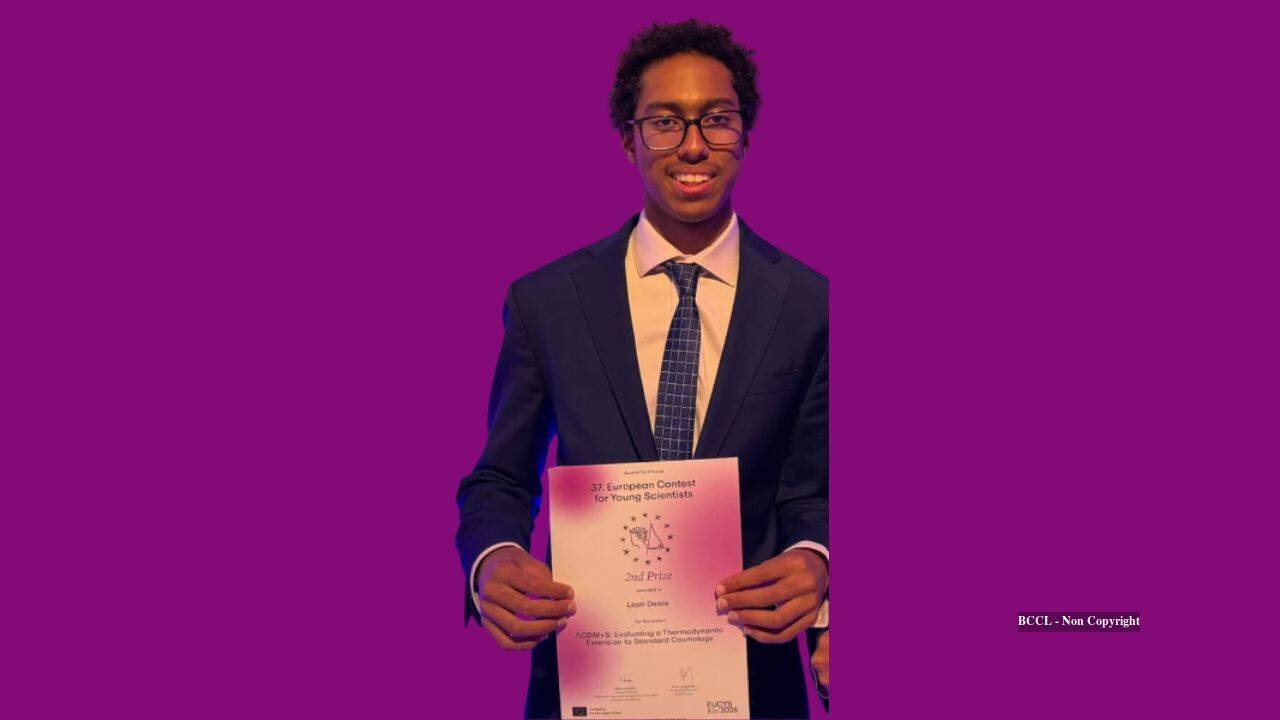
Dark energy remains the ultimate accounting fudge of modern astrophysics. Roughly sixty-eight percent of the universe consists of an invisible engine driving cosmic expansion, yet standard models treat it as a constant plug for an unsolved equation. Into this forty-year theoretical stalemate stepped a fourteen-year-old student from Kingston, Ontario named Liam Desre, who walked away with a major international prize at the European Union Contest for Young Scientists for daring to model cosmic acceleration through thermodynamics rather than phantom fields.
Headlines naturally gravitated toward the novelty of his age. Editors love a prodigy narrative. But the real story is not that a teenager built a computer simulation matching observational data to a ninety-three percent accuracy rate; the real story is how easily a high schooler could wander into the blind spots of professional cosmology. When institutional physics spends decades treating dark energy as an untouchable cosmological constant, external thinkers—unburdened by academic dogma—can spot the seams.
To understand why Desre's project caught the attention of theoretical physicists, one has to look past the trophy and examine the mechanics. Modern cosmology relies on General Relativity to map the large-scale structure of the universe. Yet, when astrophysicists try to calculate the vacuum energy density predicted by quantum mechanics, they miss the observed value by a factor of ten to the one hundred and twentieth. It is widely considered the worst prediction in physics.
Instead of adding another invisible substance to fix the math, Desre tested a thermodynamic extension. Working from the premise that entropy and information boundary properties observed around black holes might scale up to the entire universe, he built a computational model to see if cosmic expansion could emerge naturally from thermodynamic principles. As a hypothetical baseline, imagine blowing air into a balloon while tracking the heat dissipation and internal pressure changes; instead of invoking a mysterious external pump, the expansion becomes a byproduct of how energy states shift within the system.
Building the math was only the first hurdle. To test whether his hypothesis held weight against actual sky surveys, Desre had to self-teach advanced computer programming. Coding simulations of cosmic evolution is not standard curriculum for a teenager. Most university undergraduates stumble through their first numerical methods courses, wrestling with floating-point errors and boundary conditions. By treating programming as a functional tool rather than an academic requirement, he managed to construct a working pipeline that mapped entropy-driven scaling against real observational datasets.
The resulting numbers startled professional researchers who reviewed the submission. While peer-reviewed academic circles are naturally skeptical of alternative cosmological models—especially those bypassing traditional graduate credentials—physicists noted that the structural rigor of the submission mirrored a standard journal paper. It did not rely on hand-waving philosophy; it relied on explicit mathematical definitions and computational checks.
Yet, treating this project as a complete overthrow of standard cosmology would be a mistake. Theoretical physics is littered with elegant models that fit ninety percent of current data while quietly collapsing under the remaining ten. Critics within the academic community correctly point out that thermodynamic alternatives to dark energy often struggle to reconcile local gravitational bounds with large-scale homogeneity. Simulating a trend is not the same as proving a mechanism.
The deeper critique belongs to the academic apparatus itself. Why did it take an independent teenager working outside traditional laboratory funding to test a relatively straightforward entropy-based model? Modern theoretical physics has become profoundly risk-averse. Graduate students and postdoctoral researchers often find themselves trapped in grant-funded silos, discouraged from questioning the Lambda-CDM standard model because career survival depends on incremental progress within established frameworks. Venturing too far outside accepted paradigms risks career suicide in a hyper-competitive funding environment.
When an outsider points out that the emperor has no clothes, the establishment's reaction tends to alternate between condescending applause and defensive dismissal. We celebrate young minds for their raw curiosity while quietly ignoring the institutional structures that prevent professional scientists from asking those exact same foundational questions.
Desre's project did not solve the dark energy crisis. It did something far more disruptive. It exposed the comfort zone of modern theoretical physics, proving that high-level cosmological modeling is no longer exclusively locked behind university gates and supercomputer clusters.
As the simulation runs forward and the broader scientific community parses the implications of entropy-driven expansion models, the data will either hold or break under scrutiny. Regardless of whether this specific hypothesis survives rigorous peer review, the barrier to entry for questioning the universe has permanently shifted.
The equations remain open, and the cosmos continues to accelerate into the dark.