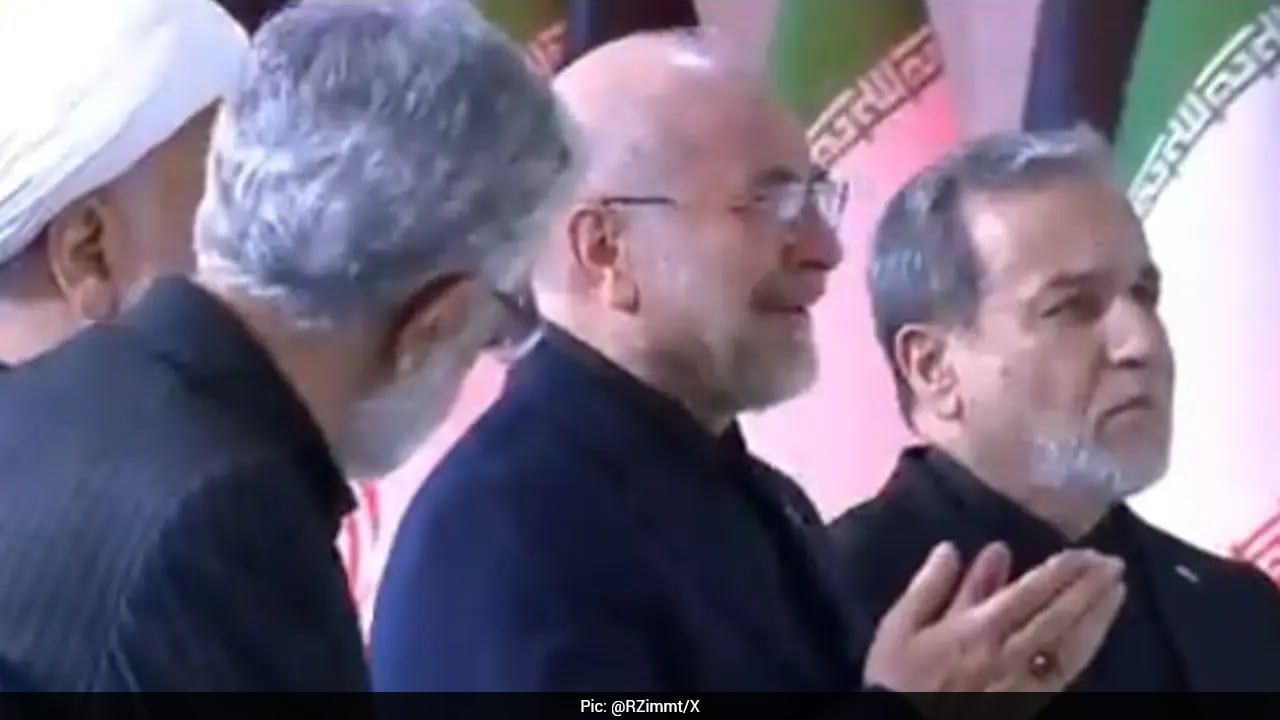
The public display of grief by Iran’s top officials during the farewell ceremony for Supreme Leader Ayatollah Ali Khamenei signals a profound shift in the country's internal power dynamics. When the parliamentary speaker and foreign minister openly wept, the international press largely covered the moment as a standard demonstration of state-mandated mourning. That interpretation misses the deeper geopolitical reality. These tears were not merely personal grief; they were a visible manifestation of intense anxiety regarding the imminent and highly volatile succession process within the Islamic Republic.
For decades, the political structure of Iran has relied on a delicate balancing act managed by the Supreme Leader. With that stabilizing force reaching its inevitable end, the factions within the regime are facing an unprecedented survival crisis. The public emotional breakdown of key figures exposes the fracture lines within a government realizing that the rules of the game are about to change forever. Read more on a connected topic: this related article.
The Succession Vacuum and Regime Survival
The political architecture of Iran places absolute authority in the office of the Supreme Leader. When the occupant of that office changes, every state institution experiences a fundamental shock. The tears from the speaker of parliament and the foreign minister must be analyzed through the lens of institutional self-preservation rather than simple religious or personal devotion.
In the Iranian system, factions compete fiercely behind closed doors while maintaining a facade of total unity in public. The speaker represents the pragmatic conservative elements within the legislature, while the foreign minister represents the diplomatic apparatus tasked with managing Iran's complex international relations. Both positions rely entirely on the backing of the supreme leader to maintain their leverage against the hardline Islamic Revolutionary Guard Corps (IRGC). More analysis by NBC News explores comparable views on this issue.
Without a clear, universally accepted successor, a dangerous power vacuum opens. The emotional vulnerability displayed by these officials reflects the terrifying realization that their political survival—and potentially their personal safety—is no longer guaranteed. The IRGC has spent years expanding its economic and military dominance, and the passing of the current leader removes the primary civilian check on their ambitions.
The Visible Fractures of the Iranian Elite
Western observers often view the Iranian leadership as a monolith. This is a mistake. The regime is a complex web of competing interest groups, including the traditional clergy, the security apparatus, and the bureaucratic technocrats.
When the cameras captured the top diplomat and the legislative head breaking down, they captured a moment of profound vulnerability for the bureaucratic and diplomatic factions. The hardline elements within the security state rarely show such weakness; they view succession as an opportunity to consolidate total control over the state.
Historical precedent shows that transitions of power in revolutionary regimes are rarely smooth. When the foundational figure departs, the ideological consensus begins to erode. The current elite are acutely aware that the public is highly dissatisfied with economic stagnation, hyperinflation, and social restrictions. A messy succession fight could trigger widespread civil unrest, making the regime vulnerable from both within and without.
Geopolitical Implications of a Shifting Guard
The immediate impact of this leadership transition will be felt far beyond the borders of Tehran. The foreign minister's tears underscore the extreme uncertainty surrounding Iran's future foreign policy, particularly its regional proxy strategy and its stance on the nuclear program.
Iran’s regional strategy has long been managed via a dual-track system: the formal diplomacy of the foreign ministry and the covert operations of the IRGC's Quds Force. The balance between these two forces has always been tilted in favor of the security state, but the supreme leader maintained the ultimate veto power.
A successor who lacks the established religious credentials or political capital of Khamenei will likely rely heavily on the military elite to legitimize their rule. This shift guarantees a more aggressive, less predictable foreign policy. The diplomatic channels that currently exist, however fragile, may become entirely obsolete as the IRGC tightens its grip on decision-making.
The Economic Realities Driving Elite Panic
Behind the ideological rhetoric and the public mourning lies a harsh economic reality that the regime can no longer ignore. Iran’s economy has been hollowed out by years of international sanctions, systemic corruption, and mismanagement. The ruling class understands that their legitimacy is tied directly to their ability to maintain basic economic stability.
The factions represented by the civilian government have consistently argued for a degree of economic modernization and limited engagement with the West to secure sanction relief. Conversely, the security apparatus benefits directly from the shadow economy generated by sanctions smuggling and state-monopolized industries.
The grief displayed by the civilian leadership is tied directly to the realization that the economic argument is being lost. With the departure of the supreme leader, the path toward economic normalization closes, locking Iran into a permanent wartime economy controlled by military industrial syndicates.
What Follows the Tears
The Assembly of Experts is officially tasked with choosing the next supreme leader, but the actual decision will be made through intense negotiation among the senior leadership of the IRGC, the powerful clerical families, and the heads of the intelligence services.
The public should watch the movements of the security forces rather than the statements of the politicians in the coming weeks. Increased security presence in major urban centers and sudden personnel changes within the ministries will provide the true indicators of who is winning the internal struggle. The tears have dried, and the brutal fight for the future of the Islamic Republic has officially begun.