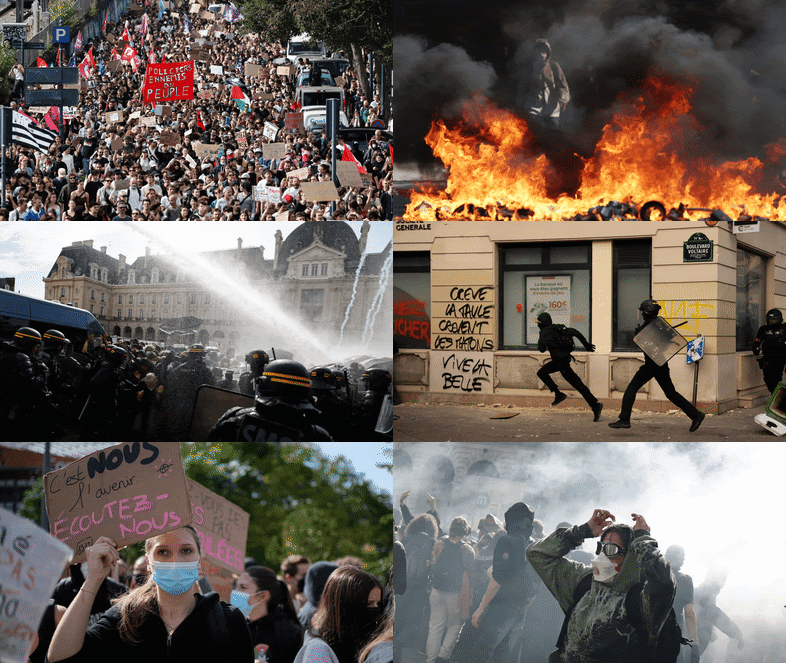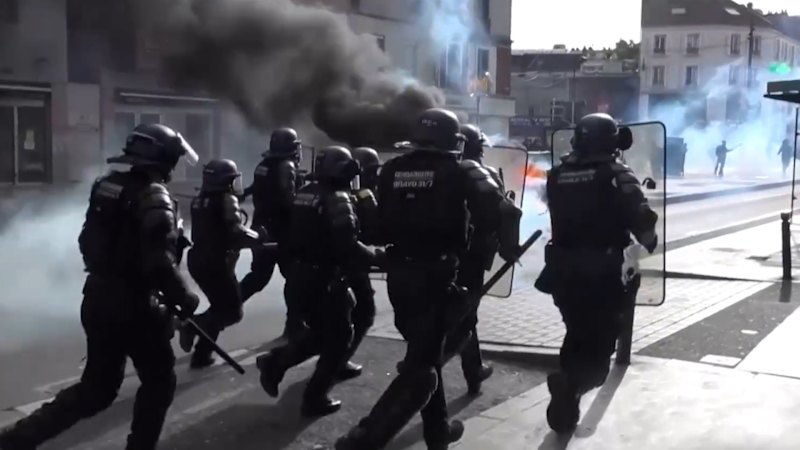
The air across French boulevards did not just taste like autumn. It tasted like vinegar, wet asphalt, and lingering chemical agents discharged from plastic canisters. When thousands of educators, parents, and students converge on government plazas to protest crumbling classrooms and vanishing posts, the state rarely answers with an open door. It answers with order. Riot police moving in heavy tactical gear, smoke obscuring historic facades, and sirens wailing down avenues normally reserved for cafe terraces.
At the center of this unrest is a bitter confrontation over French school funding. Teachers unions and regional authorities have locked horns with a national administration committed to fiscal austerity, leaving public education underfunded and overstretched. You might also find this similar coverage interesting: The Broken Promise Behind the Tuition Window.
To understand why thousands marched and why French riot police deployed tear gas, look past the immediate street-level clashes. The breakdown of public education funding in France reflects a broader political collision between centralized fiscal restraint and the grinding daily reality of under-resourced classrooms.
The Anatomy of a Budgetary Collapse
Walk into any secondary school in the suburbs of Lyon or Marseille on a rainy Tuesday morning, and the fiscal crisis becomes immediately tangible. Plaster flakes from century-old ceilings. Twenty-eight adolescents cram into rooms designed for twenty, sharing outdated textbooks that still reference geopolitical borders redrawn decades ago. As reported in recent reports by Al Jazeera, the effects are worth noting.
The national budget framework sets strict limits on regional educational expenditures. Year after year, the Ministry of Education trims operating costs to meet deficit targets imposed by European Union financial guidelines. The arithmetic is simple on paper. In practice, it translates to frozen hiring lines for tenured professors, reliance on underpaid contractual teachers with minimal pedagogical training, and the quiet dismantling of specialized support staff for students with learning disabilities.
When regional school boards absorb successive funding cuts, institutional strain hits a breaking point. Teachers do not strike lightly in France. The right to withdraw labor is culturally embedded, viewed as a necessary defense mechanism against the erosion of public service. Yet, strikes have grown longer and more desperate. The state views these walkouts through the lens of public order. Teachers view them as a last stand for the survival of public instruction.
When Demonstrations Meet State Apparatus
Public protest in France operates under a well-worn choreography. Unions file notices, routes are mapped with municipal police, and marchers gather with banners, megaphones, and sound systems. Yet, the atmosphere shifts the moment demonstrators deviate from authorized perimeters or when fringe militant groups infiltrate the flanks of the procession.
Police units, specifically the mobile gendarmerie and urban intervention forces, operate under orders to maintain absolute transit corridors and protect government ministries. When projectiles meet shields, escalation happens in seconds. Tear gas canisters arc across the gray sky, bursting into acrid white clouds that scatter crowds of all ages.
Critics argue that deploying riot police against striking teachers and high school students crosses a dangerous threshold of authoritarian overreach. Government defenders counter that security forces must maintain public order against violent agitators who hijack legitimate grievances to smash storefronts and throw cobblestones. Both statements can be true simultaneously. The tragedy lies in how quickly a debate over class sizes and pedagogical resources descends into chemical crowd dispersal.
The Cost of Structural Underinvestment
Money exists within the national treasury, but the political will to redirect it toward public education remains absent. Successive administrations have prioritized tax cuts for corporations and high earners, betting on supply-side economic revival while public infrastructure quietly rots from within.
When schools fail to deliver basic social mobility, the democratic contract frays. Public education in France was historically designed as the great equalizer, the crucible where children of immigrants and rural laborers alike could master the republic's language and laws to claim a place in society. As resources shrink, that equalizer stutters. Private institutions capture a growing share of academically elite students, leaving public schools to shoulder mounting social challenges with shrinking budgets.
Reform proposals frequently cycle through bureaucratic committees without delivering material relief. Technocratic solutions focus on administrative consolidation or digital modernization, missing the fundamental need for smaller classes, better compensation to attract qualified talent, and physical infrastructure that does not require emergency repairs during winter months.
Beyond the Barricades
The tear gas clears by evening, washed into storm drains by street sweepers. The graffiti on ministry walls gets scrubbed away before the morning commute. But the underlying friction remains unresolved.
Teachers return to classrooms with the same broken photocopiers and identical overcrowding. Ministers issue measured statements acknowledging public concern while defending fiscal orthodoxy. The cycle repeats, punctuated by periodic eruptions of smoke and sirens that serve as a stark reminder of what happens when a state stops listening to the people tasked with educating its children.