The Champions League final is rarely a masterpiece of pure football. It is an exercise in stress management, where tactical systems bend under the weight of immense pressure until something snaps. When Paris Saint-Germain drew level with Arsenal via a high-stakes penalty, the narrative instantly shifted toward individual drama. The cameras panned to the despondent goalkeeper, the ice-cold penalty taker, and the frantic managers on the touchline.
But looking at this match purely through the lens of a refereeing decision misses the entire tactical war that preceded it. The penalty was not an isolated stroke of luck. It was the direct mathematical consequence of a structural breakdown that had been threatening to happen since the opening whistle.
Arsenal had built their entire European campaign on defensive rigidity and choking the spaces in the half-spaces. For the first hour, that machine worked with predictable efficiency. Yet, top-tier European football is cruel to teams that try to preserve a lead by completely abandoning their offensive output. By retreating into a low block too early, the English side invited the exact chaos they spent months trying to avoid, proving once again that in elite football, passive defense is just a slow form of tactical suicide.
The Illusion of Control in the Low Block
Football managers love the phrase "controlling the game without the ball." It sounds sophisticated. It implies a level of mastery over space that renders the opponent’s possession useless. Mikel Arteta’s setup initially looked like a masterclass in this philosophy, suffocating the French champions and forcing them into sterile possession out wide.
But this control is an illusion that relies on absolute perfection. When a team drops its defensive line by fifteen yards, it fundamentally changes the geometry of the pitch.
- The Passing Lanes Compress: The distance between the midfield line and the defensive line shrinks, which should theoretically deny space. However, it also means any turnover happens dangerously close to your own box.
- The Outlets Evaporate: With the strikers forced to track back to the edge of their own defensive third, winning the ball no longer triggers a counter-attack. It triggers a frantic clearance.
- The Pressure Accumulates: Physical fatigue is real, but cognitive fatigue is what breaks a low block. Making defensive reads every six seconds eventually leads to a miscalculation.
PSG did not break Arsenal down with glittering patterns of play or individual genius. They did it through sustained, monotonous pressure. By occupying the wide channels and recycling the ball with speed, they forced the London side's shifting defense to cover maximum lateral distance. It was death by a thousand horizontal passes, designed specifically to tire out the tracking wingers and isolate the central defenders.
The Anatomy of the Critical Breakdown
To understand why the penalty occurred, you have to rewind the tape two minutes before the whistle blew for the foul. The breakdown started not in the box, but on the opposite flank.
A loose clearance from the edge of the Arsenal area was poorly contested in the air. Instead of a controlled transition, the ball was immediately recycled by Luis Enrique’s midfield. At this precise moment, Arsenal's defensive shape was asymmetric. The right-sided central midfielder had pushed up slightly to contest the initial second ball, leaving a momentary pocket of space behind him.
PSG’s technical staff have spent the season drilling their players to exploit these exact micro-flaws. The ball was zipped into that specific pocket. A quick, progressive pass forced a central defender to step out of the defensive line to challenge, creating a domino effect across the back four.
[PSG Attacker] ----> (Draws Center Back Out)
                          |
                          v
         [Vacated Space] <---- [Winger Cuts Inside]
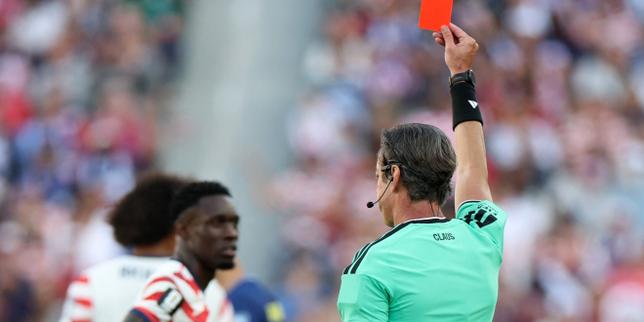
When the ball was clipped over the top into the vacated space, the cover was too late. A scrambling recovery run led to a clumsy challenge, a dangling leg, and a whistle that felt entirely inevitable. The referee had no choice. The VAR check was a mere formality.
The Cost of Neutralizing Your Own Attack
When a team decides to stop playing football and focus entirely on survival, they lose their primary psychological weapon: the threat of retaliation.
Throughout the first half, Arsenal’s transitions were sharp. They exploited PSG’s aggressive counter-press by using quick, vertical combinations through the center of the pitch. This forced the Parisian full-backs to hesitate before overlapping, knowing that an interception would leave their central defenders exposed in a two-on-two situation.
In the second half, that hesitation vanished. PSG realized there was no threat behind them. They pushed both full-backs into the final third, effectively turning their formation into an ultra-aggressive 2-3-5 system during sustained possession. This tactical shift completely overwhelmed the flanks, creating the numerical overloads that ultimately forced the defensive error leading to the penalty.
The Realities of Modern Refereeing Under Pressure
It is easy to blame the official for altering the course of a European final, but the modern game leaves very little room for interpretation on inside-the-box contact. The speed of the game has increased to a point where defenders can no longer rely on last-second recovery tackles.
If you allow an elite attacker to get their body between you and the ball inside the eighteen-yard box, you have already lost the exchange. Any contact from behind, no matter how slight, is a calculated gamble with terrible odds. The defender involved was caught between a desire to block the shot and the realization that he was on the wrong side of the attacker. It was an error born of desperation, not a lack of ability.
This highlights the shifting paradigm of defending in the VAR era. Defenders are now forced to play with a degree of physical restraint that goes against their natural instincts. You cannot slide blindly. You cannot use your upper body to unbalance an attacker in the same way you would in the middle third of the pitch. The penalty box has become a sterile environment where the slightest mechanical error is punished with maximum severity.
Where the Final Goes From Here
The equalizer fundamentally rewrites the psychological dynamic of the match. For PSG, the goal acts as a massive release of pressure, validating a possession-heavy approach that was beginning to look toothless. For Arsenal, the challenge is entirely mental. They must transition from a state of preservation back into an attacking mindset, a mechanical shift that is notoriously difficult to execute mid-game.
The managers now face a critical tactical crossroads. Luis Enrique must decide whether to chase the winner immediately using the momentum of the equalizer, or to stabilize his midfield to prevent a sudden counter-response. Arteta faces an even tougher calculation. He must abandon the low block that failed him and find a way to re-engage his forward line without exposing a back four that has already shown signs of structural fatigue.
The match is no longer about sophisticated tactical plans drawn up on a whiteboard in Surrey or Paris. It has devolved into a test of pure execution, physical stamina, and the ability to process tactical instructions under the most intense psychological scrutiny in club sports. The team that wins will not be the one with the better philosophy, but the one that manages the inevitable chaotic sequences better over the remaining minutes.