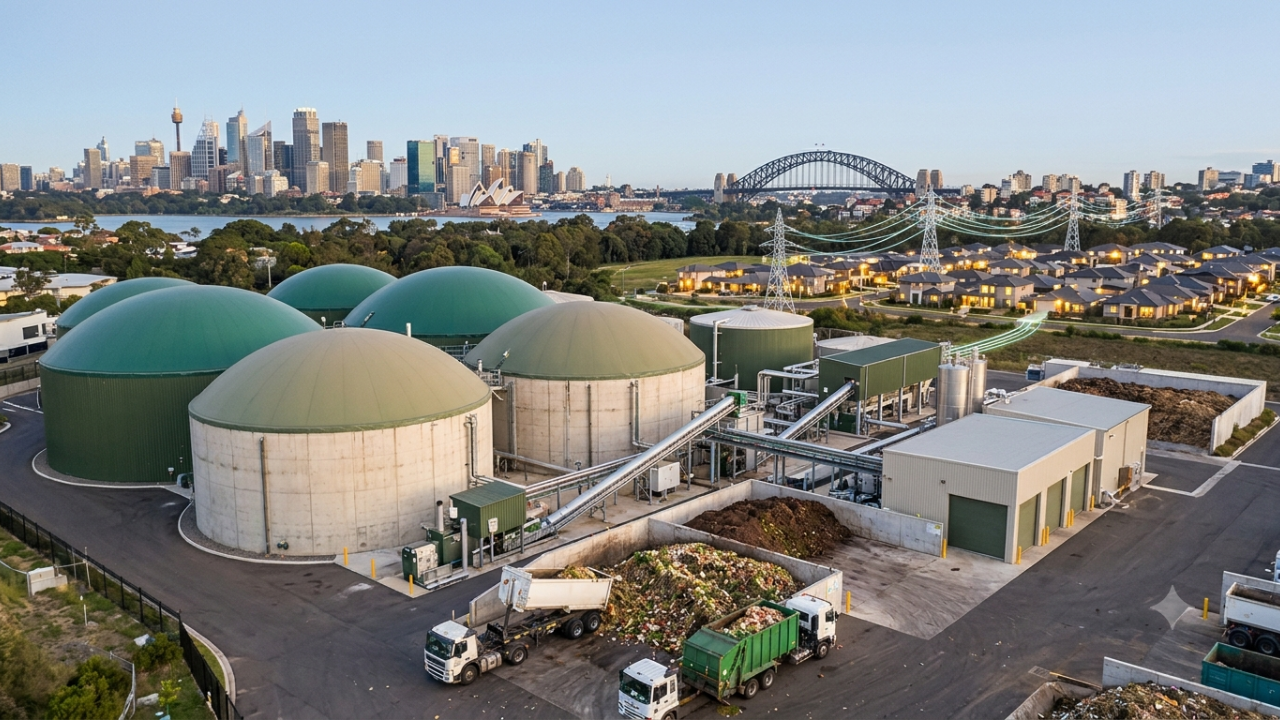
We've all tossed bruised fruit or forgotten leftovers into the bin, rarely thinking about where they go next. Most of that organic matter rots away in landfills, pumping methane directly into the atmosphere. But in Sydney, a quiet industrial revolution is turning yesterday's dinner scraps into electricity and agricultural fertilizer.
The reality of urban waste management is brutal. Landfills are filling up, and organic waste accounts for a massive chunk of harmful greenhouse gas emissions. Instead of watching food rot away in open pits, facilities like the upgraded EarthPower plant in Camellia are taking thousands of tonnes of commercial, industrial, and household food waste and putting it to work.
Sydney food waste isn't just vanishing anymore; it is actively keeping the lights on for about 4,000 local homes.
Inside the Anaerobic Digestion Process
You might wonder how a pile of discarded supermarket vegetables or restaurant scraps transforms into grid-ready electricity. It doesn't involve magic. It relies on a very old, very natural biological trick: anaerobic digestion.
When trucks arrive at the facility, they cross a weighbridge to log exact metrics before dumping solid and liquid organic streams into dedicated reception pits. Solid waste heads straight into a massive hydropulper. Water is added, and high-speed agitation strips away any single-layer packaging, shredding the material down into a thick, uniform liquid pulp.
This slurry goes straight into airtight anaerobic digesters. Inside these tanks, billions of specialized bacteria get to work. Because there is no oxygen present, the microbes consume the organic pulp and produce biogas as a natural byproduct.
That captured biogas is piped directly into cogeneration engines. These engines burn the gas to generate electricity, feeding green power straight back into the local energy grid. The facility even uses its own generated power and thermal output to stay entirely self-sufficient.
Why Sydney Food Waste Recycling Was Hard to Crack
Getting an operation like this to run smoothly is notoriously difficult. For years, Australia struggled with organic waste infrastructure, and early commercial plants faced severe operational hurdles. Food waste rarely arrives in a neat, uniform state. It comes mixed with packaging, grease trap waste, fluctuating moisture levels, and unwanted contaminants.
If you throw random debris into an anaerobic digester, the microbial balance breaks down and the system stalls. That is why recent heavy investments and technological revamps focus heavily on front-end sorting and buffer tank systems.
Advanced screening catches non-organic materials early. Specialized buffer tanks control the feed rate so the hungry bacteria inside the digesters never get overwhelmed. Managing a massive 62,500-tonne annual capacity requires surgical precision.
More Than Just Electricity
Energy generation is only half the story. The digestion process doesn't make organic matter disappear into thin air. Left behind is a nutrient-dense organic sludge.
If that sludge were dumped carelessly, it would create an environmental headache. Instead, the plant channels waste heat from the cogeneration engines into a large drying barrel. The moisture is baked out of the sludge, leaving behind a dry, granulated soil improver.
Local farms and horticultural markets buy this fertilizer to enrich depleted soils. It creates a true closed-loop system where food taken from paddocks returns as energy and restored soil.
What This Means for the Future of Waste
Scaling up projects like this requires massive cooperation between commercial food producers, supermarkets, and municipal authorities. When businesses stop treating food waste as a cheap disposal problem and start viewing it as a valuable feedstock, the entire economic model shifts.
Diverting thousands of tonnes of organic waste away from landfills directly cuts down municipal methane emissions. It proves that urban centers can generate localized renewable power without needing vast solar farms or offshore wind turbines.
Stop thinking of food waste as garbage. In Sydney, it is baseline power.