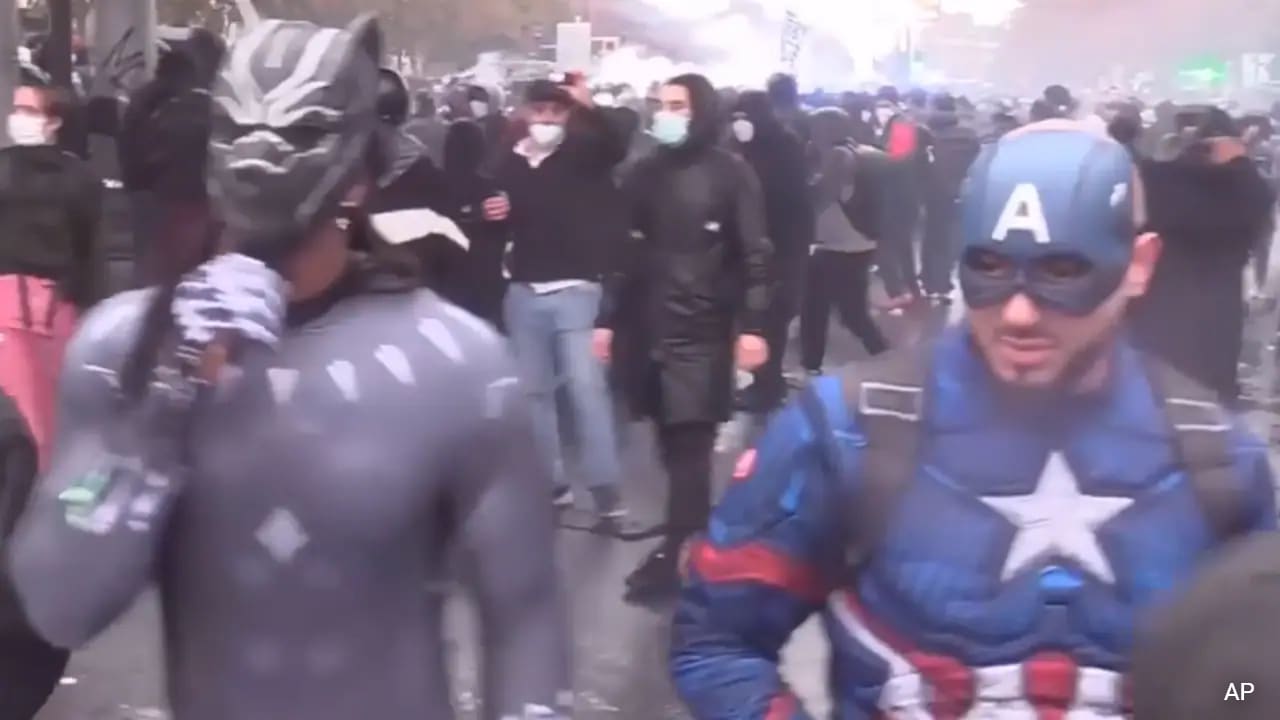
You're scrolling through your feed expecting tear gas, burning barricades, and angry chants from the latest demonstration in Paris, and suddenly Captain America walks into the frame right behind Black Panther. It looks like a leaked behind-the-scenes clip from a Marvel set, except the riot police in the background are completely real.
Those viral videos of costumed superheroes marching alongside French demonstrators aren't random pranks or lost comic-con attendees. They're deliberate, calculated street theater designed to hijack news cycles and visually outmaneuver heavily armored police lines.
When footage of Black Panther and Captain America joining France protests goes viral, most international viewers laugh at the absurdity and keep scrolling. That reaction misses the entire point of modern French protest culture, where visual symbolism often carries more weight than a megaphone.
What Actually Happened When Marvel Heroes Hit the Streets
If you've watched the viral clips circulating on social media, you've seen the exact contrast that makes these videos explode online. Against a backdrop of gray Parisian Haussmann buildings, black-clad riot units, and plumes of white smoke, figures dressed in full Wakandan vibranium armor and star-spangled suits stroll calmly through the crowd.
Let's be clear about what these clips actually show. These aren't official Marvel promotions, and they aren't isolated incidents from a single afternoon. Costumed protesters have appeared across multiple major waves of French unrest—from the Yellow Vest (Gilets Jaunes) demonstrations that erupted in 2018 to the massive 2023 pension reform strikes against raising the retirement age from 62 to 64.
In several widely shared videos from Paris, demonstrators wearing store-bought and custom-made Black Panther, Captain America, and Spider-Man suits marched directly with union members and student blocs. In one notable clip, a protester dressed as Captain America carries his signature shield while walking past lines of CRS (Compagnies Républicaines de Sécurité), the French national police's specialized riot control branch. Another shows Black Panther standing firm amid chanting crowds as flares light up the avenue.
The videos spread like wildfire because the visual dissonance is instant. You don't need to speak French or understand the nuances of Article 49.3 of the French Constitution to understand the image of Captain America facing off against riot shields.
Why French Protesters Use Pop Culture Costumes
French street demonstrations have a long, proud history of theatricality that goes way beyond holding cardboard signs. If you've ever covered or marched in a major Parisian manifestation, you know the atmosphere feels half-revolution, half-street festival—until the tear gas starts flying.
Bypassing Media Fatigue
News audiences suffer from severe protest fatigue. After the fifth consecutive weekend of strikes in France, major international outlets stop running standard photos of crowds holding union flags. Editors want something different.
Put Spider-Man, Pikachu, or Black Panther in the front row, and suddenly every news desk from London to New York picks up the footage. Protesters know this. Dressing up as an instantly recognizable global icon guarantees that cameras point at your banner instead of panning away.
Subverting the Visual Narrative of Violence
Authorities and conservative media outlets frequently frame large French protests around property damage and clashes with the black bloc—anarchist protesters dressed entirely in black to avoid identification.
A guy in a bright blue Captain America suit completely breaks that visual framing. It's almost impossible for a police spokesperson or a news anchor to paint a crowd as a menacing, faceless mob when Black Panther is calmly walking down the boulevard next to retirees and railway workers. The costume disarms the narrative before a single word is spoken.
Turning Pop Symbols Into Political Commentary
There's also a sharp layer of irony baked into these specific character choices. Think about what Captain America and Black Panther represent in global pop culture:
- Captain America is literally a symbol of fighting authoritarian overreach and standing up for the common citizen against corrupt institutions—even when his own government tells him to stand down.
- Black Panther represents sovereignty, resistance against exploitation, and protecting a community's resources from outside extraction.
- The Joker, another frequent sight at global protests from Beirut to Paris, symbolizes societal breakdown and the anger of people who feel ignored by the ruling class.
French demonstrators aren't just grabbing whatever Halloween costume was on sale. They're weaponizing American corporate intellectual property to critique Western economic policies, police militarization, and government decrees. Honestly, it's pretty brilliant.
The History Behind Costumed Protest in France
To understand why superheroes fit so naturally into French demonstrations, you have to look at how protest aesthetics evolved in France over the last decade.
During the Yellow Vest movement starting in late 2018, the high-visibility fluorescent vest itself became the ultimate democratic uniform. Anyone could buy one for five euros at a gas station. It erased class markers and created an instant visual identity that dominated global television screens for months.
Once the yellow vest became standard, protesters started experimenting with other recognizable uniforms to stand out within the sea of neon. By 2019 and 2020, French demonstrations regularly featured:
- Marianne lookalikes wearing Phrygian caps, referencing Eugène Delacroix's famous painting Liberty Leading the People.
- Handmaid's Tale costumes worn by feminist groups protesting restrictions on bodily autonomy and social protections.
- Clowns and medieval jesters mocking political leaders during pension and labor reform marches.
- Comic book superheroes like Spider-Man, Batman, Black Panther, and Captain America marching alongside union sound trucks.
During the 2023 pension protests, social media algorithms supercharged this trend. TikTok and X (formerly Twitter) reward short, visually jarring clips that require zero context. A ten-second video of Black Panther walking through tear gas smoke gets millions of views in hours, whereas a ten-minute speech by a CGT union leader gets a few thousand.
What Most People Get Wrong About Viral Protest Videos
Whenever a clip like the Black Panther and Captain America protest video goes viral, the comment sections fill up with predictable misconceptions. If you want to read international news without getting played by social media algorithms, watch out for three specific traps.
Trap 1: Assuming Old Footage Is Happening Right Now
Viral protest videos are recycled constantly. A clip of costumed demonstrators from the 2019 Yellow Vest protests or the 2023 pension strikes gets reposted every single time a farmer protest, student blockade, or labor strike hits Paris.
Always check the seasonal clues in the background. Look at what people are wearing beneath or around the costumes—heavy winter coats versus t-shirts—and check the union banners (like CGT, CFDT, or Sud Rail) to see which specific reform is being protested.
Trap 2: Thinking It Means the Protests Aren't Serious
Outside France, people sometimes see superhero costumes at a rally and assume the whole thing is a lighthearted street party. That couldn't be further from the truth.
The same demonstrations featuring Captain America and Spider-Man have involved massive nationwide economic disruptions, refinery blockades, garbage collector strikes that left thousands of tons of trash on Parisian streets, and intense clashes between demonstrators and police. The humor and theater coexist right alongside deep, genuine economic anger.
Trap 3: Believing Everyone in a Mask Is an Agitator
In France, face coverings at protests have been a major legal battleground. In 2019, the French parliament passed an "anti-rioter" law (loi anti-casseurs) that made concealing one's face during a demonstration without a legitimate reason a criminal offense punishable by up to a year in prison and a €15,000 fine.
Technically, wearing a full-face Black Panther or Spider-Man mask at a French demonstration puts a protester at legal risk of being stopped, fined, or detained by police—even if they're completely peaceful. That's why you'll often see costumed protesters pulling their masks up onto their foreheads when walking near heavy police cordons, only pulling them down when cameras roll in safer parts of the march.
How Social Media Changed Street Demonstrations Forever
Twenty years ago, the goal of a street protest in Paris was simple: get enough bodies onto the Boulevard Voltaire or Place de la République so that the evening news had to report the headcount. Union organizers argued with the Interior Ministry over whether 100,000 or 300,000 people showed up.
Today, headcounts matter less than viral moments. A single visually unforgettable clip can reach 20 million people globally before the march even reaches Place de la Nation.
Protesters understand the attention economy just as well as marketing agencies do. When someone puts on a Captain America shield and steps into a cloud of smoke in central Paris, they're creating a thumbnail image that algorithms can't resist promoting.
Journalists on the ground rely on these visual hooks too. Photojournalists covering a six-hour march look for frames that tell a story instantly—a grandmother handing water to a student, a wall of riot shields reflecting flares, or a Marvel superhero standing defiantly in the middle of a European capital.
How to Verify Viral Protest Clips Before Sharing Them
Next time you see Black Panther, Captain America, or any other unexpected figure pop up in a viral video from France, run a quick mental check before hitting repost:
- Inspect the street signs and storefronts: Paris street signs have a distinct blue-and-green rectangular frame with white lettering, and major avenues feature classic Haussmann-style limestone balconies. If the architecture doesn't match, the location caption is probably fake.
- Check the weather and foliage: Bare trees and heavy coats point to winter or early spring protests (like the January–March 2023 pension strikes), while leafy trees indicate late spring or summer demonstrations.
- Look at police uniforms: French CRS riot police wear dark navy blue uniforms with distinctive yellow stripes across their helmets, whereas the Gendarmerie Mobile wear blue stripes on their helmets. Seeing American or British police uniforms means the clip isn't from France at all.
- Search key terms in French: Plugging words like manifestation Paris super-héros or Black Panther manifestation France into a search engine will immediately tell you whether the footage comes from a current event or an older archive.
Visual protest theater isn't going anywhere—as long as cameras keep rolling on French boulevards, demonstrators will keep finding bold, absurd, and unforgettable ways to make sure the world looks at them.