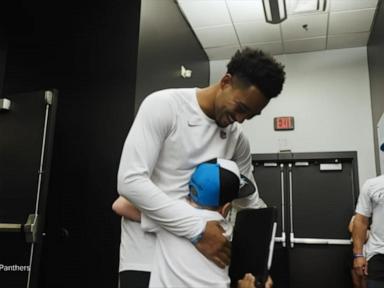
Hope is a fragile thing, especially when weighed down by hospital corridors, the rhythmic beep of monitors, and the quiet, heavy certainty of an illness that demands too much from a child.
In North Carolina, a young boy knew that world intimately. He knew the sterile scent of antiseptic. He knew the ache of long days spent watching the rest of the world run, jump, and play from behind a windowpane. Yet, his mind lived somewhere else entirely. It lived on a gridiron, under stadium lights that burned like artificial stars, where giants clashed and the roar of fifty thousand people washed away the pain. For a different perspective, read: this related article.
Football was not just a game to him. It was an escape hatch.
When you spend your childhood fighting a battle most adults cannot fathom, you anchor your spirit to something larger than yourself. For this boy, that anchor wore midnight black and process blue. The Carolina Panthers weren't just a local franchise; they were a symbol of resilience. They were a team built on grit, sudden surges of momentum, and the fierce belief that you could always fight your way back from a deficit. Similar reporting on this trend has been published by CBS Sports.
David Muir and the national spotlight often find stories of heartbreak, but occasionally, they capture the exact moment that heartbreak fractures to let the light in.
Consider what happens next: a knock on a door, a camera crew, and a revelation that bends reality.
The surprise did not arrive with a siren or a formal announcement. It unfolded with the careful choreography of a dream coming true. When the boy learned that his wish had been granted—that he was not merely going to watch his heroes from the nosebleed seats, but step directly into their world—the air in the room changed.
We forget what it feels like to anticipate pure joy. As adults, we armor ourselves against disappointment. We calculate risks, brace for impact, and temper our excitement. Children possess a terrifyingly beautiful capacity for total, unbridled surrender to happiness.
When he walked onto the turf at Bank of America Stadium, the vastness of the arena must have felt overwhelming. The green of the grass is sharper in person. The padding on the walls is thicker. The air smells of freshly cut sod, leather, and anticipation.
Then came the team.
Professional athletes are modern mythologies made flesh. They tower over ordinary mortals, moving with a terrifying, graceful speed. But strip away the helmets, the shoulder pads, and the multi-million-dollar contracts, and you find human beings who remember what it was like to be a kid sitting on a living room rug, staring up at a television screen, wishing on a star.
Players walked over. Helmets came off. Faces broke into genuine, unscripted grins.
There is a specific kind of magic that happens when a child meets their idol. It is an alchemy of awe and validation. In that brief exchange of words, high-fives, and shared laughter, the boy was no longer defined by his medical chart. He was a teammate. He was part of the huddle.
David Muir’s broadcast on World News Tonight shared this moment with millions, transforming a private miracle into a collective sigh of relief and happiness. People across the country paused their dinner routines, looked up at glowing screens, and felt the tight knot in their own chests loosen.
Why do these moments capture our collective imagination so fiercely?
Because deep down, we are all fighting invisible battles. We all carry weights that our coworkers, neighbors, and casual acquaintances never see. When we watch a sick child experience an afternoon of pure, uninterrupted magic, we project our own longing for redemption onto the scene. We want to believe that the world is fundamentally kind. We want proof that joy can pierce through the darkest circumstances.
The Carolina Panthers gave that boy a jersey, a football, and access to a sanctuary. But what they really handed him was a memory that cancer or chronic illness could never, ever touch.
Years from now, when the medical trials are long behind him and the hospital rooms are a distant echo, he will still remember the exact sound of cleats hitting the turf. He will remember the heavy weight of an official NFL helmet resting in his small hands. He will remember the way a 300-pound lineman looked down at him not with pity, but with absolute respect.
That is the true power of sports. It transcends statistics, standings, and Sunday afternoon television ratings. It builds bridges across the vast, lonely canyons of human suffering.
The stadium lights eventually dimmed that evening. The cameras packed up. The players went home to ice their bruised bodies and review game tape. The boy returned to his routine, but he carried a secret weapon back into the fight: proof that miracles do happen, and sometimes, they wear football jerseys.