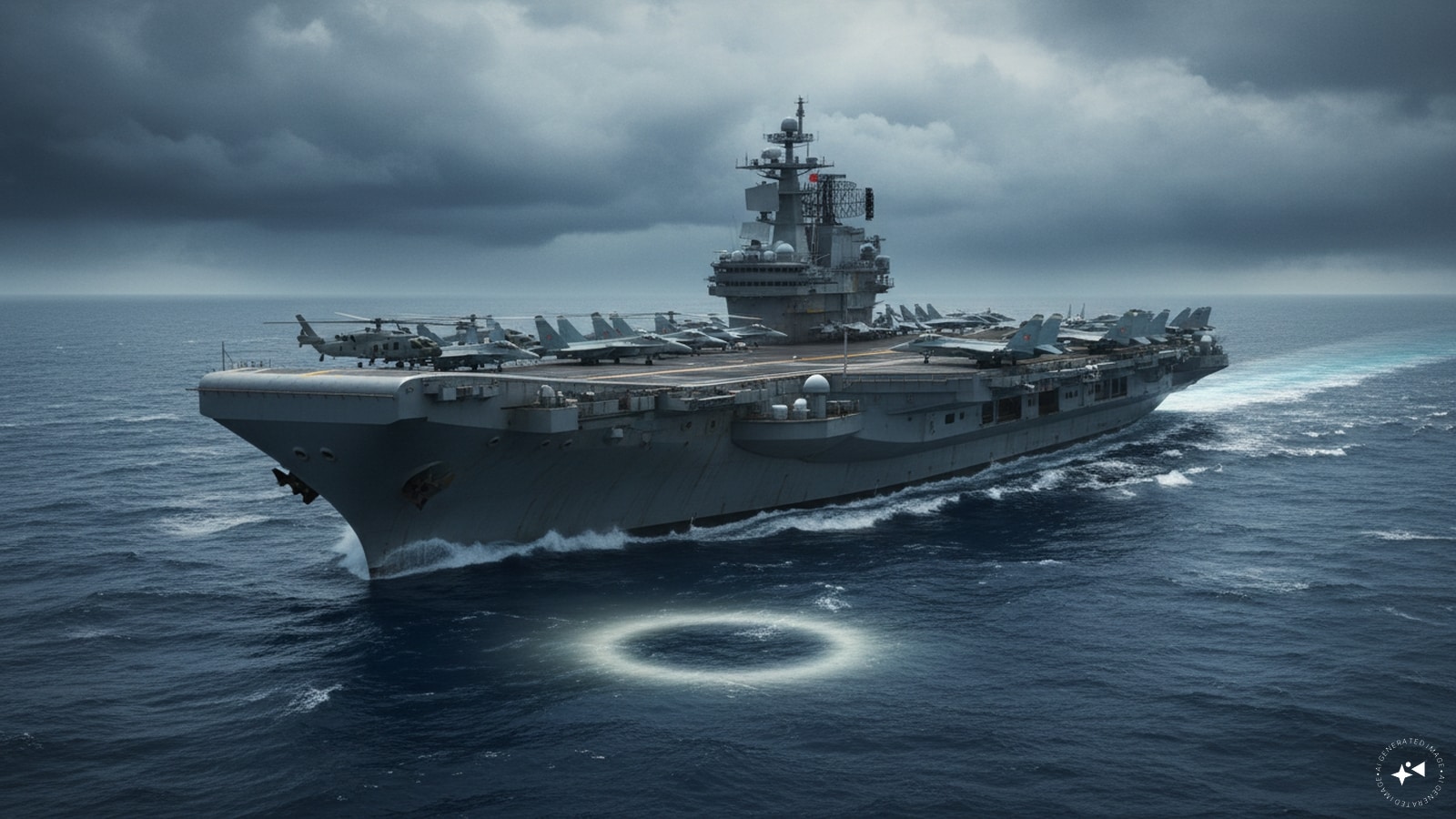
The strategic calculus governing modern carrier strike groups relies on an asymmetric friction point: while surface combatants project immense kinetic and political power, they remain tethered to vulnerable sensor, logistics, and escort networks. Recent defense analyses highlight that China's rapidly expanding aircraft carrier fleet—anchored by large platforms like the Type 003 Fujian and upcoming nuclear-powered hulls—faces severe exposure to undersea ambush. Evaluating this exposure requires moving past generalized threat assessments and dissecting the mechanics of naval architecture, anti-submarine warfare limitations, and the cost functions of blue-water power projection.
The Architectural Constraints of Surface Dominance
Aircraft carriers are fundamentally high-value, low-density assets. Constructing an 80,000-ton supercarrier demands immense capital, specialized industrial capacity, and years of shipyard availability. Because these platforms concentrate immense offensive output onto a single floating airfield, they create an oversized target for opposing naval planners.
The operational mechanics of a carrier group dictate that the capital ship cannot operate in isolation. It requires a continuous shield of destroyers, frigates, and replenishment ships to manage air defense, surface threats, and fuel logistics. However, this defensive screen introduces its own vulnerabilities. The physical footprint of a carrier strike group generates significant acoustic and electronic signatures, making total concealment in contested littoral zones or chokepoints practically impossible.
When opposing forces evaluate how to counter these fleets, the primary vector of exploitation shifts away from symmetric surface engagement and toward the subsurface domain. Submarines possess a high degree of acoustic stealth, allowing them to exploit gaps in an adversary's outer defense ring.
The Undersea Detection Deficit
The core vulnerability of China's carrier fleet stems from structural challenges in anti-submarine warfare. Operating a blue-water navy requires a mature, deeply integrated undersea surveillance architecture, including fixed acoustic sensor arrays, persistent maritime patrol aircraft, and advanced submarine-hunting surface combatants.
While the People's Liberation Army Navy has closed gaps in surface combatant manufacturing and air defense, its integrated anti-submarine warfare capabilities lag behind its surface fleet expansion. Detecting modern, ultra-quiet nuclear and air-independent propulsion submarines requires complex multi-static active sonar coordination and extensive open-ocean operating experience.
In noisy littoral environments, such as the shallow waters of the Western Pacific and key transit choke points, acoustic tracking becomes exponentially more difficult. Thermal layers, high commercial shipping traffic, and shallow bathymetry distort sonar returns. Consequently, a forward-deployed subsurface ambush force can establish firing positions inside the outer screening ring of a carrier group before being positively identified.
Cost Imposition and Strategic Trade-Offs
To fully comprehend the risk profile of China's carrier expansion, analysts must examine the economic asymmetry of the naval competition. Building and maintaining a carrier fleet imposes a massive recurring fiscal burden. Conversely, deploying subsurface assets, maritime mines, and distributed anti-ship networks demands significantly lower capital expenditure per unit of kinetic threat generated.
This dynamic creates a cost-imposition challenge. If opposing alliances utilize quiet attack submarines and unmanned undersea vehicles to persistently shadow Chinese carrier groups, Beijing is forced to divert disproportionate resources away from power projection and toward defensive screening. Every dollar spent on upgrading carrier escort capabilities or repairing damaged sensor nodes represents an opportunity cost against other military priorities.
Furthermore, the geographical reality of China's immediate maritime approaches works against unrestricted surface operations. Exiting the first island chain requires transiting heavily monitored straits where subsurface assets can lay in wait. The time-distance-force equation heavily favors an ambushing force that can operate with relative impunity beneath the thermocline.
Operational Friction in Blue-Water Transition
Transitioning from a regional defense posture to a global blue-water navy exposes a fleet to complex operational friction. A carrier is only as effective as its sortie generation rate, which in turn depends on uninterrupted aviation fuel replenishment, ordnance handling, and continuous maintenance cycles.
When a carrier group is constantly forced into high-readiness defensive postures to counter subsurface threats, its operational tempo degrades. Maneuvering to evade suspected torpedo contacts disrupts flight deck operations, alters planned flight paths, and places extreme mechanical strain on both the carrier and its escort vessels.
The long-term viability of the fleet hinges on whether auxiliary logistics networks can be protected from subsurface and cyber-electronic disruption. If the submarine threat forces carriers to operate further from contested zones to ensure survivability, the combat radius of their embarked air wings decreases, limiting their strategic utility in regional flashpoints.
Deploy advanced distributed undersea sensor grids paired with long-range, uncrewed autonomous underwater vehicles to continuously track carrier transit corridors, thereby forcing opposing fleets into perpetual defensive maneuvering and neutralizing their offensive initiative.


