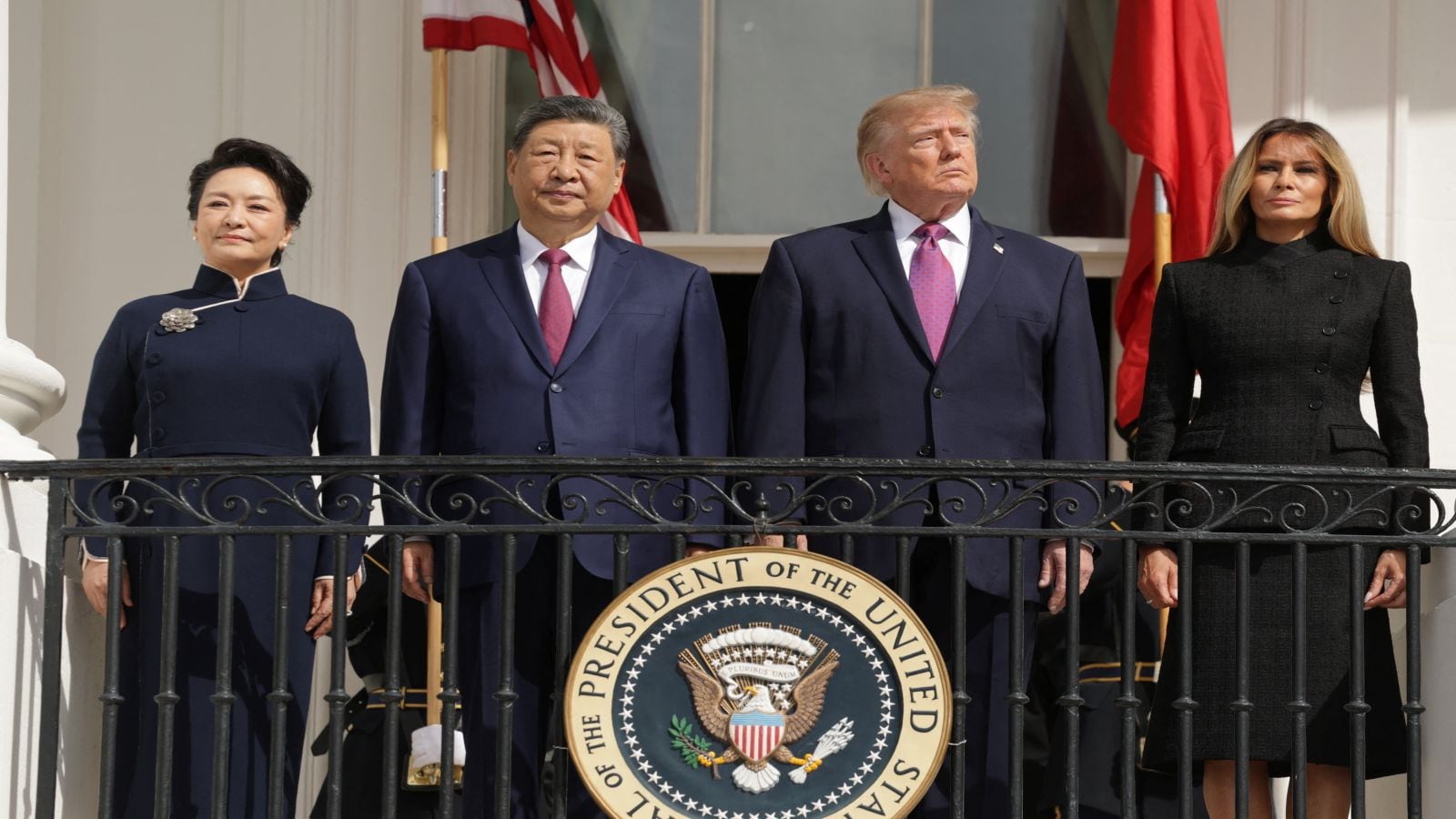
Great-power diplomacy is rarely evaluated through its formal communiqués; it is measured by the structural asymmetries exposed during the encounter. When Donald Trump welcomed Xi Jinping to Washington for a state visit, the visible display of pageantry—featuring military formations, state dinners at the East Room, and carefully choreographed bilateral sessions—masked a rigorous bargaining environment defined by hard constraints. Strip away the symbolism of the arrival ceremony, and the summit reveals a precise economic and strategic equation where both capitals operate under acute domestic and international pressures.
The Cost Function of Trade Truces and Bilateral Asymmetry
The decision to extend the Busan agreement—a temporary bilateral trade truce negotiated between Washington and Beijing—serves as the primary baseline for economic stability. However, analyzing this truce through conventional diplomatic metrics obscures its underlying cost function. For Washington, maintaining tariff mechanisms in reserve acts as a perpetual option value, allowing the executive branch to exert continuous pressure on Chinese export volumes without immediate domestic inflationary feedback loops. For Beijing, the imperative is securing predictability for industrial supply chains while preventing structural concessions that would impair long-term technological autonomy.
The friction points in trade negotiations are rarely about nominal purchase figures. Past state visits generated grandiose announcements of multi-billion-dollar aircraft and agricultural commitments that evaporated during post-summit implementation phases. This systemic misalignment stems from structural divergence in economic governance. Washington operates on a decentralized corporate model where export totals depend on private sector procurement decisions. Beijing operates on a centralized state-planning matrix where procurement targets can be mandated but are frequently weaponized or paused when counter-pressures arise.
Agricultural and energy purchases function as tactical bargaining chips rather than permanent structural integrations. When China agrees to buy American liquefied natural gas or agricultural commodities, it is executing a short-term risk-mitigation strategy to forestall broader tariff escalation. Conversely, Washington accepts these marginal purchase agreements to satisfy domestic constituency demands while deferring structural reforms on intellectual property protection and state-directed industrial subsidies. This transactional equilibrium prevents open economic warfare while institutionalizing chronic mistrust. Each side calculates that maintaining the fragile truce yields a higher net utility than precipitating a total structural break, yet neither invests in long-term economic convergence.
Technological Decoupling and the Artificial Intelligence Chokepoint
The most volatile vector of contemporary bilateral friction resides in artificial intelligence governance and semiconductor access. Recent regulatory postures from the United States Treasury and national security apparatus reflect a deliberate strategy of asymmetric containment. Advanced semiconductor export controls, combined with investigations into model distillation and algorithmic watermarking, create a high-friction operating environment for global tech conglomerates.
Beijing characterizes these controls as monopolistic pretexts designed to lock in American technological dominance, vowing retaliatory countermeasures if enforcement mechanisms expand. The economic mechanics of this dispute involve two competing network effects. The United States controls the foundational hardware layer through specialized chip architecture and advanced lithography equipment. China controls the downstream manufacturing ecosystem, rare earth processing nodes, and massive consumer datasets necessary for rapid iterative deployment.
During the Washington summit, the official AI dialogue served to institutionalize communication channels rather than resolve foundational disagreements. Neither power is willing to compromise its sovereign digital infrastructure. Washington views unrestricted compute access as an unacceptable national security hazard, while Beijing views compute restrictions as an existential threat to its industrial upgrading trajectory. The structural equilibrium, therefore, settles into a managed containment model where both sides agree on procedural guardrails while quietly accelerating indigenous substitution programs. The chokepoint strategy succeeds in slowing competitor velocity, but it simultaneously forces accelerated domestic R&D inside the targeted economy, eroding long-term technological monopolies.
Signaling Mechanisms in Territorial Deterrence
Taiwan remains the foundational red line of the bilateral architecture, operating as a binary risk variable where miscalculation triggers systemic conflict. Official diplomatic communiqués maintain the traditional declaratory posture of strategic ambiguity, but the operational reality relies on informal signaling and private diplomatic channels.
When heads of state convene, the rhetoric delivered in public press statements carries secondary weight compared to the private parameters established regarding military crisis communication. The establishment of regularized military dialogues aims to reduce the probability of operational accidents in the Taiwan Strait and the South China Sea. However, these communication mechanisms are frequently fragile, susceptible to suspension whenever either capital perceives a violation of core sovereignty markers.
The strategic asymmetry lies in the divergence of time horizons. Beijing views territorial reunification as a historical imperative governed by inexorable long-term metrics, whereas Washington views cross-strait stability through the lens of immediate deterrence credibility and alliance management in the Indo-Pacific. This temporal mismatch means that tactical concessions on trade or technology rarely translate into permanent détente on maritime security. Deterrence relies on maintaining credible military denial capabilities while signaling clear red lines to prevent inadvertent escalation into kinetic conflict.
The Multilateral Perimeter and Nuclear Escalation Pressures
Beyond bilateral friction, great-power competition increasingly incorporates multilateral alignments and nuclear posture metrics. Recent strategic assessments from Washington highlight the rapid expansion of China's nuclear arsenal, prompting calls for Beijing to integrate into formal strategic stability frameworks.
Beijing resists immediate inclusion in bilateral arms reduction architectures, arguing that its nuclear inventory remains defensive and vastly inferior to the combined strategic stockpiles of the United States and Russia. This dynamic introduces a classic security dilemma. As Washington seeks to constrain multi-theater nuclear proliferation, Beijing interprets these demands as an attempt to freeze its strategic modernization at a permanent disadvantage.
Furthermore, diplomatic maneuvers involving third-party actors—such as discussions surrounding regional security in the Middle East and evolving trilateral diplomatic vectors—demonstrate that bilateral summits are no longer isolated bilateral events. They are nodes in a broader geopolitical network where secondary flashpoints directly influence primary negotiations. When energy security, sanctions enforcement, and regional proxies enter the agenda, the bargaining space expands from bilateral trade balances to global order management. Each participant calculates their posture based on systemic exposure, ensuring that localized agreements remain contingent upon broader geopolitical alignments.
Strategic Trajectory
Navigating this structural impasse requires abandoning the expectation of comprehensive resolution. The diplomatic architecture between Washington and Beijing is not designed for permanent harmony; it is an engine for crisis management. Future interactions will be dictated by institutionalized friction management, where intermittent trade truces and tech dialogues prevent catastrophic economic decoupling while underlying structural competition intensifies across technological and maritime domains.
To understand how the visual and diplomatic framing was established during this visit, review the White House Arrival Ceremony Broadcast. This broadcast captures the arrival ceremony at the White House that set the visual and diplomatic tone for the bilateral talks.