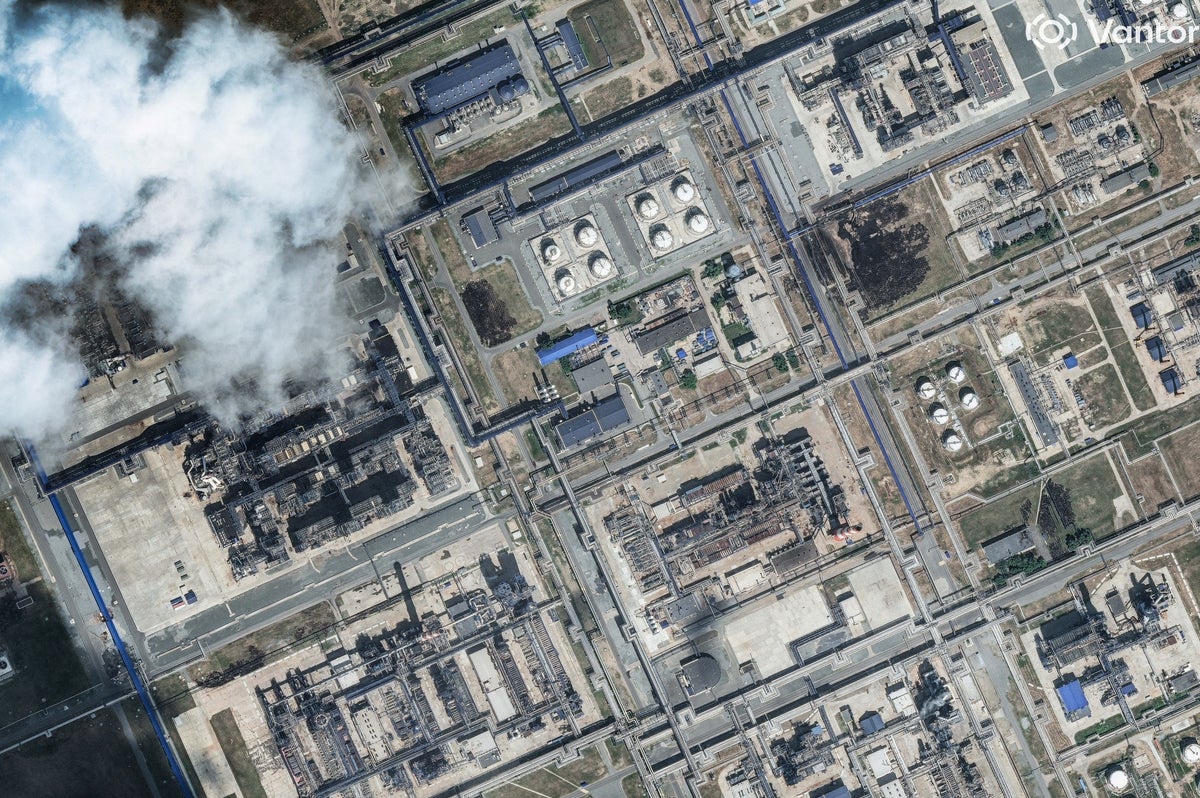
Geopolitical signaling rarely occurs in a vacuum. When strategic military strikes coincide precisely with high-level diplomatic engagements, analysts often misread the event as a tactical coincidence or a crude attempt to sabotage negotiations. A more rigorous interpretation requires evaluating the event through the lens of institutional timing, leverage creation, and supply-chain vulnerability. The reported strike against a primary Russian petroleum processing facility, executed immediately following the meeting between Ukrainian leadership and Donald Trump, demonstrates a calculated effort to alter the bargaining space rather than merely inflict localized infrastructure damage.
To understand this dynamic, we must deconstruct the mechanics of energy infrastructure targeting, the structural constraints of the Russian domestic fuel market, and the signaling protocols utilized by state actors under asymmetric conditions.
The Dual Architecture of Strategic Signaling
Diplomatic engagements involving principal stakeholders generate specific windows of volatility. When a state actor engages with a newly positioned or returning administration known for favoring rapid transactional resolutions to protracted conflicts, the incentives for shaping the operational environment multiply.
Diplomatic Timing and Asymmetric Leverage
In international negotiations, military operations executed during or immediately after summits serve two distinct signaling functions:
- Constraint Generation: By altering facts on the ground, the actor conducting the strike forces external mediators to account for new physical realities, preventing the diplomatic narrative from settling into a static stalemate.
- Credibility Demonstration: Declarative policy regarding military capacity is cheap; demonstrated capacity against high-value targets alters the perceived risk profile of the adversary.
The strike against the refinery functions as a physical punctuation mark in a broader diplomatic dialogue. It communicates to international observers that domestic economic pressure points remain accessible and vulnerable, regardless of broader diplomatic postures or proposed frameworks for conflict freezing.
The Domestic Russian Refining Vulnerability
Modern petroleum refining relies on continuous-flow processing units, specifically fluid catalytic crackers and hydrocrackers, which require precise thermal and pressure balances. These components possess two critical vulnerabilities:
- Proprietary Technology Dependency: Advanced refining units in major Russian facilities historically relied on specialized Western engineering, catalysts, and maintenance systems. Sanctions have severely restricted access to these replacement parts.
- Geographic Concentration: Refining capacity is not infinitely mobile. Striking a primary processing hub forces regional redistribution of refined products, straining logistics networks already burdened by military supply chains.
When a refinery sustains structural damage to its primary distillation columns, the repair timeline is measured in months rather than days. This creates a cascading domestic deficit in diesel and gasoline availability, forcing state planners to choose between supplying domestic civilian markets and fueling active military operations.
The Economic Cost Function of Energy Infrastructure Targeting
Evaluating the efficacy of refinery strikes requires moving beyond the immediate metric of barrel-per-day production loss. The true economic impact is found in second-order structural distortions.
Substitution Costs and Export Restrictions
Refineries convert crude oil into high-value export commodities. When primary distillation capacity drops, the state faces a stark optimization problem:
- Divert raw crude directly to international markets at a discount due to shipping constraints and price caps.
- Absorb the loss of refined product export revenues, which typically yield higher margins than crude.
- Impose domestic fuel export bans to stabilize local prices, directly sacrificing hard currency inflows.
[ Refinery Strike ]
       │
       ├──> Primary Distillation Damage ──> Domestic Fuel Shortages ──> Export Bans ──> Revenue Compression
       │
       └──> Replacement Bottleneck ──────> Extended Downtime ────────> Logistics Strain ──> Military Supply Friction
This matrix illustrates why energy infrastructure remains the primary economic pressure point for a resource-dependent economy. The friction is not merely the destruction of capital, but the forced operational inefficiency imposed on the entire distribution network.
The Capital Expenditure Deficit
Rebuilding specialized high-tech industrial infrastructure under conditions of severe technological isolation introduces exponential costs. Procurement must rely on secondary or tertiary supply chains, often involving complex sanctions-evasion networks that inflate unit costs and extend delivery timelines. Consequently, each successful strike compounds the long-term capital expenditure deficit of the sector, degrading future productive capacity long after the immediate conflict concludes.
Operational Execution and Information Friction
In assessing military operations against industrial targets, information asymmetry dictates the strategic value of the event. Official state statements regarding successful interdiction are routinely subject to verification challenges, requiring analysts to triangulate claims using secondary indicators.
Verification Indicators
Because direct, ground-level access to struck facilities is restricted, external analysts must rely on proxy data to measure structural impact:
- Thermal Anomalies: Satellite-based infrared radiometry detects abnormal heat signatures associated with extended flaring or structural fires at specific coordinates.
- Logistics Shifts: Variations in railcar routing and regional fuel tanker distribution patterns reveal domestic supply crunches.
- Official Retaliation Patterns: Shifts in the adversary's targeting priorities often serve as a reliable inverse indicator of successful infrastructural damage.
The alignment of a major infrastructural strike with high-level diplomatic exchanges guarantees maximum information velocity. The event bypasses normal intelligence channels, instantly capturing the attention of decision-makers and forcing an immediate reassessment of assumptions regarding escalation dominance.
Strategic Trajectory
The convergence of military interdiction and diplomatic signaling establishes a repeatable operational pattern. As long as asymmetric capabilities allow for precision strikes against critical nodes within the adversary's refining network, state actors will continue to utilize this mechanism to disrupt economic equilibrium during critical political junctures. The efficacy of these campaigns is measured not by immediate territorial gains, but by the steady accumulation of structural friction within the adversary's economic and logistical machinery.