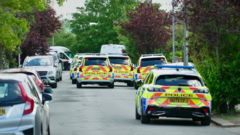
The transition from a containment-based standoff to a terminal force event represents a failure of the kinetic equilibrium between law enforcement and an armed subject. When police engage in an overnight standoff, they operate under a strategy of time-as-resource, attempting to degrade the subject’s psychological resistance while maintaining a perimeter. The moment this dynamic shifts to a fatal shooting, it indicates that the threshold of "imminent threat" was crossed, moving the encounter from a negotiation phase into a rapid-response defensive phase. Understanding why these events conclude with lethal force requires analyzing the interaction between spatial control, threat assessment cycles, and the psychological decay inherent in prolonged barricade situations.
The Triad of Tactical Escalation
Every police-involved shooting during a standoff is governed by three primary variables: the subject’s behavioral volatility, the physical geometry of the environment, and the department’s Use of Force policy.
- Behavioral Volatility: This involves the subject’s mental state, often exacerbated by sleep deprivation in overnight scenarios. Prolonged stress increases the likelihood of irrational decision-making, which police interpret as heightened unpredictability.
- Physical Geometry: The perimeter is not a static line but a shifting zone of risk. If a subject moves from a "hard cover" position (behind a wall) to an "open threshold" (a doorway or window) with a weapon, the tactical calculus changes instantly.
- Legal and Policy Thresholds: Officers do not fire based on the mere presence of a weapon but on the specific action or intent perceived through that weapon’s use.
The interplay of these factors creates a pressure cooker where the objective of "peaceful resolution" often clashes with the necessity of "officer safety."
The Mechanics of the Standoff Lifecycle
A standoff that lasts through the night follows a predictable lifecycle of energy and tension. Initially, the scene is defined by chaos as responders establish a perimeter. Once the site is contained, the situation enters a plateau phase. This is where negotiators attempt to establish rapport. However, the plateau is fragile.
In most terminal outcomes, the break in this plateau is triggered by a "precipitating action" by the subject. This might be as subtle as a change in posture or as overt as pointing a firearm at a tactical team. The data suggests that as a standoff crosses the six-to-eight-hour mark, the risk of a violent conclusion increases. This is largely due to the exhaustion of both the subject and the first responders. Tired officers experience a narrowing of their visual field and slower cognitive processing, while a tired subject loses the impulse control required to remain compliant.
The Threshold of Lethal Force
The legal standard for using lethal force generally rests on the "Reasonable Officer" standard—whether a similarly trained individual would perceive a threat to life. In the context of an armed standoff, this is quantified through the OODA Loop (Observe, Orient, Decide, Act).
- Observation: Officers monitor the subject’s hands and the orientation of their weapon.
- Orientation: The officer must process whether the subject’s movement is a defensive repositioning or an offensive lunging.
- Decision: A micro-second determination of whether the threat is "active."
- Action: The discharge of the firearm.
When an armed man is shot dead after an overnight standoff, it is almost always because the "Decide" phase was compressed by the subject’s sudden movement. The luxury of time, which was the primary tool during the negotiation phase, vanishes.
Spatial Control and the "Fatal Funnel"
Tactical teams view the environment through the lens of spatial dominance. A "standoff" usually occurs because the subject has occupied a position of advantage—a home or a vehicle. Law enforcement attempts to negate this advantage by using:
- Loud Hailers and Flashbangs: Sensory overload tools designed to disrupt the subject’s OODA loop.
- Chemical Agents: Gas is used to force a subject out of a hardened position into the open, where they can be more easily apprehended.
- Tactical Robots: These serve as a buffer, allowing for visual confirmation without risking human life.
The failure of these non-lethal interventions often leads to the final kinetic confrontation. If a subject refuses to be flushed out or, conversely, rushes the perimeter while armed, the tactical team is forced into a reactive posture. At this point, the "fatal funnel"—the narrow paths of entry and exit—becomes the site of the engagement.
Risk Factors in Overnight Engagements
Overnight standoffs present unique challenges that daytime incidents do not. The lack of ambient light necessitates the use of high-intensity floodlights and night vision, which can distort depth perception and heighten the subject’s sense of being under siege.
- Isolation: The dark environment isolates the subject, making the "negotiated reality" harder to maintain.
- Tactical Fatigue: Maintaining a high-alert perimeter for 8+ hours leads to "vigilance decrement." This is a documented psychological phenomenon where the ability to detect subtle cues of danger or compliance diminishes over time.
- Logistical Strain: Overnight operations require shifts in personnel. The transition of command between "A-watch" and "B-watch" is a period of heightened vulnerability where communication gaps can occur.
Assessing the Outcome: Success vs. Failure
From a purely analytical perspective, the death of a subject is viewed as a failure of the "de-escalation mandate." However, in a professional tactical review, the "success" of the operation is measured by the prevention of further loss of life—specifically the lives of bystanders and officers.
The tragedy of an armed man being shot by police is often the end result of a "suicide by cop" dynamic or a complete breakdown in the subject's mental faculty. In these instances, the police are no longer acting as investigators or negotiators; they are acting as a reactive force responding to a specific kinetic threat.
Tactical Recommendation for Future Containment
To mitigate the terminal outcomes of overnight standoffs, departments must shift from a "static perimeter" model to a "dynamic containment" model. This involves:
- Iterative Negotiation: Moving beyond the "negotiator on a phone" model to integrated mental health professionals who can provide real-time psychological profiling to the tactical commander.
- Automated Surveillance: Using drone technology to maintain eyes on the subject without putting officers in a position where they feel forced to fire prematurely to protect themselves.
- Strict Time-Bound Objectives: Implementing a protocol where tactical plans are refreshed every two hours to prevent the "fatigue trap" and ensure that the strategy is evolving as the subject’s mental state degrades.
The objective is to extend the "plateau" of the standoff until the subject’s capacity for violence is exhausted, rather than allowing the situation to escalate into a final, fatal confrontation.