Diplomatic negotiations aimed at resolving post-conflict governance in the Gaza Strip have entered a severe structural stalemate, driven by an unbridgeable information asymmetry between the United States-backed Board of Peace, the leadership of Hamas, and the Israeli administration under Prime Minister Benjamin Netanyahu. Following direct talks in Egypt between U.S. envoy Jared Kushner and Hamas leadership, followed by an immediate high-stakes delegation meeting in Jerusalem featuring Kushner, Board of Peace Director-General Nickolay Mladenov, and former British Prime Minister Tony Blair, the central point of friction is no longer the conceptual existence of a peace framework, but rather the execution sequencing and verification mechanisms of complete militant disarmament.
The diplomatic architecture relies on a phased transition model intended to shift administrative control of the enclave to the National Committee for the Administration of Gaza while dismantling military infrastructure. However, the operational reality on the ground exposes a profound sequencing dilemma. Prime Minister Benjamin Netanyahu publicly rejected the current fifteen-point roadmap, establishing a rigid operational constraint: Israeli Defense Forces will maintain territorial control and reject military withdrawals or reconstruction initiatives until absolute, verifiable disarmament of all heavy and light weaponry is executed. Conversely, Hamas demands that Israel implement initial commitments, including halting military operations and executing troop withdrawals to baseline positions, before any physical decommissioning of weapons occurs. This creates a zero-sum sequencing trap where each actor conditions its compliance on prior execution by the opposing party, freezing the operational timeline indefinitely.
The Information Asymmetry and Trust Deficit
The core failure mode of the current negotiation matrix lies in the absence of a verified, trust-minimized execution mechanism. The Board of Peace faces an acute verification problem. Without an independent international stabilizing force deployed inside the enclave, any claim of disarmament by militant factions remains unverifiable to the Israeli security apparatus.
From the perspective of Israeli strategic planning, a premature military withdrawal exposes the state to an immediate tactical vulnerability should militant infrastructure remain intact beneath civilian cover. The Israeli government operates under a high-risk penalty function: any verification failure regarding disarmament carries catastrophic national security costs. Therefore, the cabinet demands total, uncompromised transparency and structural proof of disarmament before yielding operational depth or territorial control, which currently encompasses roughly sixty percent of the Gaza Strip.
On the opposing side, Hamas and its regional interlocutors, including Egypt, Qatar, and Turkey, evaluate the U.S.-backed framework through the lens of political survival and irreversible leverage loss. Surrendering the entirety of their military capability prior to securing concrete milestones toward Palestinian self-determination and permanent Israeli withdrawal strips the organization of its sole leverage asset. The demand by regional powers—including Saudi Arabia and the United Arab Emirates—that Israel immediately adopt the roadmap shifts diplomatic pressure squarely onto Jerusalem, yet it fails to resolve the underlying mechanics of how verifiable disarmament can occur in a fractured urban combat zone without an intervening enforcement mechanism.
The Technocratic Governance Bottleneck
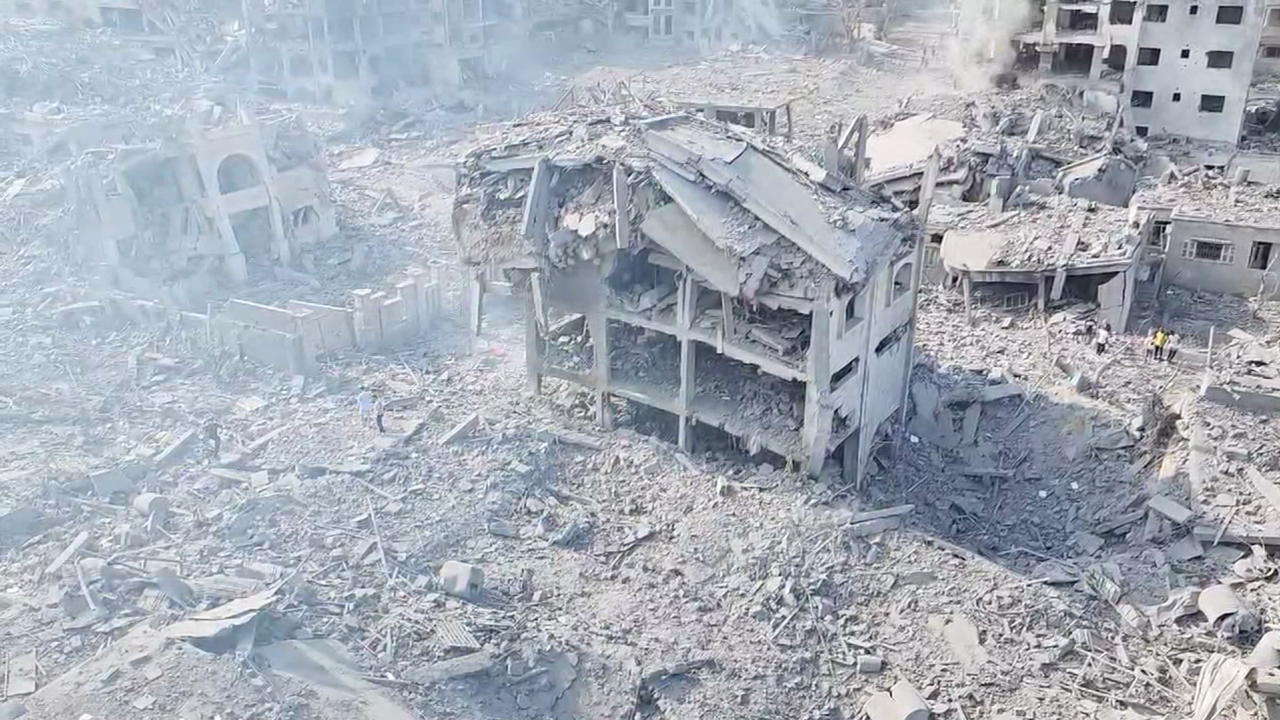
Beyond the military calculus, the transition of civil authority represents a separate logistical choke point. The proposed transfer of governance responsibilities to a technocratic body—the National Committee for the Administration of Gaza—requires functional security, physical access, and administrative infrastructure that currently do not exist within the war-demolished enclave.
The transition model assumes a clean separation between civil administration and security enforcement. In practice, establishing a technocratic administration requires an environment stabilized by an international security force capable of separating combatants and enforcing civil order. Because Israeli forces refuse to permit the deployment of these international stabilization forces or initiate withdrawals until comprehensive disarmament occurs, the technocratic committee remains locked out of the operational theater. This structural dependency forms a closed loop:
- Civil reconstruction requires international stabilization forces.
- International stabilization forces require a secured, demilitarized environment.
- Demilitarization requires complete disarmament by Hamas.
- Disarmament requires prior Israeli military withdrawal and cessation of hostilities.
- Cessation of hostilities and withdrawal require verified disarmament.
This circular logic prevents any single party from moving first without assuming total asymmetric risk.
Strategic Action and Execution Playbook
To break the current equilibrium, external mediators must bypass bilateral bargaining and alter the cost-benefit structure through verifiable, incremental milestones rather than all-or-nothing compliance demands.
The immediate tactical play requires the Board of Peace to establish an independent, third-party verification protocol with real-time telemetry and dual-key inspection rights over designated demilitarization zones. Rather than demanding total, instantaneous surrender of all arms across the entire territory, mediators must enforce a localized, phased handover model linked to immediate, reciprocal territorial handovers by the Israeli military.
Simultaneously, the deployment of the international stabilization force must be decoupled from total disarmament and instead tied to the physical securement of initial humanitarian and reconstruction corridors in designated sectors such as Rafah. By shrinking the scope of the initial verification boundary from a territory-wide mandate to a localized, strictly monitored pilot zone, negotiators can test compliance mechanics under controlled conditions. If compliance fails, the penalty function is automatically triggered via localized resumption of defensive operations; if compliance succeeds, the verified framework serves as a scalable template for adjacent sectors. The alternative—maintaining the current posture of reciprocal vetoes—guarantees the permanent paralysis of the diplomatic roadmap and the perpetuation of the operational status quo.

:max_bytes(150000):strip_icc()/lake-mead-173940030-5c25228846e0fb00014e8584.jpg)
