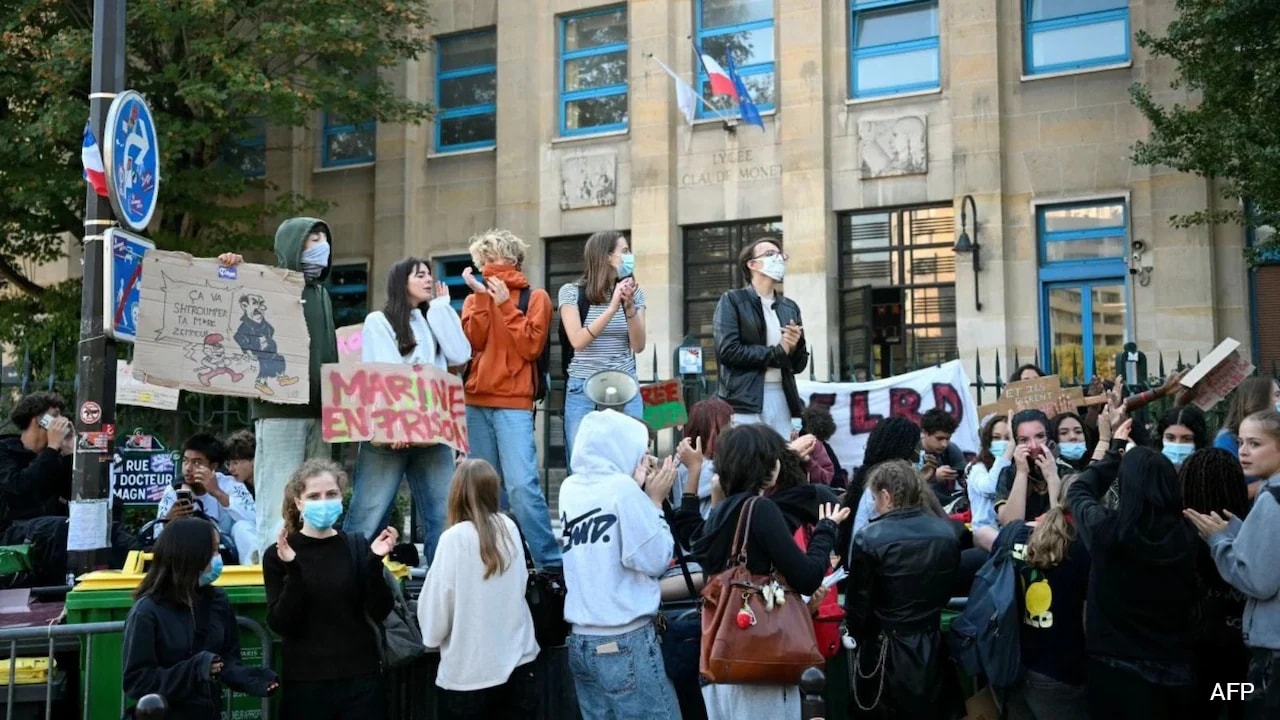
Mass demonstrations across secondary institutions expose a fundamental structural failure in resource allocation and institutional responsiveness. When an educational ecosystem enters its eighth week of coordinated blockades, the phenomenon ceases to be a localized disruption. It functions as a systemic indicator of institutional feedback failure. The operational mechanics behind the closure of hundreds of French lycées illustrate how decentralized civil disobedience weaponizes physical infrastructure to force state-level bargaining.
Understanding this crisis requires deconstructing the operational variables that convert low-level student grievances into nationwide paralysis. In similar news, we also covered: Inside the Siberian Lab Scare That Sparked Global Plague Rumors.
The Cost Function of Institutional Neglect
The grievances driving students to blockade campus gates with wheelie bins and construction debris are anchored in measurable deficits: chronically low staffing ratios, insufficient infrastructure investment, and opaque university admissions screening mechanisms.
When investment fails to scale linearly with enrollment density, schools absorb the stress through degraded service quality. The economic equation governing these demonstrations relies on an asymmetry of leverage. Students possess negligible institutional power within formal bureaucratic hierarchies. Their primary asset is disruption. By withholding educational participation and physically inhibiting access, students externalize the cost of administrative stagnation onto the state.
The Structural Mechanics of Student Mobilization and School Closures in France TIME has provided coverage on this fascinating topic in extensive detail.
news, business
Mass demonstrations and widespread institutional shutdowns do not materialize through spontaneous public sentiment; they operate as the predictable output of centralized student federation networks, acute socioeconomic friction points, and pre-existing institutional vulnerabilities. When hundreds of educational facilities close their doors across France amid coordinated youth unrest, the phenomenon reveals a distinct operational playbook. This dynamic relies on institutional bottlenecks, rapid mobilization economics, and structural friction between national policy directives and local labor realities. Understanding this friction requires setting aside superficial narratives of temporary public disorder and examining the precise mechanisms driving institutional paralysis.
The Mechanics of Institutional Vulnerability
The French public education apparatus features a highly centralized architecture, creating a single point of structural stress. Unlike decentralized school networks where operational decisions fragment across municipal or regional boards, the French secondary and higher education framework concentrates leverage at national decision-making nodes. When student unions target reforms affecting pension systems, retirement age thresholds, or curriculum adjustments, they exploit an asymmetric leverage model.
Closing a school does not require unanimous consent from the student body; it requires a critical mass capable of physical obstruction. By blockading access points with debris, chained furniture, or human chains during early morning operational windows, a small percentage of an enrolled cohort can effectively neutralize an entire facility. Administrators face a compounding security calculus. Liability laws, regional safety protocols, and the physical safety of minor students compel leadership teams to suspend classes rather than risk escalation.
This creates a disproportionate cost function for school operators. A minority of mobilized participants can impose high operational friction, forcing district administrators to choose between administrative paralysis or civil conflict at the school gates. The system lacks local elasticity, meaning a localized blockade in Marseille or Paris triggers systemic responses governed by centralized risk aversion.
The Economic and Logistical Friction Points
Student movements in France draw their operational continuity from specific structural grievances. These grievances generally cluster around purchasing power degradation, educational funding allocation, and structural reforms to post-graduation labor entry. When inflation compresses household budgets, youth cohorts experience an immediate squeeze in transportation costs, housing availability, and subsidized campus dining services.
The economic logic of the protest can be mapped through three distinct variables:
- Opportunity Cost of Disruption: For university students facing compressed wage growth and delayed entry into stable professional tracks, the short-term cost of missing lectures approaches zero, whereas the long-term utility of extracting policy concessions from the state appears significant.
- Logistical Interdependence: Modern educational institutions depend on synchronized public transportation networks. When youth coalitions coordinate with broader transport union strikes, the resulting friction creates cascading absenteeism among faculty and administrative personnel, rendering normal operations impossible regardless of student presence.
- Signaling Value: For national syndicates, physical closures serve as a high-visibility signal to the executive branch. Media coverage of barricaded entrances converts localized campus dissatisfaction into national political leverage, forcing the government to factor potential economic disruption into legislative timelines.
The State Response Function and Escalation Dynamics
The state’s reaction to widespread educational closures follows a distinct regulatory and security sequence. Initially, authorities attempt administrative containment by granting local rectors discretionary power to authorize temporary closures to preserve public order. However, prolonged closures trigger a secondary phase characterized by police deployment to clear access points.
This intervention frequently alters the escalation dynamics. The deployment of law enforcement around educational facilities often widens the coalition of participants. Moderate students who remained indifferent to the initial policy dispute frequently mobilize in response to images of police presence near campus gates. This transforms a targeted policy protest into a broader defense of academic autonomy and youth assembly rights.
Consequently, the state faces a strategic dilemma. Premature intervention risks amplifying the movement by validating student grievances regarding authoritarian overreach. Delayed intervention emboldens the syndicates, leading to broader inter-sectoral synchronization where high school students coordinate actions with university undergraduates and industrial labor unions.
Strategic Trajectory and Institutional Adaptation
The recurrence of systemic educational blockades in France points to a permanent structural vulnerability in the nation's governance model. As long as centralized reform initiatives bypass localized consultative frameworks, organized youth syndicates will retain an efficient, low-cost mechanism for disrupting state operations. Future administrative stability will depend less on containment tactics at school gates and more on restructuring how policy changes are communicated and negotiated before they reach the legislative implementation phase.