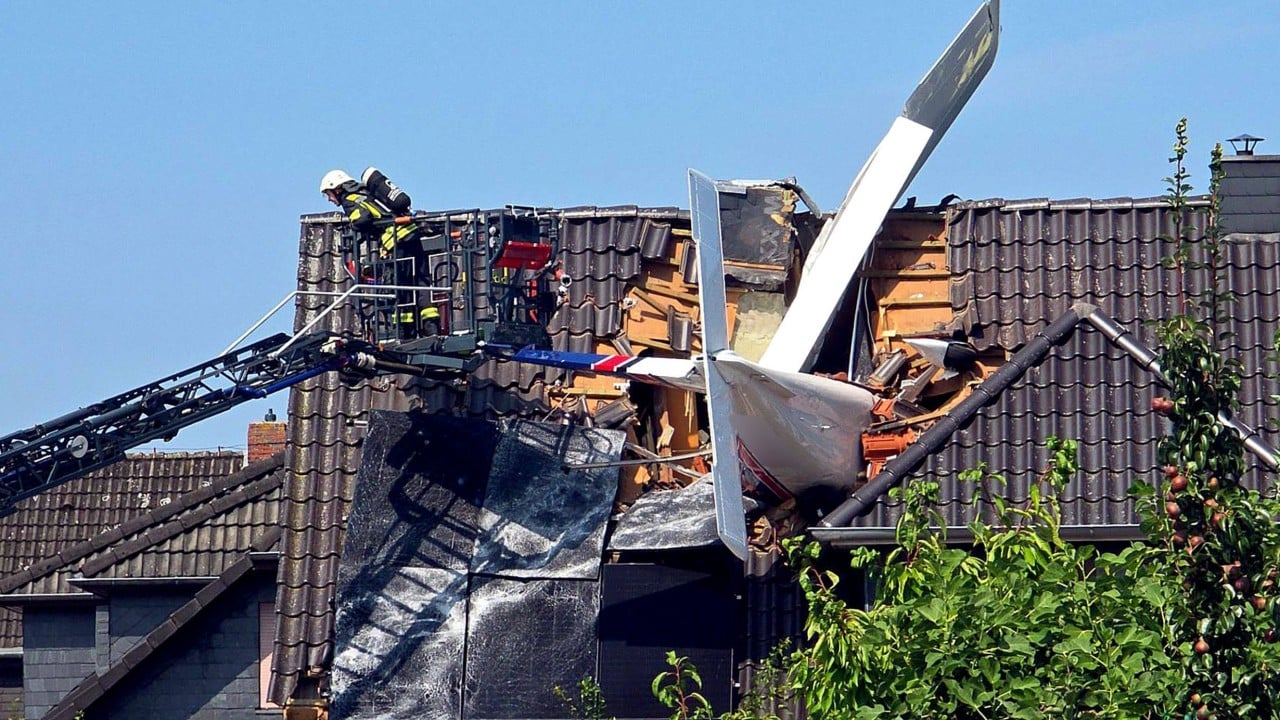
The kinetic profile of a residential aviation accident follows a strict physical blueprint defined by mass, velocity vector, and structural impedance. When a light aircraft collides with a domestic dwelling, the resulting catastrophe is rarely an unpredictable anomaly. Instead, it is the terminal intersection of human error, aerodynamic stall physics, and the low structural tolerance of residential framing against concentrated ballistic loads.
The recent fatal crash of a small aircraft into a residential structure in Germany, resulting in two fatalities, highlights a recurring pattern in general aviation safety. Standard reporting often focuses on the immediate human toll and the localized emergency response. This approach misses the broader systemic mechanisms that dictate why low-altitude failures disproportionately terminate in built environments. To understand these events, one must deconstruct the operational variables governing light aircraft terminal phases, the mechanics of residential kinetic energy absorption, and the urban planning failures that place domestic zones beneath high-risk flight paths. If you enjoyed this post, you should look at: this related article.
The Aerodynamic Mechanics of Terminal Phase Failures
General aviation accidents rarely occur at cruising altitude. Statistical distributions consistently concentrate risk within the takeoff and landing phases, where aircraft operate on the back side of the power curve. In this regime, any degradation of airspeed or thrust forces a rapid deterioration of lift.
When a small aircraft loses power or encounters an aerodynamic stall at low altitude, the pilot operates under severe temporal constraints. The decision space shrinks to seconds. Kinetic energy management becomes an exercise in triage. For another perspective on this development, refer to the latest coverage from The Guardian.
[Low-Altitude Engine Failure / Stall]
       │
       ▼
[Temporal Compression (< 30 Seconds)]
       │
       ▼
[Decisions Constrained by Obstruction Density]
       │
       ▼
[Forced Trajectory Alignment with Built Environment]
Without sufficient altitude to trade for airspeed, the aircraft's flight path vector is dictated by momentum and immediate ground obstructions. Urban sprawl and suburban zoning practices ensure that open fields are increasingly scarce near regional airfields. Consequently, the forced landing envelope almost invariably intersects with human habitation.
The physical variables governing this phase include:
- Wing Loading and Stall Speed: High-density configurations lower stall margins during maneuvers.
- Density Altitude: Temperature and pressure altitude reduce engine output and aerodynamic lift efficiency.
- Inertial Coupling: Low-altitude turns executed without coordinated rudder input accelerate yaw-induced spins, steepening the descent angle toward vertical.
Residential Structures as Kinetic Energy Sinks
A standard single-family home offers virtually no structural resistance to a fixed-wing aircraft. Residential framing relies on wood or light-gauge steel studs, drywall, and brick veneer. These materials are engineered to withstand gravity loads and wind shear, not dynamic impact forces from high-mass projectiles traveling at terminal approach speeds.
When a light aircraft strikes a house, the kinetic energy calculation determines the extent of structural collapse. Kinetic energy scales linearly with mass and quadratically with velocity. Even a small four-seat aircraft weighing two thousand pounds moving at eighty knots possesses massive destructive potential.
Upon impact, the aircraft's engine acts as a dense battering ram. Because the engine block represents the heaviest single component of the airframe, it maintains forward momentum long after the lighter composite or aluminum fuselage crumples. This concentrates the impact force onto a narrow surface area, easily breaching exterior walls and internal load-bearing partitions.
The subsequent fire hazard compounds the structural failure. Aviation fuel releases thermal energy rapidly upon atomization. Residential structures, filled with synthetic furnishings and timber framing, accelerate flashover conditions within minutes. The collapse mechanism shifts from mechanical shear to thermal degradation of structural integrity, trapping occupants and overwhelming local municipal response times before containment can be established.
The Urban Proximity Paradox
A critical systemic vulnerability in aviation safety involves the encroachment of residential zones around regional airports. Historically, small airfields were constructed in rural or semi-rural peripheries. Urban expansion over subsequent decades enveloped these facilities, creating high-density neighborhoods directly beneath departure and arrival corridors.
This proximity introduces a compounding risk factor. The probability of an off-field landing impacting a structure increases proportionally with the density of the surrounding real estate. Pilots experiencing engine anomalies near airports face a binary choice: attempt a perilous turn back to the runway, a maneuver fraught with spin hazards, or select a forced landing spot straight ahead. Straight-ahead options are increasingly occupied by housing developments.
Municipal planning agencies often fail to enforce strict land-use zoning in accident-prone departure and arrival zones. Clear zones and runway protection zones exist to mitigate this exact vulnerability, yet pressure for commercial and residential development frequently overrides aviation safety buffers. When an aircraft suffers a catastrophic failure within three miles of a runway, the lack of sterile buffer zones transforms minor mechanical failures into fatal residential disasters.
Mitigating Low-Altitude Urban Impact Risk
Reducing the frequency of residential aviation fatalities requires targeted structural interventions across pilot training, airframe technology, and airspace management.
Flight training curricula must shift emphasis toward off-field landing discipline. Pilots are frequently conditioned to attempt runway saves, which can lead to low-altitude stalls. Emphasizing controlled descent into non-structural terrain, even if sub-optimal, reduces the lethality profile compared to an uncontrolled spin into a dwelling.
On the manufacturing front, the broader adoption of whole-airframe parachute systems in modern general aviation fleets changes the survival calculus. By deploying a ballistic parachute, the aircraft's terminal descent vector is arrested, converting a chaotic, high-velocity directional crash into a controlled vertical descent. While parachutes do not eliminate ground impact risks, they preserve directional stability and reduce kinetic energy at the point of contact, lowering structural penetration limits.
Airspace integration also demands modernization. The proliferation of electronic flight bag technologies and mandatory ADS-B tracking provides high-resolution data on flight paths. Analyzing recurring low-altitude deviation vectors near regional airports allows safety boards to identify high-risk corridors before structural failures occur.
The intersection of general aviation and residential geography remains a persistent vulnerability in transportation safety. Addressing it requires moving past the categorization of these events as isolated tragedies and treating them as predictable failures of kinetic energy management within built environments.
Implement mandatory geofenced safety corridors around regional airports, restricting high-angle departure profiles over residential zones while simultaneously mandating ballistic recovery system retrofits for all certified single-engine aircraft operating within high-density airspace.