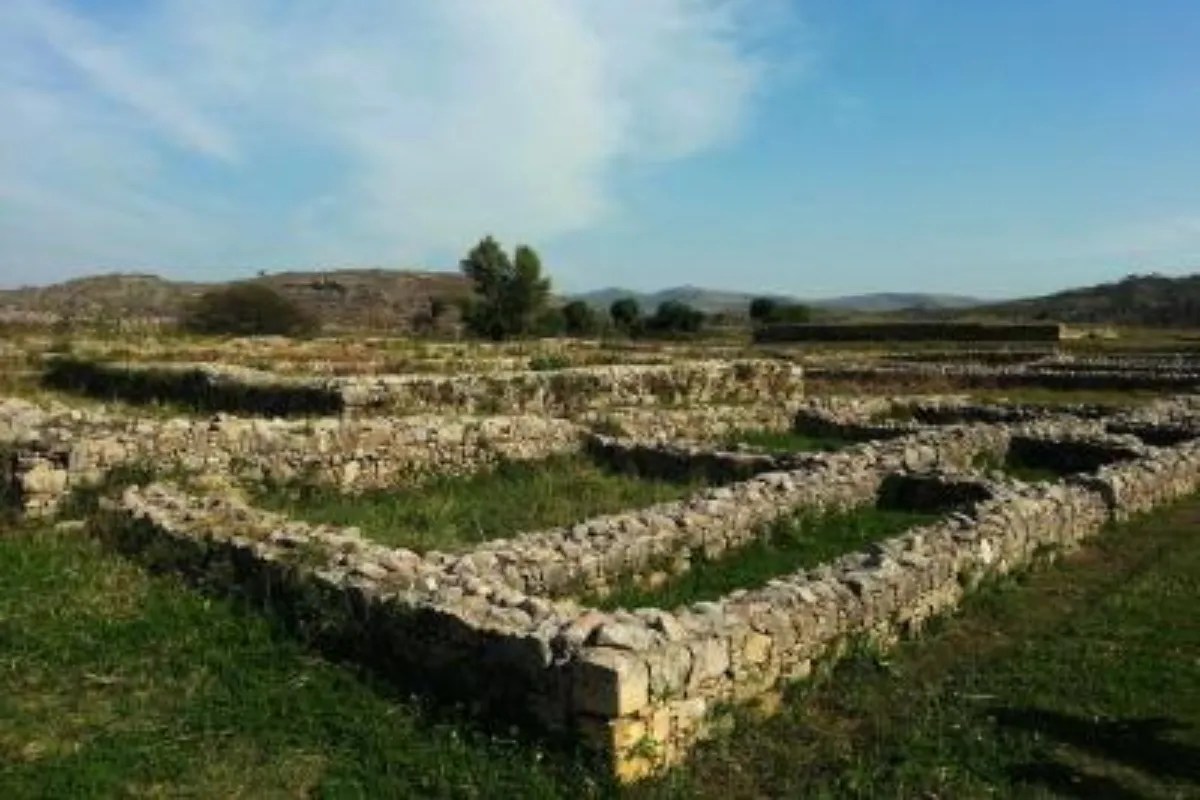
The institutional conflict between UNESCO and Pakistan’s Punjab Archaeology Department over the ancient city of Taxila exposes a fundamental systemic vulnerability in heritage management: the prioritization of civil engineering and visitor metrics over structural authenticity. When UNESCO issued a formal ultimatum threatening to reclassify portions of the 2,000-year-old Vedic and Buddhist complex—specifically the sites of Sirkap and Mohra Moradu—to the List of World Heritage in Danger, it underscored a failure of conservation logic.
This crisis is not an isolated administrative dispute. It represents a direct clash between two irreconcilable preservation philosophies: structural stabilization through historical continuity and aesthetic renewal through modern masonry. By using contemporary materials like cement and uniform, polished stonework to rebuild and elevate ancient walls, localized authorities compromised the structural integrity and historical authenticity that justified the site's World Heritage inscription in 1980. Read more on a related issue: this related article.
The Conservation Matrix: Authenticity versus Infrastructure
To evaluate why the interventions at Sirkap and Mohra Moradu triggered international condemnation, the work must be analyzed through the core components of the UNESCO Operational Guidelines for the Implementation of the World Heritage Convention. These guidelines establish a rigid framework governing two key variables: authenticity (the material, craftsmanship, and setting of the asset) and integrity (the physical wholeness and intactness of the site).
The structural vulnerabilities introduced by the Punjab Archaeology Department can be categorized across three distinct execution failures: More reporting by The New York Times delves into comparable perspectives on the subject.
- Material Incompatibility: The introduction of modern Portland cement into historical masonry systems represents a critical physical risk. Ancient structures at Taxila utilize non-hydraulic lime mortars or dry-stone corbelled masonry, which possess specific thermal expansion coefficients and moisture-permeability rates. Cement acts as an impermeable barrier. It traps moisture within the adjacent, porous ancient stones, accelerating freeze-thaw degradation and salt efflorescence, which eventually pulverizes the original material.
- Geometric Distortion: Photographic evidence and whistleblower documentation transmitted to UNESCO in March established that original masonry walls were not merely stabilized; their vertical profiles were systematically elevated. Altering the structural height of a foundational ruin permanently distorts the spatial logic of the archaeological stratum, invalidating subsequent stratigraphic analysis.
- Visual Uniformity: The replacement of irregular, hand-hewn ancient stone courses with polished, standardized modern materials replaces historical variance with an artificial, contemporary aesthetic. This creates a false historical record, confusing the visual data essential for academic and archaeological interpretation.
Institutional Divergence and the Denominator Problem
The underlying cause of the degradation at Taxila stems from a bureaucratic decoupling within the domestic governance structure. The Ministry of National Heritage and Culture Division, alongside the federal Department of Archaeology and Museums (DOAM), operates as the diplomatic liaison to international bodies. However, localized execution falls under provincial entities, specifically the Punjab Archaeology Department.
This decentralized structure creates an operational bottleneck characterized by distinct operational objective functions:
[International Level: UNESCO]
Objective: Maximize Historical Fidelity & Structural Authenticity
       |
[Federal Level: DOAM / Ministry of Heritage]
Objective: Maintain Diplomatic Credibility & Secure Future Inscriptions
       |
[Provincial Level: Punjab Archaeology Department]
Objective: Maximize Visitor Throughput, Visual Uniformity & Engineering Velocity
Provincial bodies frequently interpret heritage preservation through the lens of urban planning and civil engineering. Under the Taxila Archaeological Heritage Master Plan, success metrics are often skewed toward infrastructure durability and tourism monetization rather than strict adherence to low-intervention preservation standards. When local officials defend their actions as necessary stabilization measures to prevent deterioration, they reveal a profound misunderstanding of the Venice Charter (1964). This international standard establishes that restoration must terminate where conjecture begins, and any necessary reinforcing material must always be distinct from the original fabric.
Strategic Diplomatic and Economic Repercussions
The operational errors at Taxila carry significant downside risks for Pakistan’s broader cultural and economic strategies. The immediate penalty for non-compliance is relegation to the List of World Heritage in Danger, a classification previously used by UNESCO to signal catastrophic site mismanagement, such as the actions that led to the delisting of the Dresden Elbe Valley in Germany.
The institutional damage extends along two main fronts:
The Expansion Bottleneck
Pakistan currently holds 24 sites on the UNESCO Tentative List, awaiting formal nomination and upgrade to World Heritage status. These include critical archaeological assets such as Rani Ghat in Khyber Pakhtunkhwa and the Scytho-Parthian ruins at Bhanbhore in Sindh. By demonstrating an inability to enforce international preservation standards at an existing site, the state severely damages the credibility of its pending applications. The international evaluation panels, managed by the International Council on Monuments and Sites (ICOMOS), weigh past management performance heavily when assessing new nominations.
The Capital Allocation Deficit
World Heritage status functions as a validation mechanism that attracts foreign direct investment, international research grants, and specialized multilateral conservation capital. Downgrading Taxila signals to international philanthropy and institutional donors that capital deployed into Pakistani heritage infrastructure is subject to misallocation and unscientific intervention. This reduces the pool of available external funding, shifting the entire financial burden of site maintenance back onto an already strained national treasury.
Remediation Protocol and Technical Requirements
Reversing the damage inflicted upon Sirkap and Mohra Moradu requires an immediate halt to ongoing construction and the deployment of a rigorous, multi-step scientific remediation framework. The Punjab Archaeology Department’s assertion that there is "no question of reversing" the work must be corrected through federal executive intervention to prevent the permanent loss of international certification.
The technical remediation protocol requires the following immediate actions:
- Deconstructive Masonry Audit: A comprehensive structural mapping of all walls modified since the initiation of the project must be executed. This requires non-destructive testing (NDT), including ground-penetrating radar and digital photogrammetry, to isolate modern interventions from original substrates.
- Chemical Extraction of Modern Mortars: All Portland-based cements introduced into the ancient stonework must be micro-mechanically extracted. This delicate process must be performed by certified conservators to ensure the structural face of the underlying ancient stone is not fractured during the removal of the rigid modern mortar matrix.
- Adherence to the Anastylosis Principle: Any future stabilization must strictly employ the principle of anastylosis—realigning disassembled original elements using minimal, chemically compatible, and completely reversible modern bonding agents (such as hydraulic lime mortars matched to the chemical profile of the site’s historical materials). All new stones used for critical structural load-bearing support must be left unpolished and physically stamped with the year of intervention to prevent historical forgery.
The long-term resolution of the Taxila crisis depends on transforming the domestic management framework from an engineering-driven approach into an investigation-led discipline. If the provincial authorities fail to integrate international heritage guidelines directly into their local procurement contracts, the degradation of the site will continue. This structural failure will ultimately lead to delisting, permanently harming the region's historical legacy and international standing.