The operational mechanics of asymmetric warfare rely on the exploitation of economic asymmetries. When the Ansar Allah movement, commonly known as the Houthis, targets Saudi Arabian airports with unmanned aerial vehicles and ballistic missile systems, standard military analysis often mischaracterizes these events as isolated tactical strikes. This approach misses the strategic objective. The campaign represents a systematic calculation designed to impose maximum economic friction on an asymmetric opponent through low-cost, high-yield kinetic pressure.
To understand the trajectory of the conflict, analysts must dissect the cost function governing these attacks. Traditional air defense architecture is economically unsustainable when pitted against mass-produced, low-cost loitering munitions. A Patriot or similar interceptor missile system incurs capital expenditures that routinely exceed millions of dollars per deployment, whereas an offensive drone platform can be manufactured for a fraction of that cost. This delta creates an economic depletion strategy. The primary metric of success for the striking force is not solely the physical damage inflicted upon terminal facilities or runway infrastructure, but the compounding financial and operational friction forced onto the defending state and its commercial partners.
The Tripartite Friction Matrix
The offensive strategy operates across three distinct vectors, each engineered to degrade national operational capacity without requiring conventional military parity.
Capital Expenditure Asymmetry
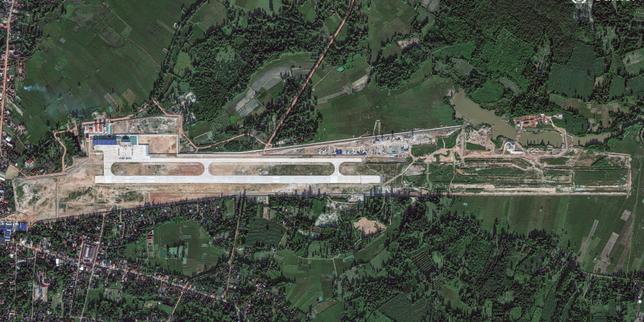
The financial burden of maintaining persistent defensive readiness dwarfs the capital required to execute sporadic offensive volleys. Saudi civil aviation hubs, while fortified with advanced multi-tier missile defense umbrellas, possess massive surface areas that cannot be hermetically sealed. Every operational disruption—whether a temporary suspension of ground operations or a diversion of inbound wide-body commercial aircraft—forces structural inefficiencies onto national carriers and regional logistics networks.
Investor Sentiment and Insurance Premiums
Critical infrastructure vulnerability directly alters risk pricing models for foreign direct investment and regional commerce. When civil aviation nodes become targets, international underwriting syndicates reprice maritime and aviation insurance risk across the entire Arabian Peninsula. The resulting surge in premiums acts as a systemic tax on non-oil commercial sectors, complicating national diversification initiatives such as Vision 2030 by introducing persistent geopolitical risk premiums into foreign capital calculations.
Strategic Divergence in Coalition Objectives
The timing of these campaigns often correlates with diplomatic impasses or stalemated multilateral negotiations. By maintaining a baseline kinetic tempo against civilian-military dual-use facilities like Abha or King Abdullah International Airports, the Sanaa-based leadership imposes political costs on the Saudi-led coalition. The objective is to fracture the coalition's internal consensus by forcing participating states to weigh the ongoing cost of defensive posture alignment against diminishing returns in regional power projection.
Logistical Bottlenecks and Defense Limitations
Military analysts frequently overestimate the efficacy of point defense systems against saturated, low-altitude trajectories. Ballistic trajectories can be tracked through radar telemetry and intercepted with high probability, but low-flying delta-wing or rotary drones flying complex terrain-masking paths exploit radar horizon limitations.
This introduces a persistent detection deficit. Ground-based radar arrays face geographical and curvature-of-the-earth constraints when attempting to detect low-radar-cross-section targets approaching over complex topography. Consequently, defending forces are forced into a reactive posture, relying on expensive airborne warning and control systems or dense point-defense batteries that cannot be ubiquitously deployed across every provincial airport.
The resulting operational bottlenecks manifest in three ways:
- Capacity Restriction: Temporary airspace closures reduce throughput at vital regional transit hubs, delaying passenger and cargo movement.
- Maintenance Strain: High operational tempos wear down sophisticated radar and interceptor components, creating maintenance backlogs and logistical dependencies on external defense contractors.
- Personnel Fatigue: Sustained high-alert rotations degrade human performance metrics among defense operators, increasing the statistical probability of system or tactical oversight during multi-vector engagements.
The Macroeconomic Toll on Regional Integration
The long-term objective of persistent airport targeting extends beyond immediate kinetic disruption; it seeks to alter the calculus of regional economic integration. Saudi Arabia's strategic pivot toward becoming a global logistics, tourism, and financial powerhouse depends on unhindered, predictable connectivity.
When commercial aviation is framed as a contested battlespace, international carriers reassess route profitability. The substitution effect takes hold: business travelers and cargo operators seek alternative regional hubs that are insulated from kinetic spillover. This structural shift drains talent, capital, and regional headquarters potential away from the targeted economy, achieving strategic objectives through indirect economic attrition rather than battlefield conquest.
Strategic Forecast
As long as the fundamental power asymmetry persists—characterized by high-cost defensive requirements versus low-cost offensive capabilities—kinetic pressure against civil-military infrastructure will remain a core instrument of coercion. Future engagements will likely feature enhanced electronic warfare integration, utilizing GPS-spoofing countermeasures and autonomous swarming tactics designed to overwhelm localized interception capacities entirely.
Mitigating this vulnerability requires a pivot away from purely kinetic interception models toward directed-energy solutions, low-cost electronic countermeasures, and localized counter-uas jamming grids capable of neutralizing threats prior to terminal airspace entry. Until these defensive economies of scale are achieved, the strategic initiative remains skewed toward the actor capable of imposing disproportionate economic and operational friction at minimal cost.