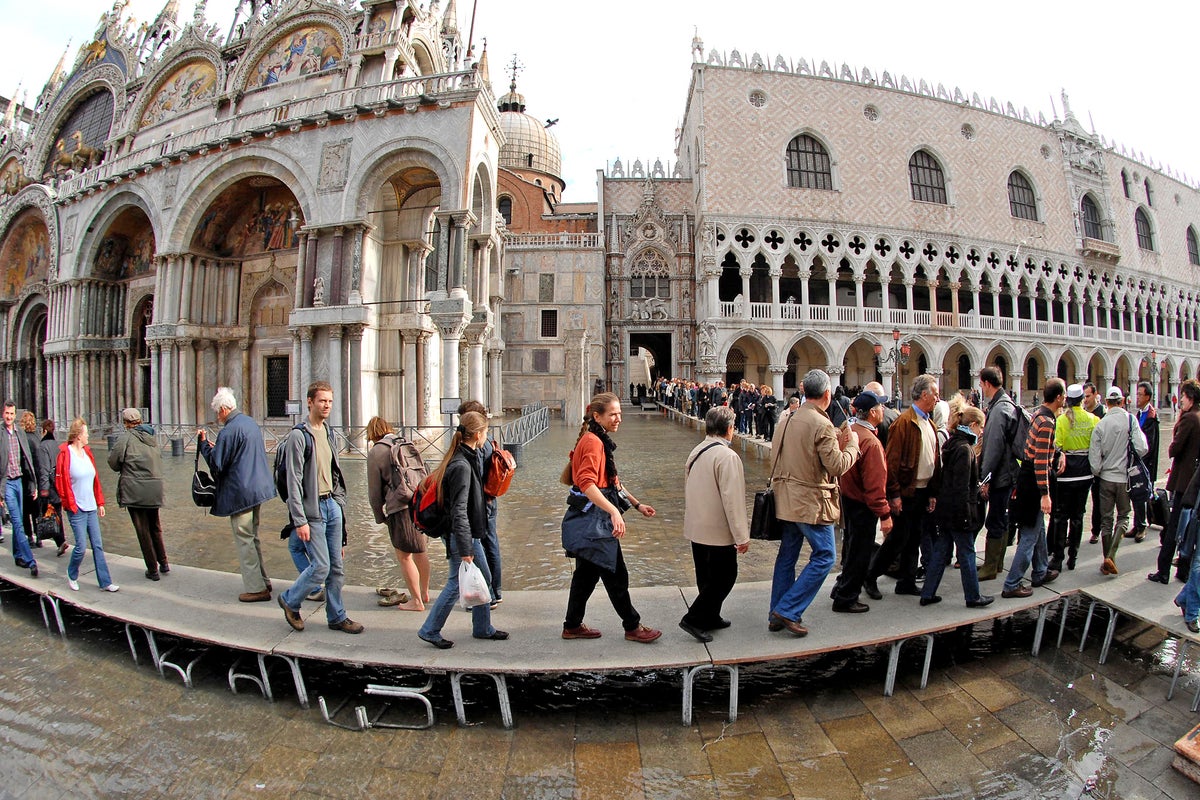
Venice is currently trapped in a trilemma of hydraulic engineering, economic dependency, and geological subsidence that renders current preservation strategies fundamentally insufficient. The MOSE (Modulo Sperimentale Elettromeccanico) system, while temporarily mitigating high-tide events, operates on a logic of intervention frequency that is inversely proportional to its long-term structural integrity. To understand why Venice as it currently exists cannot be preserved, one must look past the visual aesthetics of flooding and analyze the specific convergence of relative sea-level rise (RSLR), salt-water corrosion of Istrian stone foundations, and the metabolic exhaustion of the Venetian lagoon.
The Mechanics of Relative Sea-Level Rise
The existential threat to Venice is not merely the rising ocean but the delta between eustatic sea-level rise and local land subsidence. This relationship is defined by the formula for Relative Sea-Level Rise (RSLR). In the Venetian context, subsidence is driven by two primary factors: In related updates, take a look at: Why Driving an 18 Year Old Nissan Pathfinder from Sharjah to Salalah Makes More Sense Than a New SUV.
- Compaction of Quaternary Sediments: The weight of the city presses down on layers of silt and clay. While large-scale groundwater extraction was halted in the 1970s, residual compression continues at a rate of approximately 1-2mm per year.
- Tectonic Forcing: The regional subduction of the Adriatic plate under the Apennines adds a geological downward tilt that is beyond human engineering to reverse.
When these factors meet the accelerating eustatic rise caused by thermal expansion of the oceans and glacial melt, the city faces a projected RSLR of 30cm to 150cm by the end of the century. The structural implication is clear: the "Acqua Alta" events that were once statistical outliers are becoming the operational baseline.
The Operational Failure of the MOSE Barrier
The MOSE system consists of 78 mobile gates across the three inlets of the lagoon: Lido, Malamocco, and Chioggia. Its design was predicated on a sea-level rise scenario from the late 20th century, which significantly underestimated 21st-century projections. The system faces a critical bottleneck in "The Threshold of Closure." Condé Nast Traveler has also covered this fascinating subject in extensive detail.
As sea levels rise, the frequency of closures required to keep the city dry increases exponentially. At a rise of 50cm, the gates would need to be closed nearly every day. This creates a catastrophic feedback loop:
- Lagoon Hypoxia: The lagoon requires tidal exchange to flush sewage and industrial runoff. Constant closure transforms the lagoon into a stagnant, eutrophic pond, destroying the ecosystem and creating a public health crisis.
- Mechanical Fatigue: The gates are submerged in a highly corrosive, hyper-saline environment. Frequent activation increases the rate of sediment accumulation in the gate housings and accelerates the wear on hinges. The maintenance cost function for MOSE is not linear; it scales aggressively with the frequency of use.
- Port Paralysis: Venice remains a functional port. Daily gate closures would effectively sever the maritime economy, forcing a choice between the physical preservation of the buildings and the economic survival of the harbor industries.
The Capillary Rise and the Chemical Decay of Istrian Stone
Most analysis focuses on the height of the water, but the true "silent killer" of Venetian architecture is capillary rise—the process where porous masonry sucks salt water upward through the walls. This creates a zone of saturation that moves higher as the baseline sea level rises.
When the water evaporates from the brickwork, salt crystals (sodium chloride and sulfates) form inside the pores. This crystallization pressure exceeds the tensile strength of the historical materials, causing the brick to "explode" at a microscopic level. This is not a problem that MOSE can solve. Even if the streets are dry, the foundations are perpetually submerged in a higher water table, pushing the decay line into the living quarters of the first floors.
The structural integrity of Venice relies on wooden piles driven into the caranto (a hard clay layer). While these piles are preserved in anaerobic (oxygen-free) conditions underwater, the rising and falling of tides—and the changing salinity of the lagoon—introduce oxygen and biological degraders that threaten the very base of the city.
The Economic Mirage of Tourism-Funded Preservation
The belief that Venice can "buy" its way out of sinking through tourism revenue is a fundamental misunderstanding of the city's internal economy. The "Disneyfication" of the city creates a monoculture that is fragile.
- The Resident Exodus: As the ground floors of buildings become uninhabitable and the cost of maintaining historical property skyrockets, the permanent population declines. A city without residents loses the localized knowledge and small-scale maintenance (e.g., cleaning small canals, repairing private water-gates) that prevents systemic decay.
- The Maintenance Deficit: The cost of specialized labor in a water-based environment is roughly 3-4 times higher than on the mainland. Tourism revenue is high-volume but low-margin for the city’s actual infrastructure. The tax revenue generated by day-trippers does not cover the capital expenditure required for massive hydraulic projects.
Alternative Engineering Frameworks and Their Limitations
Beyond MOSE, several theoretical frameworks have been proposed, yet each carries significant logical or physical flaws.
1. The Pumping Hypothesis (The "Lifting" Strategy)
Proposals exist to inject seawater or specialized fluids into the deep aquifers below Venice to "inflate" the ground and lift the city by 20-30cm.
The Constraint: The geological layers beneath Venice are not uniform. Uneven lifting would result in differential settlement, essentially cracking the city's historical buildings in half. The risk of irreversible structural trauma to the UNESCO site makes this a non-viable strategy for the current century.
2. Complete Lagoon Enclosure
Transforming the lagoon into a freshwater lake by permanently sealing the inlets.
The Constraint: This requires the total relocation of the Port of Marghera and a complete overhaul of the city’s sewage system, which currently relies on tidal flushing. The cost of building a comprehensive sewage treatment network under the water-logged streets of Venice is estimated in the tens of billions of euros, exceeding the national budget's capacity for a single municipality.
3. Localized Defense (The "Glass Wall" Strategy)
Raising the "insulation" of individual buildings or squares (such as the recent glass barriers around St. Mark's Basilica).
The Constraint: This is a localized solution for a systemic problem. While it protects high-value assets, it does nothing to prevent the surrounding infrastructure—pipes, electrical conduits, and transit routes—from failing. It creates "islands of dry" in an ocean of decay.
The Strategic Shift from Preservation to Managed Transformation
The current policy of "preservation as it was" is a fight against the second law of thermodynamics. The entropy of the Venetian system is increasing. A data-driven strategy requires accepting that the Venice of 2100 cannot be the Venice of 1900.
The transition must move toward Selective Resilience. This involves:
- Hard Zoning: Identifying which districts are geologically and structurally defensible and which must be allowed to transition into "aquatic ruins" or abandoned levels.
- The Amphibious Pivot: Moving critical infrastructure (electricity, data, water) to elevated or waterproofed "backbone" systems that do not rely on the ground-floor permeability of historical buildings.
- Hydrological Isolation: Accepting that the lagoon will eventually need to be permanently separated from the Adriatic. This necessitates an immediate, 20-year plan to build a closed-loop waste management system for the city to prevent it from becoming a septic tank once the tide-exchange is severed.
The future of Venice is not a dry city, but a controlled, semi-submerged urban laboratory. Success is no longer defined by keeping the water out of the streets, but by maintaining the structural stability of the upper stories while the lower levels are conceded to the sea. The investment must shift from "stopping the tide" to "decoupling the city from the tide." Any strategy that does not plan for the permanent closure of the lagoon is merely delaying the inevitable liquidation of the city's architectural capital.