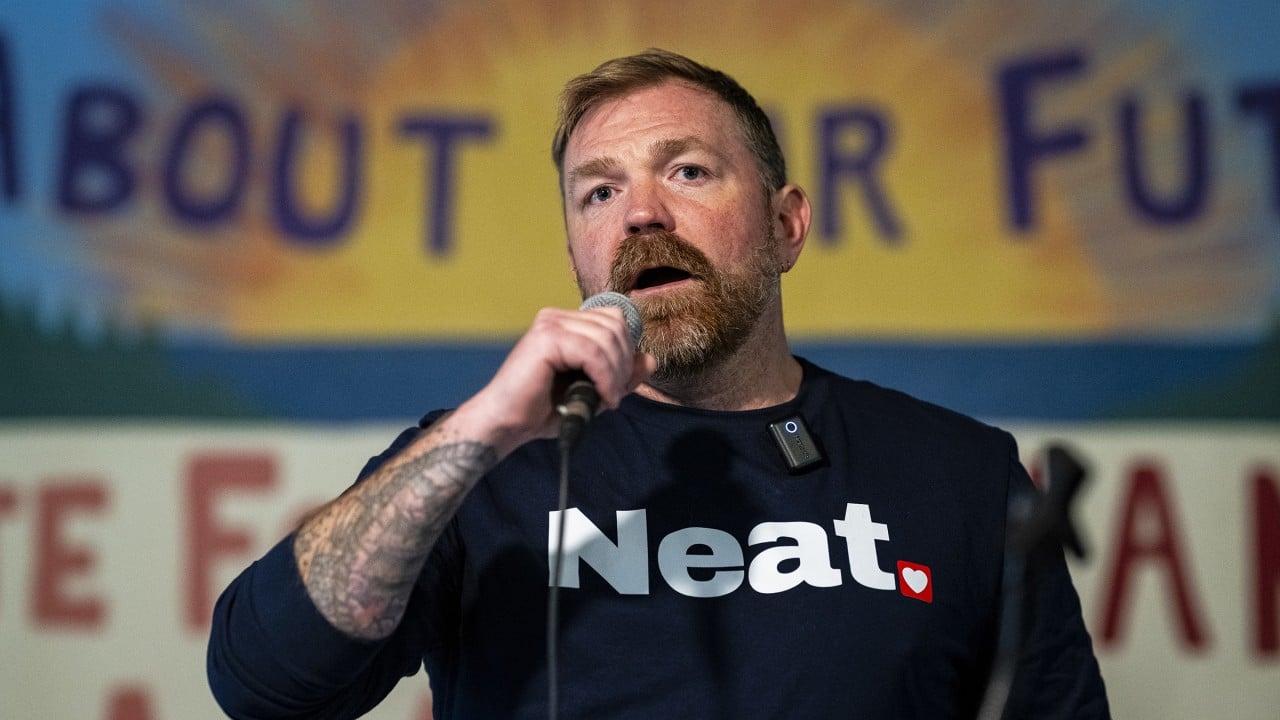
The collapse of Graham Platner’s campaign for the United States Senate in Maine establishes a definitive case study in the structural limits of populist political arbitrage. When an insurgent candidate wins a major party primary on a highly leveraged outsider brand, the subsequent discovery of systemic personal liabilities triggers a specific, cascading institutional correction. Platner's exit, catalyzed by an allegation of sexual assault by a former partner, demonstrates that the survival function of a modern political campaign depends entirely on its capacity to secure structural party resources, preserve cross-factional voter coalitions, and minimize systemic risk for downstream down-ballot candidates. When these variables drop below operational thresholds, even a candidate who secured 72% of the primary vote faces mandatory institutional liquidation.
Understanding this collapse requires an analysis of the specific mechanisms that governs political risk management, candidates' vetting architecture, and the strategic calculus of ballot replacement operations under strict statutory constraints.
The Tri-Partite Asset Failure: Vetting, Brand, and Institutional Capital
An electoral campaign operates as a capital-intensive startup requiring three distinct forms of currency: grassroots volunteer equity, institutional endorsement capital, and financial liquidity. The Platner campaign suffered a simultaneous structural failure across all three variables within a 72-hour window.
1. Vetting Asymmetry and the Pricing of Tail Risk
Political organizations frequently misprice tail risk during the primary phase when confronting an incumbent with high name recognition, such as Senator Susan Collins. In this instance, the democratic primary apparatus experienced a profound vetting failure. Standard corporate or national-level political background checks typically scale in cost and duration to uncover deep-seated personal or digital liabilities. The Platner campaign utilized an accelerated, low-cost vetting model that failed to properly evaluate historical risks, including controversial historical forum interactions, highly visible symbolic chest iconography, and previous interpersonal domestic disputes.
When a campaign fails to internalize and neutralize its own liabilities early, it cedes absolute control over the disclosure timeline to investigative journalism and opposition research operations. This creates an information asymmetry where the candidate's brand value depreciates faster than the campaign can deploy defensive communications.
2. The Credibility Threshold in Progressive Coalition Management
Populations within progressive coalitions are uniquely sensitive to specific categories of behavioral liabilities. While populist economic platforms can successfully absorb a baseline level of eccentric or unpolished personal history—frequently rebranded by strategists as authentic, non-corporate posturing—allegations involving non-consensual physical behavior break the foundational values of the progressive base.
The mechanism of collapse follows a predictable logic:
- The Initial Boundary Breach: Allegations of domestic or sexual misconduct fundamentally contradict the socio-political platform of modern progressive organizing.
- The Endorsement Contraction: National surrogates, such as Senator Bernie Sanders and Representative Ro Khanna, must protect their own institutional brands. The speed of their endorsement revocations is directly proportional to the risk of down-class contamination to their own political organizations.
- The Resource Chokehold: Once national figures exit, institutional committees, including Senate leadership organs, implement an immediate financial embargo, cutting off the capital required to purchase media inventory and maintain field operations.
3. The Institutional Defiance Deficit
In his 11-minute departure address, Platner explicitly framed his withdrawal not as a concession of guilt, but as a submission to systemic institutional engineering. This argument misinterprets the mechanics of party operations. Political parties are not monolithic ideocracies; they are risk-averse coordination engines designed to maximize the probability of securing legislative majorities.
When a nominee's net favorability projection falls below the threshold required to remain competitive, and when that nominee threatens to depress turnout or alienate independent voters needed for concurrent state-level races, the state party apparatus must move to force a vacancy. The institutional pressure applied to Platner was an act of raw portfolio optimization: protecting the collective ballot line from a toxic asset.
[Vetting Failure: Unmitigated Tail Risk]
                 │
                 ▼
[Public Disclosure of Assault Allegation]
                 │
                 ▼
[Immediate Surrogate Endorsement Revocation]
                 │
                 ▼
[Institutional Financial Embargo] ──► [Campaign Liquidation]
The Mechanics of Statutory Ballot Optimization
The sudden vacancy created by a nominee’s exit outside of a primary window forces the state party into a high-stakes logistical and legal maneuver. Under Maine statutory framework, strict deadlines dictate the lifespan of a vacancy and the parameters for choosing a replacement.
With the formal withdrawal executed ahead of the critical state deadline, the Maine Democratic Party faces a constrained window closing on July 27 at 5:00 p.m. to certify a new candidate to face the incumbent in November. This compressed timeline fundamentally alters the nature of political competition, shifting it from a public-facing retail market to an internal party convention ecosystem.
The Replacement Matrix
The selection of a successor cannot simply replicate the primary process; it requires balancing immediate ideological continuity against broad general-election viability. Two distinct operational archetypes have emerged to claim the vacant ballot line:
- The Progressive Legacy Strategy: Championed by figures like former state Senate President Troy Jackson, this approach seeks to inherit the infrastructure, small-dollar donor lists, and policy priorities of the collapsed campaign. The strategic rationale rests on preserving the high-energy progressive turnout that delivered record-setting participation in the June primary.
- The Pragmatic Reset Strategy: Represented by centrist or business-aligned figures who previously sat out or aborted early campaigns, such as Maine Beer Company co-founder Dan Kleban. This strategy seeks to treat the vacancy as a systemic reset, shifting the general election matchup from a highly polarized ideological referendum to a traditional, center-left appeal designed to recapture suburban independents who find the incumbent vulnerable but were alienated by populist rhetoric.
The fundamental tension governing this decision rests on a clear mathematical trade-off. Choosing an unvetted or deeply ideological alternative risks fracturing the mainstream party base and depressing critical moderate turnout. Conversely, imposing a handpicked establishment figure via party committee fiat risks completely alienating the active progressive base that made up Platner's 72% primary victory, potentially resulting in a catastrophic drop-off in volunteer engagement and grassroots donations.
The Strategic Path Forward
To stabilize the ticket and mount a credible challenge against an entrenched incumbent, the state party leadership must execute a precise, three-part sequence designed to manage risk and rebuild coalition unity:
- Enforce Absolute Separation from the Prior Campaign: Party leadership must reject any back-channel attempts by the exiting candidate or his close advisors to dictate the succession rules or claim influence over the vacant seat. The ballot line belongs exclusively to the state party infrastructure under law; permitting a compromised campaign to influence the transition process dilutes the institutional credibility of the new nominee.
- Deploy an Accelerated Double-Vetting Protocol: Any candidate seeking the nomination at the upcoming convention must submit to an immediate, exhaustive forensic audit of all financial records, personal associations, and digital histories. The party cannot afford a secondary vetting failure under a compressed general election timeline where zero structural recovery time remains.
- Construct a Unified Platform Around Economic Resilience: To bridge the rift between the progressive and moderate factions, the incoming nominee must bypass divisive cultural debates and anchor their message to broadly popular economic issues. Focusing on working-class wage protections, regional resource independence, and specific rural infrastructure investments allows the party to retain the core of the populist base while offering a safe, stable alternative for the independent voters necessary to win the state.