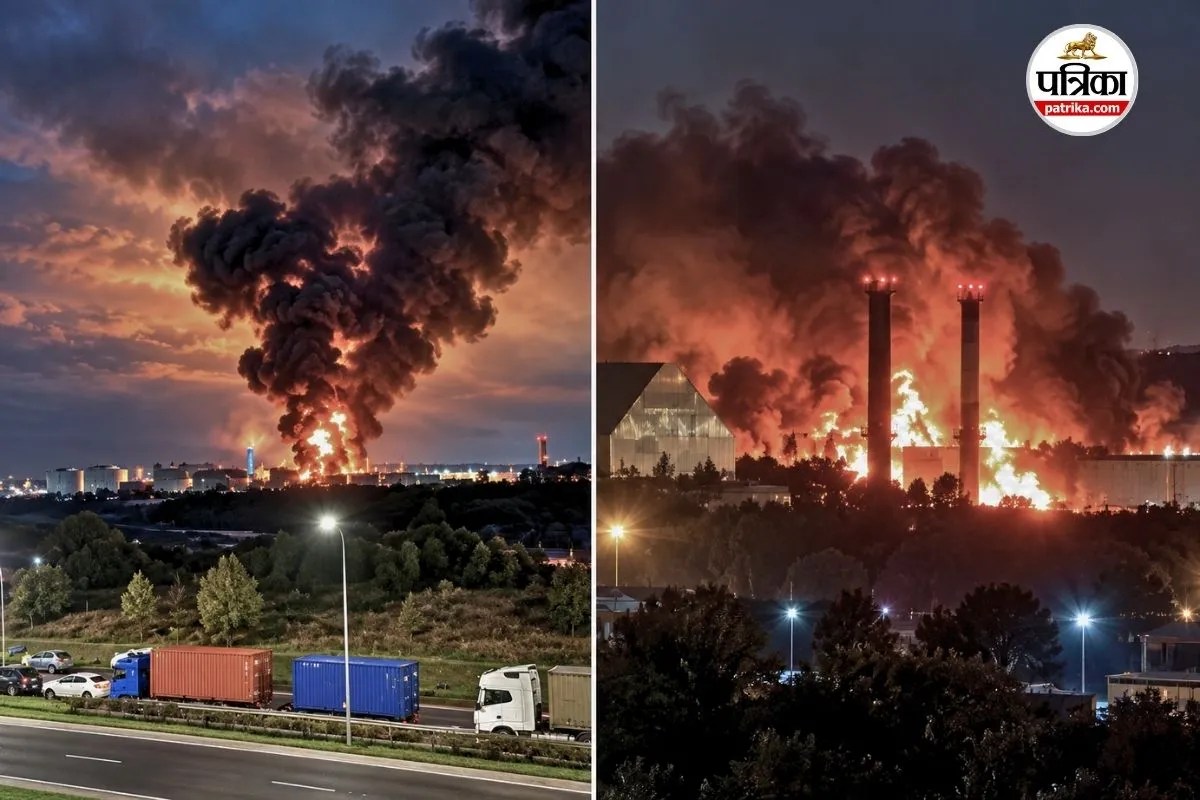
A fire at a Russian oil terminal. Grounded flights at an airport. A headline screaming that a major drone strike just shook Saint Petersburg.
Spare me the victory laps. And spare me the doom-mongering, too. If you liked this piece, you should check out: this related article.
Every time long-range drones hit deep into Russian territory—whether near the Gulf of Finland or along the Baltic coast—the standard coverage follows a script so predictable you could set your watch by it. One side treats a burning storage tank like the death knell of an entire war machine. The other treats temporary flight holds and smoking infrastructure like minor inconveniences that barely register.
Both readings are lazy. Both miss how modern industrial warfare, energy logistics, and air-defense economics actually work. For another perspective on this event, see the latest update from The Washington Post.
A blaze at a port facility or an oil depot is not a magic off-switch for a sprawling economy. At the same time, brushing it off as "just a PR stunt" ignores the real friction it creates across logistics, insurance, labor, and air-defense allocation. When you look closely at a strike near a major hub like Saint Petersburg, you are not looking at a single blown-up tank. You are looking at an expensive game of attrition where every intercepted drone, rerouted tanker, and diverted flight costs real money on both sides.
The Lazy Consensus Around Deep Strikes
Conventional commentary loves binary verdicts. Either a strike "cripples" energy exports or it "fails" to stop anything. Neither captures reality.
First, define the terms properly so we stop talking past one another. Upstream production is pulling crude or gas out of the ground. Midstream and export infrastructure includes pipelines, rail spurs, refineries, and port terminals that process, store, and ship those goods. Airspace denial is the temporary halting of commercial aviation due to radar tracks, electronic warfare, or active interceptors.
A fire at a terminal sits in the midstream and export bucket. It can slow loading, force rerouting, or damage specific tanks or pumps. What it rarely does on its own is permanently erase a country's underlying resource base overnight. Storage farms are built with redundancy, buffers, and bypass routes. Tank farms often hold spare capacity specifically so one damaged unit does not shut down an entire operation.
Yet the opposite take—that striking deep hubs achieves nothing meaningful—is just as sloppy. I have watched analysts and executives in risk management repeatedly underestimate second-order operational drag until a supply chain actually snaps. When a major metropolitan area and port corridor experiences drone alerts and terminal fires, you do not just get smoke in the sky. You get:
- Delayed departures and arrivals that ripple across crew scheduling, cargo connections, and regional transit.
- Higher risk premiums for maritime shipping, hull coverage, and regional logistics operators.
- Forced air-defense dispersion, pulling interceptor batteries and radar coverage away from front lines to protect high-value rear hubs.
In modern attrition warfare, cost exchange matters more than spectacle. A relatively inexpensive long-range drone forcing the scramble of high-cost air defenses and shutting down civilian airport operations creates asymmetric friction even when physical damage is contained.
Why People Ask the Wrong Questions After a Strike
When a headline announces a drone attack near Saint Petersburg, a fire at an oil terminal, and halted flights at an airport, search behavior spikes around a few predictable questions. Most of those questions are framed around the wrong metric.
"Does a strike on an oil terminal stop fuel exports?"
Not like flipping a light switch. That is the wrong question to ask.
A single terminal fire rarely halts an entire national export apparatus permanently. Export networks span multiple ports, pipelines, and rail corridors. If one loading point takes damage or slows down, volume can often be shifted, buffered in storage, or routed through alternative nodes—though usually at higher cost and lower efficiency.
The sharper question is: Does repeated pressure raise marginal export costs, widen discounts, and force constant maintenance and security spending? Yes. Friction compounds. A 5% or 10% drag repeated across dozens of nodes looks unimpressive on a single day, yet over quarters it eats into margins, slows turnaround times, and strains repair crews.
"Why do airports shut down over a few drones?"
Because commercial aviation has zero tolerance for ambiguity.
Civilian air traffic control is built around predictable corridors, clean radar returns, and strict safety margins. When unidentified aerial tracks enter controlled airspace—or when air-defense batteries and electronic-warfare jammers go hot—keeping airliners aloft turns an operational headache into a catastrophic safety risk.
Even a small number of drones can paralyze millions of dollars of scheduled passenger and freight movement for hours. Grounding flights is cheap for the attacker and costly for the defender. Anyone who treats an airport closure as "just a minor delay" has never had to untangle a disrupted hub schedule when aircraft, crews, and slots are out of position.
"Are long-range drones a war-winning breakthrough?"
No weapon system is a silver bullet on its own. Calling every new strike a decisive turning point is lazy journalism.
Long-range uncrewed aerial vehicles (UAVs) have changed the geometry of rear-area vulnerability, as defense analysts like Phillips O'Brien and strategic studies researchers have long argued when examining industrial depth and logistics. Rear areas are no longer untouched sanctuaries. Factories, depots, rail junctions, and energy hubs hundreds of miles behind the front now face persistent threat exposure.
Still, drones have real limits. Payloads are constrained. Weather, electronic warfare, and layered air defenses degrade hit rates. You do not win a protracted industrial conflict with pinpricks alone; you shape it by forcing your adversary to spend treasure and attention defending everything everywhere.
Inside the Mechanics of Escalation and Friction
To see why a strike involving a port oil terminal and an airport closure matters more than the raw footage suggests, strip away the emotion and trace the operational chain.
1. The Air-Defense Dilemma
Every country with a massive landmass faces a brutal math problem: you cannot protect every square mile equally.
Strategic defense thinkers from Carl von Clausewitz onward have emphasized that concentrating force everywhere means concentrating it nowhere. Air-defense systems—interceptors, radars, mobile gun-missile units—are finite and expensive. When deep strikes threaten major cities, energy hubs, and transport nodes, commanders face a painful choice:
- Keep air defenses concentrated near the front line to protect troops and forward logistics.
- Pull systems back to shield capitals, ports, refineries, and political centers.
Either choice hurts. Leave rear hubs exposed, and infrastructure takes hits that disrupt supply chains and morale. Pull batteries back, and front-line units lose cover.
2. The Logistics and Insurance Tax
Even when a fire is extinguished quickly and airport operations resume within hours, the ledger changes.
Logistics managers, insurers, and port operators price risk dynamically. Higher threat levels mean:
- Longer routing or extra buffer stock to absorb sudden bottlenecks.
- Higher war-risk or security surcharges on shipping and transport contracts.
- Extra physical hardening—barriers, netting, dispersion of fuel reserves, and redundant power or pumping setups.
None of that shows up as a dramatic explosion on camera. All of it acts as a silent tax on doing business in a contested environment.
3. Thought Experiment: Two Ways to Read the Same Smoke
Imagine a scenario where two analysts look at the exact same satellite image of a burning fuel storage tank near a major northern port and a flight-status board showing departures on hold.
Analyst A declares that the target's energy lifeline is severed and grounded planes prove total system collapse. By evening, tankers are still moving through neighboring berths and planes are back in the air. Analyst A loses credibility.
Analyst B notes the contained fire, points out that base crude extraction continues, and concludes that nothing changed. Six months later, after dozens of similar disruptions, higher insurance costs, repair backlogs, and stretched air-defense inventories have quietly eroded efficiency across the network. Analyst B missed the cumulative curve.
The real story sits between those two extremes: incremental attrition layered onto complex systems.
Where My Contrarian Take Has Blind Spots
A sharp argument loses credibility if it pretends there are no counter-arguments or risks to getting the read wrong. Here is where pushing a "friction and attrition" thesis can trip you up.
First, over-interpreting routine strikes is a classic trap. Not every drone incident near a major city or industrial site causes severe operational damage. Interceptions happen. Misses happen. Small fires get put out fast. If you treat every alert or minor blaze as a major strategic inflection point, you will cry wolf constantly.
Second, adaptability is real. Industrial economies and logistics networks are stubborn. Operators reroute pipelines, build protective shielding around critical tanks, harden control rooms, and adjust flight corridors. What creates chaos in month one often becomes a managed nuisance by month six.
Third, intent and messaging can matter even when physical damage is modest. Political leaders and publics do not always judge events by barrel counts or tonnage. Sometimes the psychological shock of air-raid alerts or visible smoke near a major city carries weight that cold balance-sheet math overlooks.
What Smart Observers and Operators Should Do Instead
If you follow geopolitical risk, energy markets, aviation, or supply chains, stop reacting to the loudest headline and start tracking the right signals.
- Watch duration and repetition, not one-off headlines. A single terminal fire or a few hours of halted flights tells you very little. A pattern of strikes hitting the same corridor over weeks tells you whether defenses have holes or logistics are bending.
- Separate spectacle from throughput. Ask what actually stopped moving, for how long, and whether alternative routes absorbed the load. Look for sustained slowdowns rather than dramatic visuals.
- Track air-defense trade-offs. Pay attention to where interceptors are being deployed and what kind of munitions are being burned. Running down high-end air defenses to swat low-cost drones is a structural problem no matter which side you watch.
- Build slack into your own supply chains. If you run logistics, procurement, or travel operations anywhere near active conflict zones or contested airspace, assume sudden closures and reroutes are features of the environment, not rare flukes. Plan for delays before they hit your schedule.
Stop cheering or panicking over a single plume of smoke. Watch the cost curve.