Unsanctioned crosswalk paint in Los Angeles operates as a low-cost visual salience intervention inside a sluggish municipal engineering pipeline, not a simple act of civil disobedience. Letters to the editor arguing that painting crossings is life-saving rather than rebellious capture a real operational tension between urgent pedestrian exposure and multi-year capital delivery, yet they stop at moral persuasion. Treating unsanctioned crosswalks as an analytical systems problem exposes why residents resort to paint, where paint actually alters driver behavior, and why paint alone cannot substitute for physical speed control.
To evaluate the argument behind tactical urbanism crosswalks, a rigorous analysis must separate three layers: political signaling (demonstrating neighborhood demand where formal requests stall), perceptual affordance (increasing visual contrast and conflict-zone awareness for approaching drivers), and kinetic restraint (physically forcing lower vehicle speeds or shorter crossing distances). Standard public commentary blends these layers together, treating every stripe of paint as equal proof of a pedestrian safety intervention.
Mapping the Competitor Logic and Its Missing Links
Letters to the editor championing painted crosswalks as life-saving measures typically rely on a compact chain of reasoning: pedestrians are getting hurt on wide or fast streets, city bureaucracy moves too slowly to mark crossings, residents apply paint themselves, and visible crossings therefore protect walkers. That intuition points toward a genuine institutional latency problem in large municipal road networks. When residents see severe traffic hazards day after day, waiting through traffic studies, funding cycles, and work-order queues feels like passive acceptance of preventable harm.
The first limitation in that argument is that it equates visual marking with crash prevention. Paint changes what a driver notices in the visual field; it does not by itself alter a vehicle's mass, stopping distance, or kinetic energy. In traffic safety engineering, a marked crosswalk on a high-speed, multi-lane arterial can even create a false sense of security if pedestrians assume approaching drivers see them and will yield, while drivers traveling above the posted speed limit fail to stop in time.
The second limitation is that the letters conflate rebellion with systems diagnosis. Calling grassroots painting "not rebellious" reframes citizen action as civic care, which works rhetorically in a short letter. Operationally, however, framing the issue around motives misses why the gap exists in the first place: municipal street design standards, liability exposure, work-order prioritization, and capital project bottlenecks govern how a street safety intervention gets built at scale.
A third missing link involves second-order operational consequences. Unapproved pavement markings can use materials with poor skid resistance, peel quickly under heavy traffic, confuse sightlines if placed awkwardly near turning radii, or get painted over by maintenance crews. Meanwhile, the underlying street geometry—such as wide lanes, long unsignalized crossing spans, and free-flowing right turns—remains untouched.
What Is Known Versus What Remains Hypothesis
In traffic safety analysis, separating established physical and behavioral mechanisms from contested predictions prevents overclaiming from grassroots experiments.
Established Mechanisms in Street Safety
- Impact speed governs severity: Biomechanical and crash-investigation evidence establishes that pedestrian injury severity and fatality risk rise steeply as vehicle impact speed increases. Lowering travel speeds is a primary determinant of survival when a conflict occurs.
- Visual contrast aids detection: High-visibility pavement markings increase the conspicuity of a conflict zone compared to plain asphalt, helping drivers register an intersection or crossing point earlier in their scan path.
- Engineering queues delay delivery: Large cities manage thousands of intersections across competing priorities, meaning spot interventions often wait behind corridor studies, ADA curb-ramp upgrades, and capital budgets.
- Paint lacks physical speed arrest: Pavement striping has negligible physical resistance; a vehicle moving fast over thermoplastic or latex paint experiences virtually no mechanical deceleration from the stripe itself.
Educated Hypotheses Requiring Empirical Verification
- Spot resident striping shifts yielding rates: A hypothesis worth testing locally is whether unsanctioned crosswalks measurably increase driver yielding at specific low-speed residential intersections compared to unmarked corners.
- Grassroots visibility accelerates city action: Another hypothesis is that visible community markings sometimes shorten municipal response times by forcing field inspection, though formal records are needed to separate correlation from routine scheduling.
- Unsanctioned paint alters legal and maintenance risk: It is plausible that non-standard markings create friction over municipal liability and pavement maintenance standards, yet the net effect on overall neighborhood safety likely varies sharply by street classification.
Why Drivers Miss Crosswalks and How Paint Intervenes
Understanding how painted crosswalks affect driver behavior requires looking at cognitive load and visual attention behind the wheel. Driving through an urban corridor is a continuous filtering task. A motorist processes lane boundaries, lead vehicles, traffic signals, parked cars, mirrors, navigation prompts, and roadside clutter within narrow reaction windows.
When a street looks like a high-speed thoroughfare—wide lanes, generous corner radii, minimal friction along the curb—drivers adopt a design speed matched to the visual openness of the road rather than a conservative urban speed. In that state, peripheral cues like a pedestrian stepping off a curb can be missed or registered too late for comfortable braking.
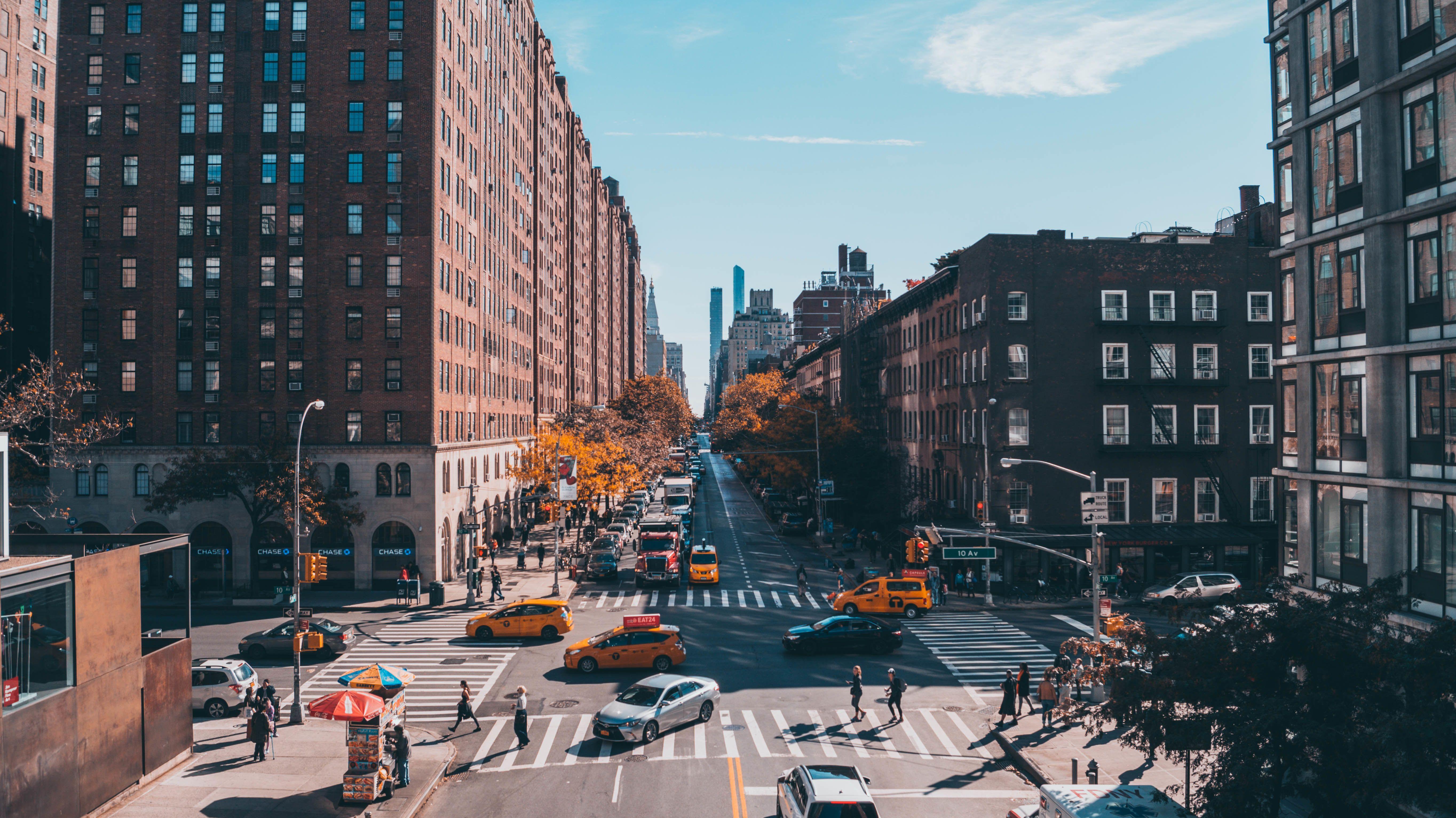
Painted bars across the travel lane act as a spatial anchor right where pedestrian and vehicle paths intersect. By breaking up uniform gray asphalt with high-contrast geometry, markings can draw visual fixation toward the conflict zone and signal that cross-traffic or pedestrians may occupy that space.
Paint can sharpen where a driver looks, but only street geometry and speed management reliably change how fast a car arrives and how hard it hits.
Still, visual salience has clear boundaries. Under glare, rain, night lighting, or heavy traffic congestion, faded or low-contrast paint loses effectiveness. If a driver is traveling fast on a multi-lane street, seeing a crosswalk two seconds earlier does little good if braking distance exceeds available space or if an adjacent lane blocks visibility. That is why safety practitioners pair markings with daylighting (removing sightline obstructions near corners), curb extensions, median refuge islands, raised crossings, or signalized timing when volumes and speeds warrant them.
Why Los Angeles Bottlenecks Persist and What Residents Ask
People researching unsanctioned crosswalks in Los Angeles or painting crosswalks without permission usually want to know three practical things: whether painted crosswalks actually save lives, why cities take so long to paint or redesign crossings, and what happens when residents paint streets themselves.
Crosswalks save lives most reliably when they are part of a speed-managed crossing system, not when they stand alone as paint on a fast street. If a crossing reduces conflict uncertainty on a calm neighborhood street or accompanies speed reductions and visibility improvements, it lowers risk. If paint is placed across a wide, high-speed road without reducing speed or crossing exposure, crash severity remains a major threat.
Municipal delays rarely stem from a single villain; they emerge from process friction. Public agencies must coordinate traffic engineering warrants, curb-ramp accessibility rules, utility or resurfacing schedules, union and contractor workflows, and budget constraints. A resident can buy paint in an afternoon and apply it in an hour; a city agency must evaluate network-wide risk, standardize materials, and manage public-works accountability across millions of residents.
When residents paint crosswalks without authorization, three operational realities collide:
- Pavement durability and traction: Consumer or craft paints may wear rapidly or behave differently under wet braking than rated traffic markings, creating maintenance or skid concerns.
- Bureaucratic erasure: Public crews operating under standard maintenance rules may remove non-standard markings during routine sweeping, resurfacing, or compliance sweeps.
- Misallocated advocacy energy: Spending political capital solely on guerrilla paint can distract from fixing the permitting and work-order bottlenecks that keep legal crossings and physical traffic calming stuck in queue.
An Operational Blueprint for Faster, Safer Crossings
Turning grassroots urgency into durable safety gains requires treating crosswalk delivery as a bottleneck-reduction problem rather than a tug-of-war between activists and bureaucrats.
- Audit the corridor's speed and geometry first. Before focusing on markings alone, assess lane widths, posted versus operating speeds, crossing distance, sightlines at corners, and pedestrian generators such as schools, transit stops, and parks.
- Classify the crossing by risk tier. Separate low-speed neighborhood intersections—where basic visibility and yield behavior dominate—from multi-lane or high-speed streets where physical speed reduction, refuge islands, or signals are essential.
- Establish a fast-track permitted pilot path. Advocate for a streamlined community street-safety permit that specifies approved retroreflective or slip-resistant materials, clear placement rules, and rapid engineering sign-off for low-risk locations.
- Bundle quick-build elements with capital requests. Pair high-visibility striping with curb clearance (daylighting), flexible delineators, or speed feedback where appropriate, while logging formal data on near-misses, speeds, and volumes to support permanent capital funding.
- Track cycle time, not just complaints. Measure how long requests sit in engineering review, work-order scheduling, and installation so accountability targets the actual implementation lag.
Limitations and Strategic Tradeoffs
No pedestrian safety strategy is a silver bullet. Fast-track community programs can inadvertently concentrate attention in better-organized or higher-income neighborhoods unless equity criteria actively prioritize high-injury corridors in underserved areas. Over-reliance on paint without physical traffic calming can also produce an illusion of safety that leaves vulnerable road users exposed on high-speed arterials.
Conversely, rigid bureaucratic caution has its own cost: every month spent perfecting a standalone study while a dangerous crossing goes unmarked carries real human and economic risk. Effective urban governance balances engineering rigor with iterative deployment, using low-cost, reversible treatments where appropriate while directing heavy capital toward high-severity corridors.
The decisive strategic play for city leaders and civic advocates is to build a tiered rapid-delivery track for low-risk neighborhood crossings paired with transparent work-order SLA tracking—converting citizen urgency from unauthorized pavement paint into a legal, repeatable pipeline that clears simple crossings in weeks instead of years while reserving capital engineering for high-speed corridors.