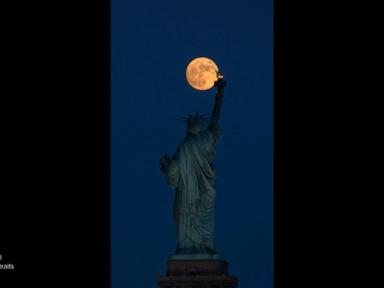
Every June, newsrooms across America run the exact same photo. You know the one: a massive, pinkish-orange celestial orb perfectly framed behind the Statue of Liberty or the Empire State Building. This year, the media machine is working double time, wrapping the standard "Strawberry Moon" event in the heavy, suffocating blanket of America's upcoming 250th anniversary. They call it a "breathtaking tribute to freedom." They call it "poetic timing."
It is neither. It is a masterclass in lazy, algorithmic journalism designed to manufacture cheap awe.
The media relies on these cosmic coincidences to avoid talking about anything of substance. We are told to look at the sky and feel a collective, unified surge of patriotism because a rock in space happened to reflect sunlight near a copper monument. It is time to dismantle the optical illusion.
The Mathematical Truth Behind the Perfect Shot
Let's start with the photography itself. The viral videos and photos filling your feeds are not miracles of timing. They are products of aggressive compression artifacts and focal length manipulation.
When you see a giant moon looming directly behind Lady Liberty, you are not looking at what the human eye sees. You are looking at the extreme use of telephoto lenses—often 400mm to 800mm—shot from miles away. This creates forced perspective, an optical illusion that compresses the distance between the foreground object and the background celestial body.
Imagine standing on a pier in New Jersey with a tripod, tracking an orbit calculated months in advance by an app like PhotoPills. There is zero serendipity involved. It is a highly engineered, repetitive mechanical process. Yet, the accompanying articles present these images as spontaneous, spiritual events. They package calculated geometry as divine validation of national pride.
The Misnomer of the "Strawberry" Moon
The public is routinely misled about what they are actually looking at.
- The Color Myth: The moon is not strawberry-colored because of its name. It looks orange or reddish for the exact same reason every low-hanging moon does: Rayleigh scattering. When the moon is low on the horizon, its light must pass through a thicker layer of Earth's atmosphere, filtering out shorter blue wavelengths and leaving the longer red ones.
- The Origin Myth: The name comes from Native American traditions, specifically the Algonquin tribes, marking the ripening of wild strawberries. It has absolutely nothing to do with European-American civic monuments or impending semi-quincentennial celebrations.
Forcing an indigenous seasonal marker to serve as a visual prelude to America’s 250th birthday is a bizarre, contradictory narrative leap. But the news cycle requires a hook, so the squares are forced into round holes.
The Danger of Prefabricated Nostalgia
I have spent over a decade analyzing media trends and cultural narratives. The obsession with linking routine astronomical events to major political milestones reveals a deep anxiety in modern media. Content creators are terrified of the present, so they retreat into prefabricated nostalgia.
By focusing on a giant moon glowing over a symbol of freedom, outlets can check the box for "patriotic coverage" without engaging in any actual cultural reflection. It is safe. It is sanitized. It generates millions of clicks from people who want to feel a vague sense of unity without doing any of the heavy lifting that actual citizenship requires.
The Scale of the Distraction
Look at the data of what captures public attention during these celestial news cycles. Search trends for "Strawberry Moon Statue of Liberty" spike exponentially, while actual historical analysis of the nation's upcoming milestone remains flat. We are trading historical literacy for aesthetic consumption.
The competitor's article wants you to stare at the glowing sky and feel good. That is a sedative, not journalism.
Step Away From the Screen
If you want to actually experience the solstice or honor the concept of a national milestone, the worst thing you can do is look at a compressed, telephoto image on a smartphone screen.
Stop consuming the packaged awe. Real connection to your environment or your country does not happen through a heavily edited 4K video stream of a moonrise over Manhattan. Go outside. Look at a horizon that isn't framed by a camera lens. Acknowledge the passing of time without needing a corporate media outlet to tell you what it means for your patriotism. Turn off the feed. The sky does not care about our anniversaries, and pretending it does only cheapens the reality of both.