Floating Food and the Instincts of the Deep
Float. Drift. Starve.
For three hundred million years, life on Earth relied on a single, silent constant. Gravity pulling down. Water pressing in. Every organism—from the blue whale down to the tiny, translucent crustacean—built its nervous system around the simple certainty that up is up, and down is down.
Then we put them in a metal box and hurled them into orbit.
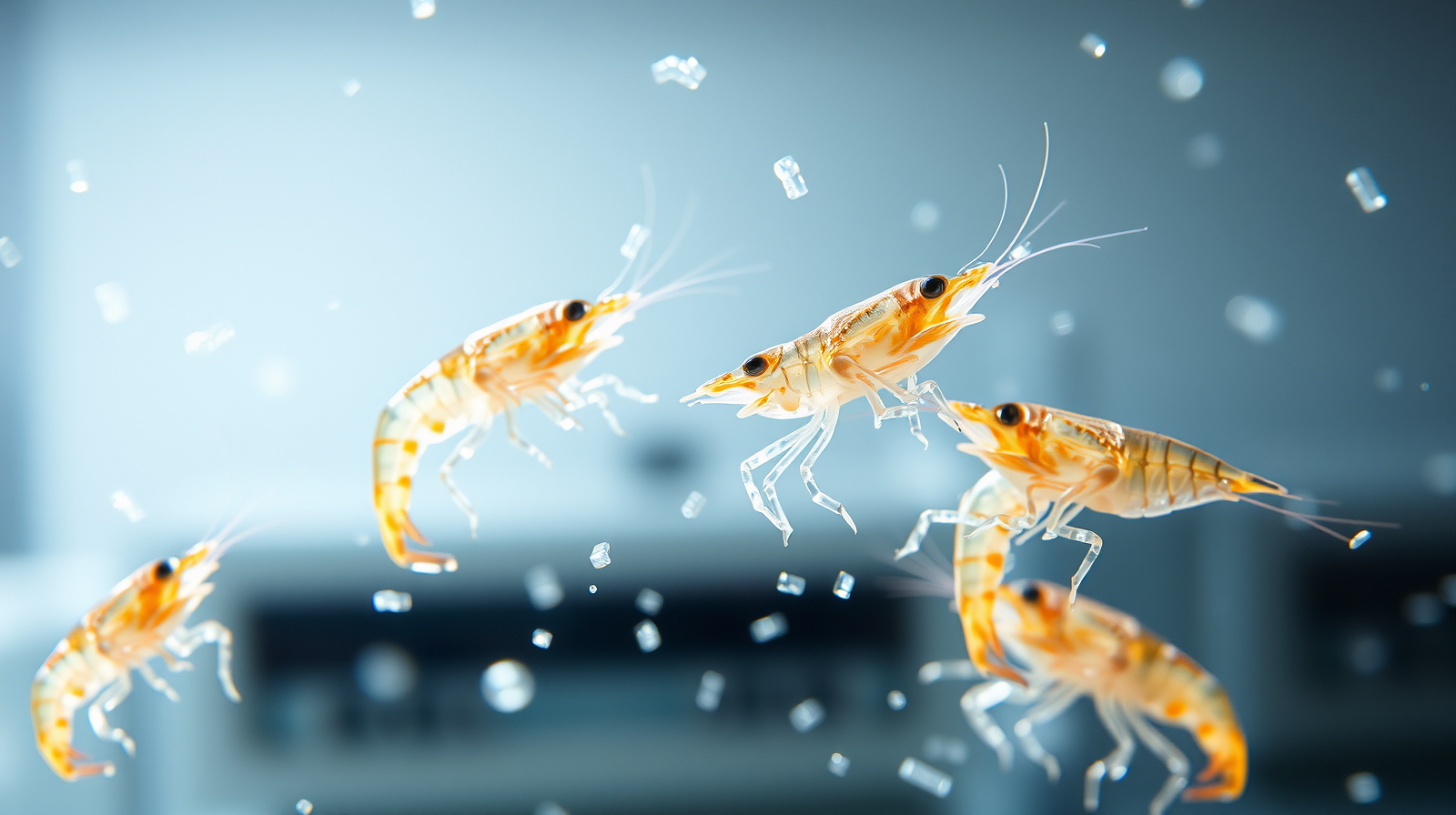
Inside a laboratory module orbiting hundreds of miles above the planet, a tiny creature twitches. It is an aquatic shrimp, suspended in a sphere of water that refuses to stay put. On Earth, a shrimp eats by orienting itself toward the sea floor, sifting through sediment, following the downward pull of heavy particles to locate its next meal. In orbit, the rules break completely. The sediment floats away in every direction. The shrimp spins, disoriented, its ancient evolutionary code rendering it entirely helpless. It swims in erratic, exhausted circles right past its floating food, unable to register that survival is hovering an inch away.
It sounds like a quirky science experiment. A strange, almost absurd anecdote from the outer edges of space research. But watch a team of astrobiologists stare through a microscope at a stressed, hungry shrimp in microgravity, and you quickly realize something much heavier is at play.
This isn't really about the shrimp. It's about us.
The Invisible Foundation of Human Survival
Consider a hypothetical astronaut named Elena. She sits in the mess deck of a deep-space habitat bound for Mars. She has been away from Earth for eight months. Outside her viewport, there is only an absolute, crushing void. Inside, the air smells faintly of recycled sweat, ozone, and rehydrated powders.
Elena is starving for fresh food. Not just calories—her body receives precise, clinical dosages of carbohydrates and synthetic vitamins every day. She is starving for texture. Crispness. The snap of something real between her teeth. She longs for the simple, psychological comfort of a real meal raised, harvested, and prepared within her living quarters.
If humanity ever intends to leave this rock for good, we cannot pack enough lunchboxes for the trip.
A single journey to Mars and back requires thousands of pounds of food per crew member. Payload weights are unforgiving. Every extra pound of cargo requires exponentially more fuel to lift out of Earth's gravity well. The math simply does not work if we rely entirely on pre-packaged, shelf-stable rations. We have to grow our own ecosystems in transit.
For years, the conversation centered almost exclusively on botany. Scientists spent decades perfecting space-grown lettuce, radishes, and dwarf wheat under specialized LED light strips. Plants, however, only address part of the human nutritional equation. They provide vitamins and carbohydrates, but long-term human spaceflight demands high-density proteins and healthy fats to combat the rapid muscle atrophy and bone density loss caused by weightlessness.
Enter aquaponics: closed-loop farming systems where aquatic animals and plants feed each other. Fish and crustaceans produce waste; bacteria convert that waste into fertilizer; plants consume the fertilizer, purifying the water for the animals to inhabit.
It is an elegant, perfect loop. On paper.
In practice, the moment you remove gravity, every mechanical link in that biological chain snaps.
Teaching an Ancient Brain New Tricks
Water behaves like a monster in zero gravity. Without weight, surface tension becomes the dominant physical force. Water doesn't flow through a pipe or sit in a tank; it clings to surfaces, creeps up walls, and forms shimmering, suffocating blobs that trap air bubbles and choke aquatic life.
If water is a nightmare to manage in orbit, the creatures inside it face a far more existential crisis.
Shrimp rely on tiny, mineralized structures in their bodies called statocysts. Think of them as nature’s internal spirit levels. As a shrimp tilts, tiny grains inside the statocyst sink toward the Earth, pressing against sensory hairs that tell the creature's brain which way is down. In microgravity, those tiny grains float aimlessly. The sensory hairs fire at random. The shrimp experiences a perpetual, terrifying sensation of falling in every direction at once.
To make matters worse, their feeding mechanics are tied to physical boundaries. On Earth, feed pellets sink to the bottom of a tank, creating a predictable feeding zone. In space, feed pellets scatter through the liquid volume, drifting unpredictably.
A animal that cannot locate its food will not eat. An animal that does not eat will not reproduce. And a closed-loop life support system that fails to reproduce becomes a high-tech coffin.
Researchers were forced to pivot from marine biology to behavioral engineering. They had to teach an animal with a brain smaller than a pinhead how to ignore millions of years of instinct.
How do you rewire an evolutionary trait in orbit? You trick the senses.
Scientists began experimenting with targeted light sources and artificial currents inside microgravity aquaponic chambers. By directing narrow beams of light through specific angles of the water containment modules, researchers created visual cues that mimicked the surface illumination of natural waters. By introducing subtle, directional water flows, they gave the creatures a physical resistance vector to swim against—a substitute for gravity.
They engineered custom feeding mechanisms that use capillary action to anchor food pellets along predictable surfaces, giving the creatures a simulated bottom to scrape.
Slowly, against every evolutionary odds, the creatures adapted. They stopped spinning. They oriented themselves toward the light, tracked the anchored food, and began to feed.
The High-Stakes Mirror of Microgravity
It is easy to look at space research and dismiss it as an expensive indulgence. Why spend millions of dollars and thousands of researcher hours teaching crustaceans to eat in zero gravity when our own planet's oceans are warming, overfished, and polluted?
Because solving a problem in a hyper-constrained environment forces solutions that revolutionize life back home.
Space is the ultimate forcing function. When you have to build a farming system inside a closed box where every drop of water, every watt of electricity, and every gram of waste must be accounted for and reused endlessly, you are forced to invent hyper-efficient tech.
The light-guided, zero-waste aquaponic systems built for orbital habitats are already finding their way into terrestrial vertical farms. The techniques developed to keep aquatic life healthy in recirculating micro-environments are being used to build high-yield, low-water protein farms in landlocked, drought-stricken regions across Africa and the American Southwest.
By stripping away the ambient comfort of gravity, scientists were forced to understand the absolute baseline requirements of living organisms.
A Meal at the Edge of Forever
Imagine back to Elena in her Mars-bound habitat.
She walks into the environmental control bay. The room hums with the gentle, rhythmic pulse of water pumps and air scrubbers. Inside a clear, tightly sealed module, a mini-ecosystem thrives. Green shoots of leafy vegetables stretch toward custom LED panels. Beneath them, in a crystal-clear sphere of controlled water, tiny creatures move with purpose, swimming against a gentle current, feeding efficiently along an illuminated track.
She reaches in during harvest cycle, preparing a fresh, protein-rich meal grown entirely within the metal shell protecting her from the vacuum.
It is a mundane moment. A simple, quiet dinner.
Yet that single meal represents the triumph of life over physics. It is the moment an ancient biological code, forged in the primeval oceans of Earth, successfully rewrote itself to survive among the stars. We often think of space exploration in terms of massive rockets, blinding fire, and titanium hulls. But our true survival in the cosmos will ultimately be decided in the quietest, smallest corners of our technology—in a tiny sphere of water, where a fragile lifeform learns to take a single, impossible bite.