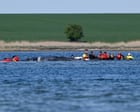
The media circus surrounding Timmy, the minke whale stranded in the shallow mudflats of the Elbe, is a masterclass in biological illiteracy and emotional vanity.
We watch the livestreamed barge rescues and the "valiant" efforts of volunteers with a sense of collective moral superiority. We cheer when the crane lifts the animal. We breathe a sigh of relief when the hull hits the water. We are told this is a triumph of human compassion over the cold indifference of nature.
It is actually a cruel, expensive performance of ego.
By the time a whale like Timmy is "rescued" by a barge, the biological math has already turned negative. We aren't saving an animal; we are prolonging an execution while patting ourselves on the back for the optics.
The Crush of Gravity
Whales are built for a world without weight. Their skeletal structures and internal organs are supported by the constant, uniform pressure of seawater. The moment a whale—especially one the size of a minke—hits the sand or a barge deck, its own mass becomes a weapon.
In the industry, we call this "crush syndrome." When a whale is stranded, the weight of its muscles and blubber compresses the blood vessels. This leads to muscle breakdown and the release of myoglobin into the bloodstream. This protein is toxic to the kidneys. Even if you get the whale back into the deep blue within hours, its internal chemistry is often already failing.
The barge rescue "go-ahead" in Germany ignores the physiological reality: Timmy isn't just stuck; he is likely already experiencing systemic organ failure. Dragging him across a mudflat, hoisting him with slings that create localized pressure points, and vibrating him on a metal barge for hours is the equivalent of "rescuing" a car crash victim by putting them in a paint mixer.
The Pathological Altruism of "Rescue"
Why do we do it? Because we have a terminal case of Disney-fied ecology.
We view every individual animal's death as a tragedy to be averted by technology. We refuse to accept that stranding is often a natural mechanism. Whales don't just "get lost." They strand because they are sick, because they have neurological parasites, because their sonar is shattered by illness, or because they are old.
By intervening, we aren't protecting the species. We are disrupting the nutrient cycle. A dead whale on a beach or a seabed is a "whale fall"—a massive biological windfall that supports thousands of organisms for decades. When we intervene, we strip the ecosystem of this resource to satisfy a 24-hour news cycle.
I have seen rescue teams spend hundreds of thousands of dollars on a single animal that dies three miles offshore two days later. That same money could have funded habitat restoration that would save thousands of healthy whales. But habitat restoration doesn't make for a "miracle" headline.
The Acoustic Pollution Elephant in the Room
The German authorities and the public are focused on the barge. They are focused on the crane. They are asking: "How do we move him?"
The better question is: "Why is he here?"
The Elbe is one of the busiest shipping lanes in Europe. It is a cacophony of low-frequency noise. For a cetacean, navigating the Elbe is like a human trying to find their way through a dark room filled with strobe lights and air horns.
If we actually cared about Timmy, we wouldn't be debating barge logistics. We would be debating ship speed limits and acoustic shielding. But that would cost the shipping industry money. It’s much cheaper—and much better PR—to fund a one-off "rescue" mission than to overhaul the maritime economy.
The Ethics of Euthanasia
We need to talk about the "E" word.
In many cases, the most humane, scientifically sound response to a stranded whale is a large-caliber bullet or a massive dose of barbiturates. It is the "un-sexy" choice. It doesn't get the "Timmy is Home!" headline.
When we force an animal through a multi-day barge rescue, we are subjecting it to unimaginable stress. Whales are highly sensitive, social, and intelligent. The noise of the machinery, the touch of human hands, and the sensation of their own skin drying out is a sensory nightmare.
We choose the barge because we are cowards. We are too afraid of the public backlash that comes with "giving up," so we choose a prolonged, agonizing "rescue" that ends in a quiet death far from the cameras.
The Financial Sinkhole
Let’s be brutally honest about the cost. A barge operation involving heavy machinery, specialized veterinary teams, and government coordination costs a fortune.
- Logistics: $50,000 - $150,000 per attempt.
- Personnel: Hundreds of man-hours diverted from actual conservation work.
- Post-Mortem: The inevitable necropsy when the rescue fails.
If you gave that money to a marine protected area (MPA), you could buy sonar-reflective buoys or pay for satellite tracking of healthy pods to prevent ship strikes. Instead, we burn the budget on a "feel-good" lost cause.
The Nuance of the Mudflats
The Wadden Sea and the Elbe mudflats are unique. They aren't just "shallow water." They are a complex labyrinth of tides.
The "lazy consensus" says that if we just get the whale to deep water, the problem is solved. But minke whales are not deep-sea specialists; they are coastal. If Timmy ended up in the Elbe, his internal navigation is compromised.
Releasing him is like dropping a person with a broken leg and no map in the middle of the Sahara and saying, "You're free! Go walk home."
What We Should Be Doing Instead
If you want to help the whales, stop cheering for the barges.
- Demand Acoustic Regulation: The real killer isn't the mud; it's the noise.
- Support Population-Level Conservation: Stop obsessing over "The One" and start worrying about the thousands.
- Accept the Cycle: Nature is not a petting zoo. Death is a functional part of the ocean’s health.
The barge is not a savior. It is a stage for a play where the whale is an unwilling prop. We aren't saving Timmy; we are performing a ritual to make ourselves feel less guilty about the state of our oceans.
Stop the barge. Put down the cameras. Let the whale die with the dignity of an animal, rather than the indignity of a spectacle.