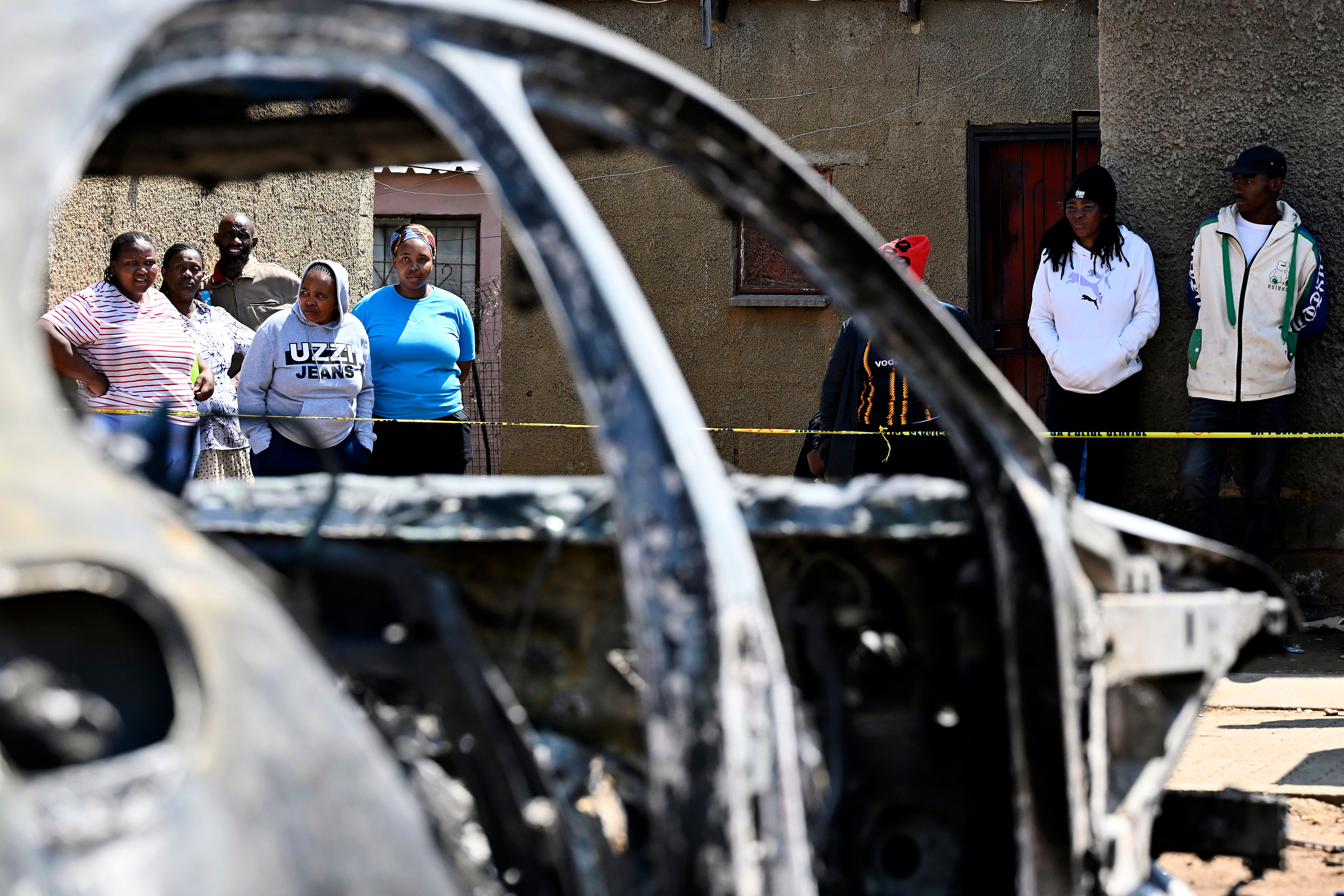
When bullets rip through a crowded tavern in Soweto or a working-class suburb in the Western Cape, the global press rushes to a comfortable, lazy script. Editors dust off templates built for foreign anomalies, label the carnage a mass shooting, and retreat to safe talking points about firearms and moral decay. It makes for clean headlines. It draws clicks. And it is completely divorced from the grim reality on the ground.
I have spent years analyzing urban security structures and watching investigative intelligence units burn through budgets while failing to grasp the baseline mechanics of endemic crime. If you look at South Africa through the narrow lens of American-style active shooter incidents, you will understand precisely zero percent of what is actually happening. These tragedies are not random spasms of madness. They are cold, calculated corporate hostile takeovers executed with automatic weapons.
To understand why dozens die in weekend massacres, you have to throw out the standard vocabulary of political punditry.
The Danger Of Bad Categorization
When international wire services report on multiple homicides in South African townships, they use terms designed for entirely different geopolitical contexts. A mass shooting implies a lone, alienated actor seeking ideological or psychological notoriety. It suggests an aberration, a sudden rupture in an otherwise stable civic order.
That is a fantasy.
In the urban corridors of South Africa, these incidents are almost universally commercial executions. They are disputes over protection fees in the minibus taxi industry, turf wars between rival extortion cartels, or coordinated hits targeting illicit mining syndicates and construction mafia networks. When four gunmen step out of a hijacked sedan and open fire with automatic rifles into a crowded drinking den, they are not acting out of political extremism or psychological fracture. They are enforcing a commercial monopoly. They are sending a message to competitors, witnesses, and municipal contractors who refused to pay the local tax.
By calling these events mass shootings, the media treats them as law enforcement emergencies requiring more squad cars and stricter background checks. But you cannot police an extortion economy the way you police a disgruntled employee with a rifle. You are dealing with organized crime syndicates that operate with better logistics, deeper intelligence networks, and more reliable local compliance than many municipal governments.
The Illusion Of State Capacity
Politicians love a media cycle involving violent crime because it offers an easy script. They express shock, dispatch a high-level ministerial delegation, promise specialized tactical units, and deploy soldiers to flashpoint townships. For forty-eight hours, sirens wail and armored personnel carriers roll down dirt roads.
Then the cameras leave. The soldiers retreat to barracks. And the extortion rings resume collecting their weekly cash drops.
The structural crisis in South Africa is not a lack of tactical firepower. The South African Police Service features specialized tactical response units that are among the most heavily armed and aggressively trained operators on the continent. The failure happens downstream. It happens in the detective branches, the forensic laboratories, and the prosecutorial pipelines.
When conviction rates for organized extortion and contract killings hover in the single digits, impunity becomes the dominant business model. Why would a cartel boss worry about a tactical deployment that lasts two weeks when he knows the local detective division lacks the basic forensics capacity to link ballistic evidence from three different crime scenes? When dockets go missing, witnesses are intimidated with absolute impunity, and court cases drag on for a decade through bureaucratic inertia, the legal system ceases to be a deterrent. It becomes an inconvenience to be managed.
Fixing this requires an unglamorous, agonizingly slow overhaul of investigative accounting and forensic infrastructure. It requires tracking illicit financial flows rather than staging theatrical raids for the evening news. But bureaucratic competence does not win elections. Spectacular deployments do.
The Spatial Legacy Of Structural Inequality
You cannot discuss the geography of these killings without confronting the physical architecture of South African cities. Decades of apartheid spatial planning did not just segregate populations; it concentrated poverty in peripheral townships designed to be easily contained, isolated from economic centers, and starved of municipal investment.
These townships are economic islands. Formal employment is scarce, infrastructure is crumbling, and municipal governance has hollowed out. In this vacuum, illicit economies do not just survive—they become the primary providers of employment, financial security, and localized social order.
When a taxi association controls commuter transit routes, it controls the lifeblood of the local economy. When a construction mafia controls municipal tender allocations through intimidation, they become the de facto employers for thousands of young men with zero alternative pathways to survival.
This is why moralizing about crime in these communities usually falls flat. When the state fails to provide physical security, economic mobility, or basic municipal services, protection rackets step into the void. They act as the parallel state. They collect revenue, settle civil disputes, and maintain a brutal, functional order. When two rival factions fight for control of that parallel state, the civilian population becomes collateral damage in a corporate war for monopoly rents.
Treating this as a simple criminal justice issue ignores the economic engine driving it. Until informal settlements are integrated into formal economic circuits with reliable public transit, legitimate employment opportunities, and functioning municipal services, no amount of police presence will stop young men from picking up rifles for hire.
The Data That Politicians Ignore
Let us look at the actual metrics that matter. The national crime statistics released annually by police authorities routinely log staggering murder totals, but they obscure the granular reality of contract violence.
Consider the concentration of homicides. A tiny fraction of police precincts account for a disproportionate majority of all violent deaths nationwide. These hotspots are not distributed randomly across the country; they map precisely onto transit hubs, informal mining zones, and contested construction corridors where illicit revenue streams intersect with weak municipal governance.
This spatial concentration proves that violent crime in South Africa is structural, not cultural or accidental. It behaves like a network infrastructure. Cut off the funding nodes, dismantle the illicit supply chains, and the violence drops. Deploy more boots on the ground to random street corners while leaving the financial networks intact, and you achieve nothing.
I have watched corporate security teams and government task forces blow millions of dollars on high-tech surveillance gear and armored vehicles while ignoring the basic paper trail of the cartels they are trying to smash. They buy drones while the extortionists are depositing cash straight into legitimate local bank accounts through shell companies and compliant small businesses. It is an absurd mismatch of priorities.
Unconventional Fixes For Endemic Crises
If we want to stop treating the symptoms and start dismantling the disease, we have to adopt a radically different playbook.
First, stop treating violent crime as a policing problem and start treating it as a financial crime problem. Extortion cartels do not operate on crypto-anonymity or cash-in-bags alone; they rely on traditional banking systems to launder protection money, buy vehicles, and pay operatives. Financial intelligence units need to work hand-in-hand with municipal licensing bodies to freeze the assets of suspected cartel fronts immediately, without waiting for the slow grind of a murder trial. Murder convictions are hard to secure when witnesses are silenced; seizing illicit bank accounts is fast, clean, and financially fatal.
Second, dismantle the monopoly structures in informal transport and construction. As long as economic access is guarded by violent syndicates controlling minibus routes and municipal tenders, violence will remain the most profitable way to settle market disputes. Opening these sectors to transparent, regulated competition backed by state-guaranteed physical security breaks the economic rationale for turf wars.
Third, overhaul whistleblower protection. The current witness protection framework is porous, underfunded, and bureaucratic. In a country where testifying against an extortion ring is a death sentence, no amount of police encouragement will coax terrified residents into open court. Until witnesses can relocate instantly and testify anonymously with ironclad digital security, the courts will remain starved of testimony.
The alternative is to keep watching the news cycle repeat itself. Every few months, another tragic tally of bodies will hit the wires. Pundits will clutch their pearls, politicians will order another temporary deployment, and the cycle will reset.
Stop asking for more police sweeps. Start demanding a fiscal war on the syndicates that profit from the blood.