The conventional wisdom on Wall Street and among energy compliance consultants is currently suffering from a collective failure of imagination.
Following the US Treasury Department’s issuance of General License X, the consensus view quickly solidified. Analysts rushed to publish commentary arguing that Iran will struggle to draw down its massive floating inventory of roughly 140 million to 200 million barrels of crude oil. They point to the "banking wall," logistics bottlenecks, the risk of dealing with designated entities, and the technical mismatches of heavy, sour crude as definitive proof that this massive volume of stranded oil will remain a slow-bleeding weight on the market.
This analysis is lazy. It views global energy flows through a neat, legalized lens that bears no resemblance to how physical commodity markets actually operate.
The physical reality is entirely different. Global crude markets are starved for medium and heavy sour barrels. The recent structural disruptions in the Middle East left a massive hole in global refining schedules. The idea that a massive cache of deeply discounted, instantly accessible crude will sit stranded on the water because of administrative hesitation ignores the core mechanics of oil arbitrage.
Iran is not going to struggle to clear its oil inventories. The market is going to swallow them whole.
The Myth of the Unwanted Barrel
The primary argument pushed by mainstream analysts rests on a fundamental misunderstanding of refinery configuration. The claim is that because Iranian heavy crude is sour—meaning it contains high levels of sulfur—most global refiners cannot process it without significant upgrades or margin degradation.
This ignores where the barrels are actually going.
Independent refiners in Shandong, often called "teapots," do not operate under western compliance mandates. They do not care about reputational risk. More importantly, their distillation columns are specifically configured to handle heavy, high-sulfur feedstocks. For years, these independent operators survived on a steady diet of discounted Venezuelan crude, Russian Urals, and Iranian barrels masked as Malaysian blends.
Consider the mathematics of the current physical market. The global oil market has been running a structural deficit, with crude inventories drawing down significantly. Saudi Arabia's previous production cuts and the recent geopolitical premium left refiners in Asia operating at razor-thin margins due to high official selling prices for official Arab Light and Arab Heavy grades.
When General License X hit the wires, it did not create a marketing problem for National Iranian Oil Company traders; it created an arbitrage opportunity. A refiner tracking a discounted barrel of Iranian Heavy compared to Brent or Dubai crude sees pure margin. In physical oil trading, price cures all operational friction. If you price a barrel cheaply enough, a refiner will alter their blending architecture to run it.
Dismantling the Banking Wall Narrative
Compliance departments love to talk about the "banking wall." They argue that because General License X is a short-term window, global financial institutions will refuse to clear transactions out of fear that the window will slam shut, leaving them exposed to future regulatory penalties.
I have spent years watching energy compliance desks over-analyze these situations. Here is what they miss: Iran does not need Western clearing banks to move 140 million barrels of oil.
During the height of maximum pressure campaigns, Iran maintained a parallel financial infrastructure. They mastered the use of regional trading hubs, front companies, and non-dollar clearing mechanisms. The introduction of official, short-term sanctions relief does not mean Iran suddenly has to learn how to open an account at JPMorgan. It simply means the existing dark fleet and barter networks can operate with a temporary veneer of legitimacy.
Imagine a scenario where a Chinese independent refiner purchases 2 million barrels of Iranian crude stored on a VLCC off the coast of Singapore. The transaction does not clear through the SWIFT network. It clears via the Cross-Border Interbank Payment System using yuan, or it is settled via the direct barter of industrial goods, machinery, and electronics required by Tehran. This mechanism has been operational for years. The temporary waiver simply accelerates the velocity of these transactions by removing the need for complex ship-to-ship transfers that stretch delivery times to 70 days.
The backlog will not clear slowly because banks are hesitant. The backlog will clear rapidly because the buyers who want this oil have already bypassed the traditional banking architecture entirely.
Floating Storage is an Asset, Not a Liability
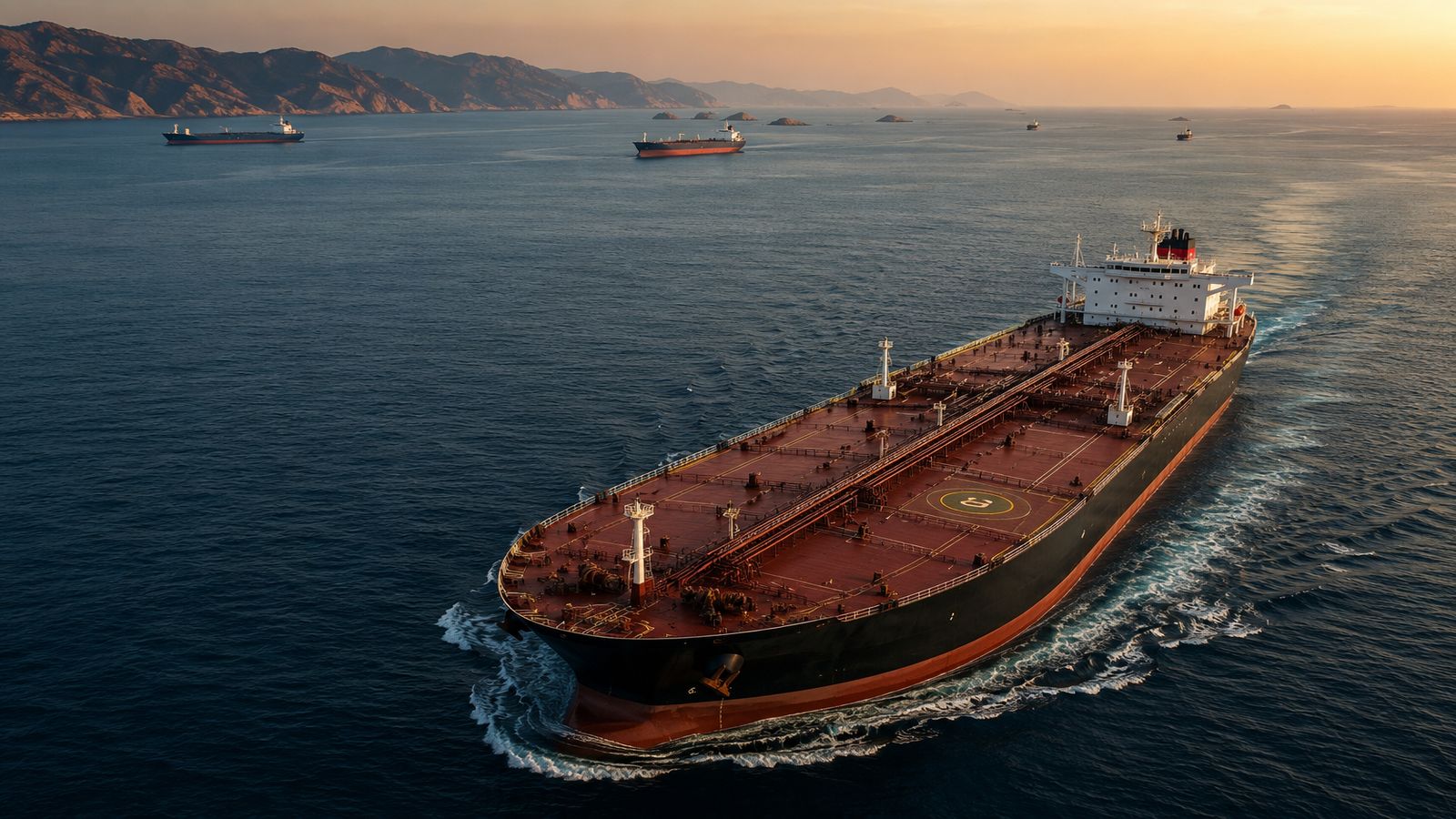
A common mistake among market observers is treating Iran's floating storage as a logistics bottleneck. The argument suggests that because the oil is loaded onto aging tankers acting as floating warehouses, offloading it into the global supply chain will cause insurance disputes and maritime delays.
This gets the logistics upside entirely backward.
In a tight physical market, floating storage is the ultimate prize: immediate liquidity. It takes weeks to ramp up upstream production from matured fields. It takes close to a month for a newly pumped barrel from an onshore well to be processed, piped to a terminal, loaded onto a vessel, and shipped to its destination.
Floating storage removes the time lag. Those 140 million barrels are already sitting on the water, fully extracted, processed, and positioned near major consumption hubs. They represent immediate supply that can be delivered to an Asian port in a fraction of the time it takes to arrange an onshore lifting from the Persian Gulf.
When a market is running a steep backwardation—where prompt barrels command a massive premium over future barrels—on-the-water inventory is highly valuable. Traders do not avoid these barrels; they compete for them because they can be delivered instantly to capture prompt refining margins.
The Hidden Cost of the Contrarian Reality
To be intellectually honest, this rapid clearance of inventory does come with a clear downside for the broader market. It will trigger a temporary, sharp correction in physical oil spreads.
The sudden injection of millions of prompt barrels onto the water will temporarily compress the prompt spread for medium and heavy grades. For traditional producers in the Middle East and West Africa who rely on high official selling prices, this inventory clearance will hurt. Their barrels will suddenly look expensive compared to the rapid unwinding of Iranian volumes.
But a compression in physical spreads is not the same thing as an inventory bottleneck. It is the direct result of an inventory market clearance. The consensus view has confused a price adjustment with a structural failure to sell. The oil will move. The price will adapt. The inventory will vanish from the water far faster than the 60-day window implies.
The Flawed Premise of the Storage Calculation
When reviewing the data compiled by traditional shipping trackers, mainstream reports often claim that Iran’s loading rates are structurally capped by the size of its domestic tanker fleet. They argue that because the National Iranian Tanker Company fleet is restricted, Iran cannot physically move the oil fast enough to clear the backlog.
This calculation fundamentally misunderstands how the dark fleet operates. The moment sanctions relief is signaled, the definition of an eligible vessel shifts. Dozens of unflagged, gray-market tankers that previously demanded massive risk premiums to transport sanctioned crude are suddenly freed to move these volumes openly. The pool of available tonnage does not stay static; it expands instantly as the regulatory risk drops.
The narrative that Iran is trapped by its own inventory is an academic fantasy. It is maintained by analysts who look at spreadsheets instead of talking to the physical traders who arrange the product slates. The physical market is short on crude, the refining margins for heavy sour blends are structurally protected by a lack of alternative supply, and the logistical mechanisms to clear the water are already lubricated by years of sanctions-evasion practice.
The inventory backlog is not a problem for Tehran. It is their immediate liquidity lottery ticket.