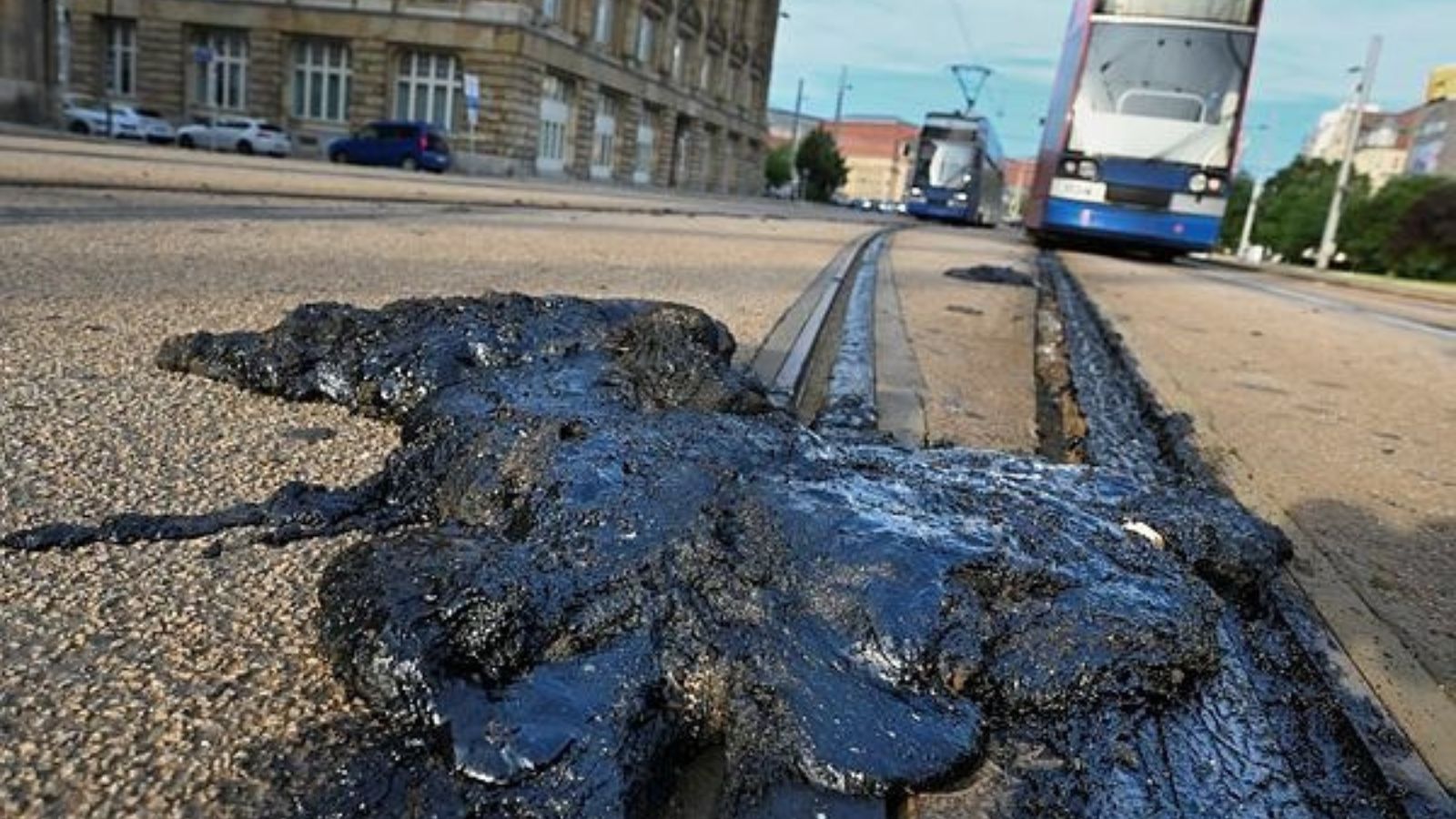
Every time summer hits 40 degrees Celsius, the internet loses its collective mind over viral videos of people frying eggs on car hoods in Poland or gasping at melted tram tracks in Leipzig. Media outlets rush to frame these visuals as the terrifying, sudden onset of an unlivable continent. They point to buckling pavement and warped rails as proof that the physical world is dissolving before our eyes.
It is a great show. It is also an incredibly lazy way to understand modern infrastructure.
As someone who spent a decade working with transit agencies across Western Europe to audit high-temperature resilience, I have watched the same script play out every summer. The media looks at a warped piece of steel and diagnoses a climate apocalypse. In reality, what you are seeing is not a failure of nature; it is a predictable, manageable consequence of basic physics and historical budgeting choices.
The panic sells clicks. The reality requires a slightly deeper look at thermodynamic limits and metallurgy.
The Egg-Frying Illusion and the Thermodynamic Reality
Let's clear up the social media circus first. No, the atmosphere in Warsaw is not suddenly operating like a kitchen stove.
An egg requires a temperature of roughly 62 to 70 degrees Celsius to denature its proteins and solidify. When the ambient air temperature is 40 degrees Celsius, it is physically impossible for the air alone to cook an egg. What the viral videos intentionally ignore is the mechanic of solar radiation absorption.
Dark asphalt, black frying pans, and sheet metal act as thermal batteries. They absorb shortwave radiation from the sun and convert it into longwave heat. On a 41-degree day, a dark metal surface exposed to direct sunlight for hours can easily exceed 65 degrees Celsius.
A Quick Lesson in Heat Transfer: Air is an excellent insulator and a terrible conductor. Metal is the opposite. You are not witnessing a change in the climate's fundamental behavior when an egg cooks on a street; you are seeing standard conductive heat transfer from a highly efficient solar collector.
If you left that same frying pan out in a 45-degree heatwave in a shaded alleyway, your egg would remain a slimy liquid. The video clips are parlor tricks masquerading as environmental data.
Why Tracks Buckle and Roads Soften
The images of distorted tram tracks in Germany and rutted highways in France look dramatic, but they are entirely predictable engineering phenomena known as thermal expansion and viscoelastic deformation.
Continuous welded rail (CWR) is the standard for modern train and tram tracks. Because the rails are welded together into miles-long continuous strips to provide a smoother ride, they have no expansion joints. When steel heats up, it wants to expand longitudinally. Because it is anchored down, that expansion turns into immense internal compressive stress.
Every rail network has a metric called the Stress-Free Temperature (SFT). This is the baseline temperature at which the rail experiences zero internal stress.
[Cold Winter] ----> Rail Wants to Shrink (Tensile Stress / Risk of Breaks)
[SFT Balance] ----> Zero Net Internal Stress
[Hot Summer]  ----> Rail Wants to Expand (Compressive Stress / Risk of Buckling)
In Central Europe, the SFT is typically set around 21 to 27 degrees Celsius—the historical sweet spot between freezing winters and warm summers. However, when ambient temperatures hit 41 degrees Celsius, direct solar radiation can push the actual internal rail temperature past 60 degrees Celsius.
When the temperature gap between the SFT and the active rail temperature becomes too wide, the mechanical force exceeds the lateral resistance of the ballast holding the track in place. The rail finds the path of least resistance to relieve the pressure. It snaps sideways. Engineers call this a track buckle.
                  _  <- Lateral Track Buckle
                 / \
________________/   \________________
Original Straight Rail Path
The exact same logic applies to the "melting" roads in France. Asphalt is not a solid; it is a high-viscosity liquid mixed with aggregate. The bitumen binder used in standard European roads has a specific softening point.
For decades, European road networks used binders designed to withstand a maximum surface temperature of around 50 degrees Celsius. When surface temperatures breach that threshold due to stagnant air and heavy solar loads, the binder liquefies slightly, allowing heavy trucks to displace the aggregate and create deep ruts.
The Hard Truth of Infrastructure Economics
The lazy consensus screams that this means our infrastructure is broken. The contrarian truth is that this is exactly how the infrastructure was budgeted to perform.
Engineering is always a trade-off between the probability of extreme events and the cost of mitigation. Could we build rail networks that never buckle at 45 degrees Celsius? Easily. You simply raise the SFT during installation, anchors the rails with heavier concrete ties, and use stiffer mechanical fasteners.
But here is the catch that the panic-merchants ignore: if you raise the SFT to protect against a rare five-day heatwave, you increase the tensile stress on those same tracks during a sub-zero winter freeze. By fixing the summer buckling problem blindly, you create a winter track-snapping problem. Broken rails in January cause high-speed derailments; warped tram tracks in June cause slow-speed service suspensions.
I have watched transport budgets get torn apart trying to balance these competing priorities. To completely overhaul a mid-sized tram network like Leipzig's to handle sustained 43-degree summers would cost hundreds of millions of euros. For a system that experiences those temperatures for less than 2% of the year, that capital expenditure is economically irrational.
It is far cheaper for a city to suspend a tram line for three days, apply water to the tracks, or wait for the cooling evening air than it is to rebuild the entire transit network. The service disruption isn't a sign of collapse; it is a sign of a system operating exactly within its calculated economic parameters.
Rethinking the Heatwave Premise
The common question asked during these news cycles is: Why can countries like India or Saudi Arabia run trains at 45 degrees Celsius without their infrastructure melting, while Europe crumbles?
The premise implies European engineering is inferior. The honest answer is simply localized optimization.
| Region | Asset Allocation Focus | Engineering Solution | Downside Risk |
|---|---|---|---|
| Middle East / India | High-Heat Resistance | High SFT, Stiffer Bitumen Binders | Winter Cracking / Brittleness |
| Western Europe | Balanced Climate | Moderate SFT, Flexible Binders | Summer Buckling / Softening |
Engineers in hotter climates use harder, less volatile bitumen grades and set their SFT much higher because their winters are non-existent. If you laid Saudi-spec asphalt on a highway in Munich, that road would crack to pieces during its first prolonged winter freeze because the binder would become brittle like glass.
Europe is not failing; it is transitioning through a messy period of recalibrating its engineering baselines.
Instead of panic-tweeting about a video of a deformed shopping cart—which was likely made of cheap, un-stabilized polypropylene left in a micro-climate thermal trap—we should focus on the unglamorous, highly technical reality of shifting SFT standards and upgrading ballast structures over normal 30-year asset replacement cycles.
Stop letting viral videos dictate your understanding of civil engineering. The world isn't melting; it's just negotiating a complex thermodynamic calculation.


